Video-Game-Case / Style prompt
PC Big-Box DOS-Era Painted Cover Frame
The 1990s PC big-box package. Painted cover, heft, manual + map + reference card inside. The game as physical object that demanded shelf space.
Customize this prompt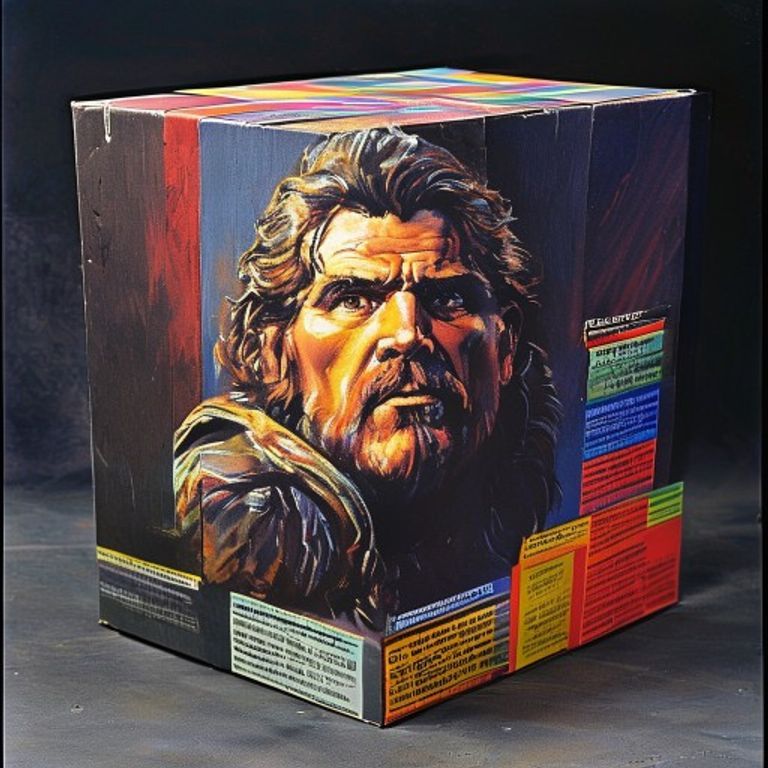
The prompt
Re-render this image as a 1992 to 1998 PC big-box video game package, the canonical large-cardboard-box era that housed DOS, early Windows, and CD-ROM PC titles before the medium shrank to DVD case and then to digital download. Box format: large rectangular cardboard box (substantial heft, roughly the size of a hardcover book turned sideways), vertical or slightly-wider-than-tall orientation, premium cardstock with full-color printing wrapping the front face and spine. Front-face illustration: painted in oil or acrylic by a working commercial illustrator, the kind of work seen on Sierra adventure titles, LucasArts adventures, Origin Systems RPGs, the heroic-fantasy or science-fiction cover painting tradition. Palette: rich saturated, deep shadows, dramatic single-source lighting, painterly brush texture visible in highlights, the painting treated as a fine-art commission rather than a digital deliverable. Top edge of the box: a thick colored title-band stripe (render as a solid colored rectangle, no legible lettering). Lower edge: a thinner band suggesting platform compatibility list and a small screenshot strip (render as a row of small colored rectangles). Spine: visible at the side of the package, a thick spine showing the box has heft, colored band with title-strip suggestion. Print quality: 1995 offset litho on premium coated cardstock, gloss varnish on the painted illustration, matte on the bands, the package designed to look serious on a bookshelf. Mood: the game as physical object that earned shelf space, the painted cover as evidence the publisher took the medium seriously enough to commission art, the big box as the format that announced the PC as a legitimate platform alongside hardcover books. No on-canvas legible text, no logos, no franchise lettering. Preserve the subject, pose, and composition of the source image exactly, change only the medium and rendering. Aspect ratio is PC big-box vertical portrait (roughly 4:5).
What it is doing
The PC big box was the last consumer-software format that demanded shelf space. Inside was the disc(s), a printed manual that was often hundreds of pages, a fold-out map, a reference card, sometimes a cloth feelie or a metal coin. The box said: this game is substantial enough to be a physical object on your shelf next to your books. Steam replaced this with a row of tile-icons that take up no space and announce no commitment. The big box is the sovereign-object grammar of the PC era at its most confident: the game was heavy enough to need a shelf, and the shelf was part of the experience.
Ways to change it
Pick any of these in the gallery and the choice is added to the prompt you copy.
- Illustrator register: glossy muscular heroic fantasy vs rich theatrical adventure painting vs Syd-Mead aerospace-architectural
- Genre register: fantasy RPG painted heroism (canonical Origin/Sierra) vs science-fiction cinematic (canonical LucasArts) vs simulation-realist photoreal (canonical Microprose)
- Box-size dial: standard PC big-box (canonical 1995) vs oversize-RPG collector (Ultima/Wing Commander deluxe) vs transitional-DVD-case (1998 shrinkage)
- Contents-thickness implication: thin disc-only box (off-style) vs medium with manual (canonical) vs thick with cloth-map and metal-feelie (deluxe)
- Spine treatment: thick spine title-band (canonical) vs embossed-foil spine (collector) vs painted-bleed spine (rare)
- Print-wear dial: mint sealed shrink-wrap (collector) vs shelf-worn corners (lived-in) vs garage-sale crushed-corner (relic)
Style lineage
Learn the visual culture this draws from: Raspberry Pi.
Related prompts
See all 26 prompts in the Video-Game-Case grammar