Video-Game-Case / Style prompt
Atari 2600 Airbrush-Fantasy Overpromise Frame
The 1979-to-1983 Atari 2600 box. Airbrushed fantasy painting, lavish epic action, the promise that bore no resemblance to the four-color blocky game inside. The overpromise as honest aspiration.
Customize this prompt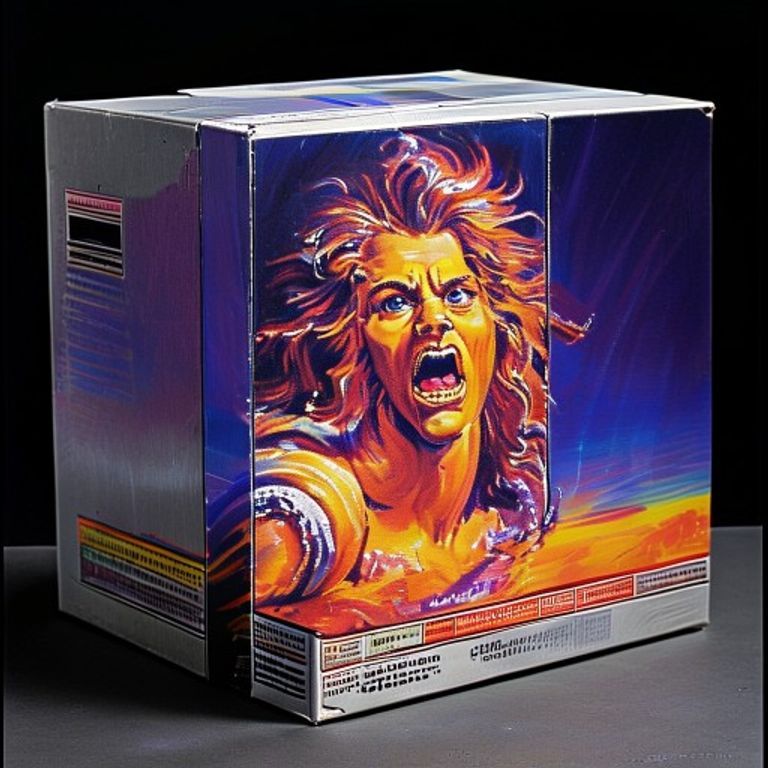
The prompt
Re-render this image as a 1979 to 1983 Atari 2600 video game package, the canonical American silver-and-black box-with-airbrush-painting era manufactured by Atari Inc. before the 1983 crash. Box format: vertical rectangular cardboard box, silver-grey background covering the upper and lower bands, a large central illustration window taking up the middle two-thirds of the front face. Central illustration: a lavish airbrushed painting in heroic-fantasy or science-fiction register, vivid saturated palette (deep purple, electric magenta, sun yellow, lava orange, cobalt blue), dramatic lighting with hard rim-light highlights from a single dramatic source, dynamic action staging, the painting promising an experience the actual blocky four-color cartridge inside could never deliver. Painting style: airbrush as the dominant tool, soft color gradients, smooth highlights, glossy specular reflections on every surface, the over-rendered chrome-and-flesh register that 1980 commercial fantasy illustration ran on. Top band of the box: a colored strip where the title would sit (render as a solid colored rectangle, no legible lettering). Bottom band: a thin colored strip suggesting platform branding and a small inset frame (render as small colored rectangles). Outer edge: thin black border tracing the package. Print quality: 1981 offset litho on uncoated cardboard, slight halftone visible, registration good but slightly soft, ink lightly absorbed into the paper. Mood: the overpromise as honest aspiration, the airbrush painting as the truer version of the experience the buyer was actually purchasing, the package treating fantasy as the product more than the cartridge. No on-canvas legible text, no specific brand logos, no franchise marks. Preserve the subject, pose, and composition of the source image exactly, change only the medium and rendering. Aspect ratio is standard Atari 2600 box vertical portrait (roughly 5:7).
What it is doing
The 1980 Atari 2600 box was an act of honest fantasy. Everyone knew the cartridge inside contained four colored rectangles on a black background. The airbrush painting on the box did not pretend the game looked like that. It painted what the experience was for the seven-year-old playing it: a lavish heroic fantasy. The overpromise was a contract between publisher and buyer: we both know the game is blocky, we both agree the box is the imagination the game is asking you to bring. Modern photoreal screenshots are the opposite: they pretend the experience is the visual fidelity. The Atari box knew the visual was the prompt and the imagination was the product.
Ways to change it
Pick any of these in the gallery and the choice is added to the prompt you copy.
- Painter register: lavish saturated heroic fantasy vs polished aerospace realism vs imaginative cartoon-and-airbrush hybrid
- Palette dial: peak-1980 saturated electric (canonical) vs muted-1979 earlier-era (austere) vs neon-1983 late-cycle excess (decadent)
- Background framing: silver-grey-on-grey signature (canonical Atari Inc) vs red-band variant (later Atari Corp) vs painted-bleed no border (rare special edition)
- Title-band placement: top-strip color band (canonical) vs bottom-strip color band (variant) vs embedded into painting (rare)
- Overpromise intensity: lavish-fantasy heavy (canonical, the further from the actual game the better) vs modest-illustrated (rare-restraint variant) vs screaming-action-scene (peak overpromise)
- Print-wear dial: mint shrink-wrapped (collector) vs garage-sale shelf wear (lived-in) vs corner-crush + price-tag residue (relic)
Style lineage
Learn the visual culture this draws from: Cook and Becker.
Related prompts
See all 26 prompts in the Video-Game-Case grammar