Guerilla / Style prompt
Warsaw Uprising Sewer Documentary
August through October 1944 Warsaw Uprising register: Armia Krajowa sewer-and-rubble documentary photography aesthetic, the city as catacomb.
Customize this prompt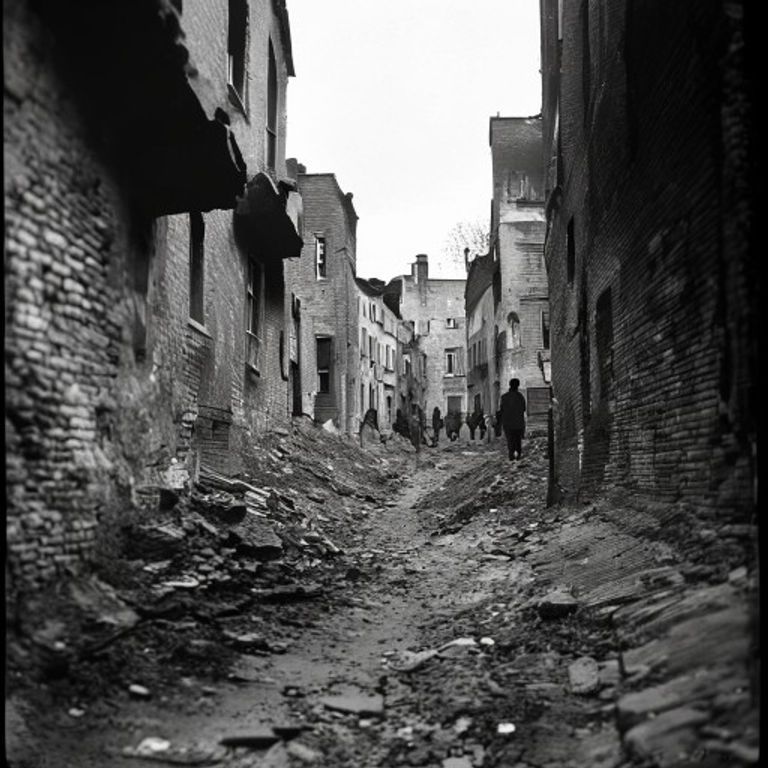
The prompt
Re-render this image in the visual register of August through October 1944 Warsaw Uprising documentary photography (the body of in-extremis photographic work produced during the 63-day Armia Krajowa rising against the German occupation, much of it shot by uprising photographers including Eugeniusz Lokajski and Sylwester Braun, recovered post-war from buried film canisters). Mid-twentieth-century 35mm and medium-format documentary photograph aesthetic, panchromatic black-and-white film, neutral gray-scale rendering with deep blacks and recovered shadow detail. Palette pure monochrome, full tonal range from chimney soot through brick-rubble mid-gray to high-key cement-dust highlight. Grain structure: visible 1940s panchromatic film grain, occasional emulsion scratch or developer mottling from the field-developed canister, slight haloing around bright passages from old optics. Subject and surface architecture: rubble-strewn cobble streets, half-collapsed tenement facades with exposed staircases, sewer-manhole entrances with figures partially descended, barricade construction from paving stones and overturned tram cars, Old Town courtyard architecture with bullet-pock wall texture. Light: harsh August sun raking across rubble (bright variant) or low-key cellar-window light with figures in deep shadow (dark variant) or sewer-tunnel beam-of-flashlight in pitch black (subterranean variant), the three light registers cover the whole 63-day topology. Rendering: documentary, the photographer working under fire, slight motion blur and uncertain focus normal, occasional camera-shake from nearby concussion, the image quality reading as desperate witnessing not staged composition. Composition: figures often shown small against monumental rubble architecture, the city as the scale-reference, occasional medium-range portrait of uprising fighters with white-and-red armband (rendered as a black-and-white band, the colors implied), face mostly in shadow under helmet or cap. Mood: 63-day endurance, deep penetration through the city's underside, Wingate's long-range-penetration logic transposed onto an urban catacomb. Strictly no on-canvas text, no Polish lettering, no AK lettering, no Kotwica anchor-symbol legibly drawn, no street signs, no slogans, no later commemorative dates, no watermark. Preserve the subject, pose, and composition of the source image exactly, change only the medium and tonal register. Aspect ratio matches source.
What it is doing
The Warsaw Uprising is the canonical case of subterranean mobility as asymmetric-warfare equalizer: the Armia Krajowa lost the surface within days but held the underside for two months by using the city's sewers as a covered-corridor maneuver network. Wingate would have understood instantly, this is his Burma long-range-penetration logic transposed onto an urban catacomb. The photographic record is documentary evidence of a force that out-maneuvered a vastly superior enemy by going downward. The visual register itself, the cement-dust gray, the sewer-beam light, the rubble scale, encodes the strategy.
Ways to change it
Pick any of these in the gallery and the choice is added to the prompt you copy.
- Topology dial: surface street barricade vs rubble courtyard partial collapse vs sewer descent manhole vs sewer-tunnel pitch-black with beam
- Light dial: August harsh raking sun vs cellar low-key window light vs flashlight beam pitch-black subterranean vs overcast September flat
- Uprising phase: early August, armbanded fighters cheering under flags, intact facades, harsh bright sun vs Old Town fall, dust-choked rubble, exhausted fighters descending into sewer manholes vs late September collapse, gutted riverside ruins, drifting smoke, wounded figures in deep shadow vs October capitulation, gaunt columns marching out past burned shells under flat gray sky
- Subject dial: lone fighter close portrait vs squad in rubble-courtyard vs civilian-and-fighter mixed crowd vs urban landscape figure-small
- Grain dial: clean recovered scan vs period-original heavy grain vs field-developed mottled vs over-exposed bright variant
Style lineage
Learn the visual culture this draws from: Andrzej Wajda (filmmaker, Kanal 1957 documenting sewer escapes).
Related prompts
See all 33 prompts in the Guerilla grammar