Guerilla / Style prompt
Italian Partisan CLN Woodcut
1943 to 1945 Italian Resistance register: CLN-aligned partisan brigade woodcut and clandestine-press visual grammar, Apennine and Po Valley resistance.
Customize this prompt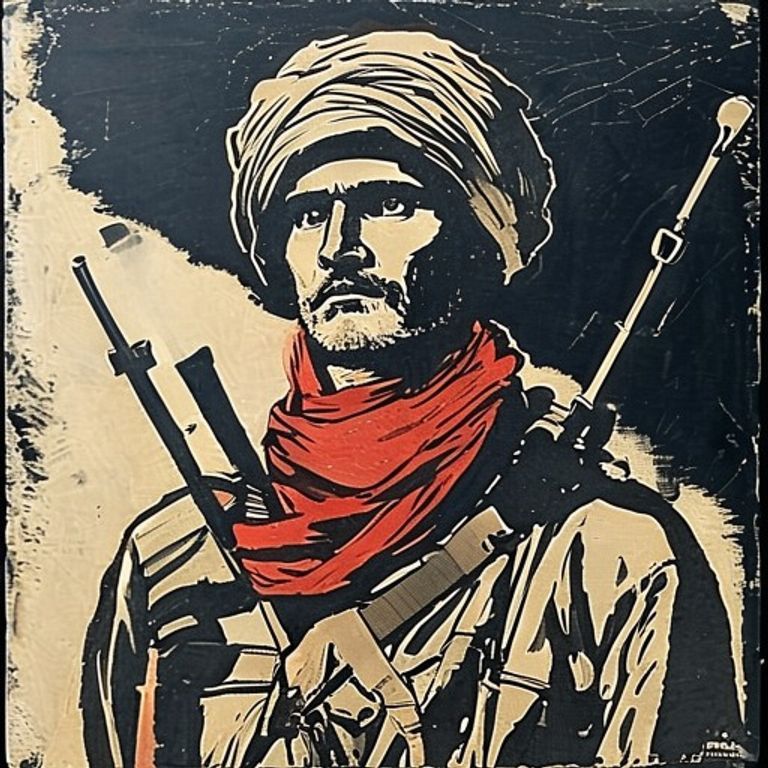
The prompt
Re-render this image in the visual register of Italian Resistance (Resistenza) clandestine-press woodcut and lithograph work from September 1943 through April 1945 (the body of partisan-brigade press output produced by Comitato di Liberazione Nazionale aligned formations, including Garibaldi Brigades, Giustizia e Liberta Brigades, and Matteotti Brigades, printed on commandeered presses in Milan, Turin, Bologna, and the Apennine mountain villages). Hand-cut linocut or woodcut aesthetic with secondary clandestine-press lithograph register, printed on coarse rationed wartime paper. Palette severely restricted: black ink on cream or beige stock, with occasional second-color overprint of arterial red or partisan-scarf red, very rarely a third color (forest green or papal-state purple). Rendering: bold black-on-cream contrast with crude relief-cut texture, visible chisel and gouge marks, white-line cut through black field rather than the more refined Mexican TGP register, the Italian partisan press leaning toward crude immediacy over technical refinement. Figure architecture: monumental working-class and peasant figures with rifles slung or held at the ready, the Garibaldi-red-neckerchief signature (cut as a black band that would have been red-overprinted), Alpine and Apennine landscape backgrounds with cypress and stone-village silhouettes, southern light implied. Surface: coarse newsprint paper with fiber texture visible, occasional ink-density variation from a press running low on ink, registration drift between black plate and red overprint, paper aging toward warm brown at the edges. Light: high-contrast graphic light, no atmospheric realism, figures lit by an abstract single-direction light source casting deep flat shadows. Composition: monumental low-angle figure framing, occasional diagonal banner-line cutting across the composition, paired-figure compositions of partisan-and-peasant or partisan-and-worker showing the alliance the CLN was trying to engineer. Mood: armed-civic seriousness, Resistance as parallel state in the mountain villages, the moment when the partisan-brigade press became the legitimacy-engine of a not-yet-existing republic. Strictly no on-canvas legible text, no Italian lettering, no CLN or Garibaldi or GL or Matteotti letter-marks, no Avanti masthead, no slogans, no signature, no watermark, no later commemorative dates. Preserve the subject, pose, and composition of the source image exactly, change only the medium and rendering. Aspect ratio matches source.
What it is doing
The Italian partisan press between September 1943 and April 1945 did something Collins would have recognized from Dublin 1919-21: it functioned as the legitimacy-engine of a parallel state before the parallel state had formal institutions. The CLN-aligned brigades did not just print bulletins, they printed the visual identity of a republic that would arrive eighteen months later. The woodcut crudity is operational, the wartime press cannot afford refinement and the audience does not want it, the register itself signals authenticity.
Ways to change it
Pick any of these in the gallery and the choice is added to the prompt you copy.
- Brigade dial: Garibaldi Communist red-neckerchief vs Giustizia e Liberta liberal-socialist vs Matteotti Socialist vs autonomous Catholic-aligned
- Region dial: Apennine mountain village vs Po Valley plain vs Turin urban factory vs Friuli northeastern partisan
- Period dial: September 1943 emerging chaotic vs summer 1944 organized peak vs winter 1944-45 hard cold defensive vs April 1945 final insurrection
- Overprint dial: pure black on cream vs black with arterial red second plate vs black with red and green tricolor vs purple-and-black mourning variant
- Subject dial: monumental partisan with rifle vs partisan-and-peasant alliance pair vs partisan-and-worker urban vs Apennine landscape with cypress silhouette and figure
Style lineage
Learn the visual culture this draws from: Italian Resistance (CLN - Committee of National Liberation).
Related prompts
See all 33 prompts in the Guerilla grammar