Guerilla / Style prompt
French Resistance Clandestine Press (mimeograph register)
1940-1944 occupied-France underground newspaper aesthetic. Combat, Libération, Défense de la France produced on stolen paper and hand-cranked Roneo machines.
Customize this prompt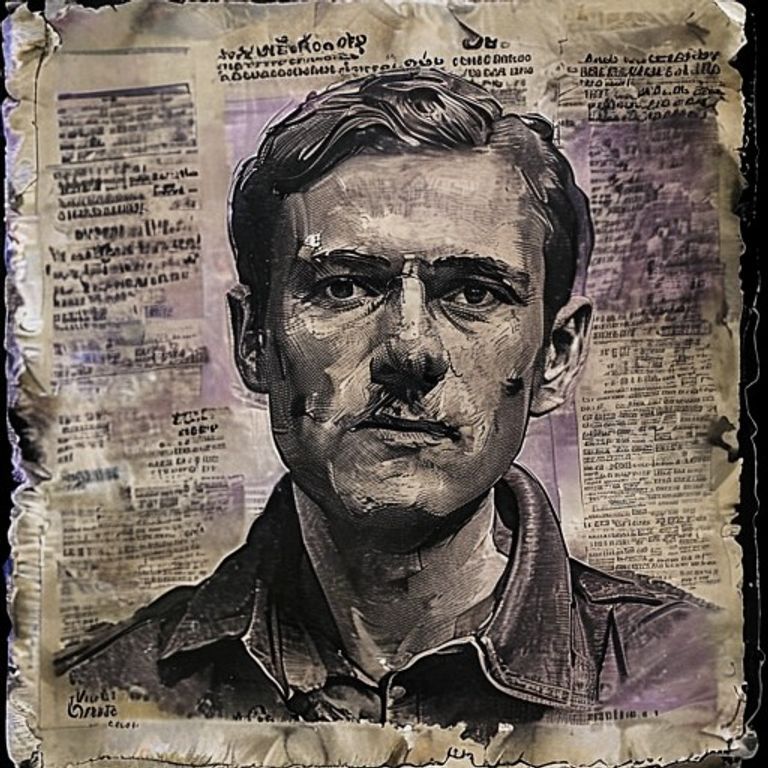
The prompt
Re-render this image as a page from a clandestine French Resistance underground newspaper produced under German occupation (1940 through 1944, the register of Combat, Libération, Défense de la France, Témoignage Chrétien, mimeographed and hand-distributed). Roneo mimeograph or hand-cranked spirit-duplicator print quality: smudgy black or violet-purple ink on rough recycled paper, uneven inking with pooled darks and faded passages, text-block bleed-through visible from the reverse side of the sheet, ink offset where wet sheets were stacked too quickly. Subject rendered as a crude woodcut or hand-drawn ink illustration occupying perhaps a quarter to a third of the visible page, surrounded by what appears to be dense text blocks (rendered as illegible grey rule-lines and ink-dash patterns, never readable, never specific letters). Palette restricted: bruised purple-black mimeograph ink, occasionally a second-pass red ink for emphasis, against unbleached newsprint cream or kraft-brown paper. Composition: the illustration sits inside a printed layout frame, not isolated, the surrounding text-bricks crowd the image, the white margins narrow as paper was scarce. Surface: visible paper grain, occasional torn edge or fold crease, slight foxing or water mark, the artifact of a sheet that traveled hand to hand. Mood: urgent, low-budget, the publication of a state-in-waiting using stolen machines. Strictly no on-canvas readable text, no legible French words, no specific newspaper masthead, no swastikas, no Cross of Lorraine, no signature, no watermark, all text-blocks rendered as illegible patterns. Preserve the subject, pose, and composition of the source image exactly, change only the medium and rendering. Aspect ratio matches source.
What it is doing
The Resistance press was a parallel state operating on the medium the occupying power most controlled. Every mimeograph machine stolen was a small declaration that information distribution belonged to whoever was willing to crank the handle in a basement. Philby's principle of deep cover applies sideways here: the publication looks like nothing official, which is exactly why it cannot be shut down by official means. The shabbiness is the credential.
Ways to change it
Pick any of these in the gallery and the choice is added to the prompt you copy.
- Year dial: 1940 earliest crude vs 1942 organized network vs 1944 pre-liberation confident
- Ink dial: pure mimeograph black vs violet duplicator purple vs red second-pass accent
- Paper dial: unbleached newsprint cream vs kraft brown wrapping vs recycled school exercise book
- Illustration dial: crude woodcut block vs hand-drawn pen and ink vs linocut bold relief
- Aging dial: freshly-printed clean vs passed hand-to-hand worn vs recovered from cellar damp
Style lineage
Learn the visual culture this draws from: French Resistance underground press (Library of Congress).
Related prompts
See all 33 prompts in the Guerilla grammar