Guerilla / Style prompt
Irish War of Independence Flying Column (Collins lens)
Documentary-photograph register of the 1919-1921 IRA flying column. The civilian who is also the soldier, photographed at the moment before nothing distinguishes him from any neighbor.
Customize this prompt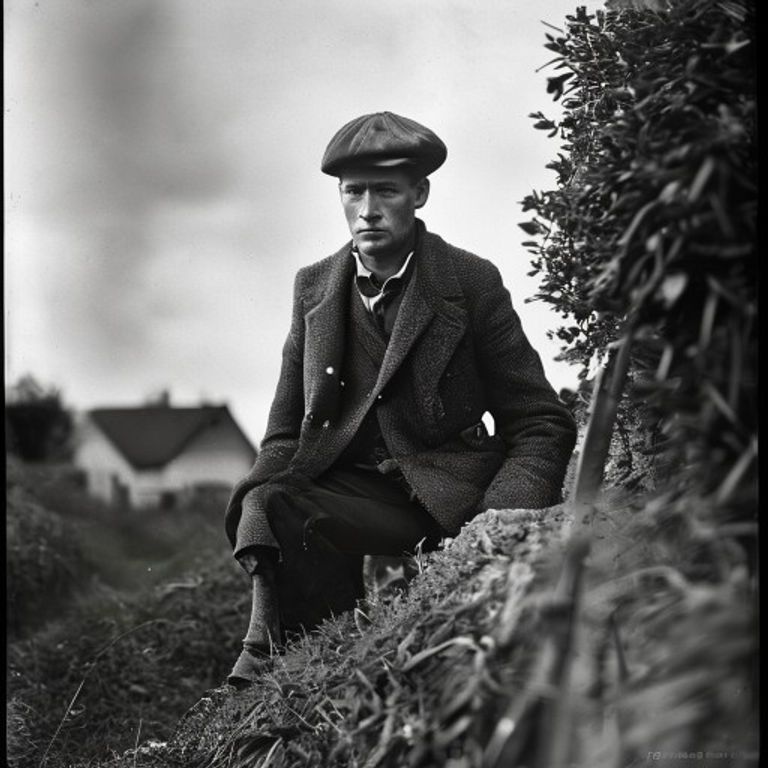
The prompt
Re-render this image as a documentary photograph from the Irish War of Independence period (1919 through 1921), specifically the flying column years that Michael Collins organized in Munster and the South Riding of Tipperary. Black-and-white silver-gelatin photographic register, period-correct: heavy grain, slight motion blur from a slow shutter, contrasty mid-greys, blocked shadows, blown highlights at the sky edge. The image looks pulled from a glass-plate negative or an early 35mm exposure recovered from a private archive rather than an official press photograph. Subject treatment: anti-heroic, anti-staged, the figure caught mid-motion or in a moment of civilian camouflage, no posed defiance, no rifle held aloft, no theatrical fist. If a weapon is present (and the source image places one), it is held low, partially concealed, ready rather than displayed. Setting: rural Irish hedgerow, boreen, stone wall, low farmhouse, soft wet light from a cloud-broken sky, the landscape neither romantic nor squalid, simply lived in. Wardrobe: civilian tweed, cloth cap, long coat, work boots, indistinguishable from any neighboring farmer, which is the entire point. Composition: documentary framing, slightly off-center, the photographer kneeling or standing at the figure's eye level, no hero shot, no monumental low angle. Mood: tactical stillness, the column rests between actions, the camera tolerated but not invited. Strictly no on-canvas text, no captions, no Gaelic lettering, no IRA insignia, no tricolour flag, no signature, no watermark. Preserve the subject, pose, and composition of the source image exactly, change only the medium and rendering. Aspect ratio matches source.
What it is doing
Collins built the flying column on a principle the British army could not counter: indistinguishable insurgents who lived inside the civilian population and surfaced for one action before re-dissolving. The photographic register matters because the photograph that survives must look like nothing, must look like a farmer in a lane, because that is exactly what the cell looked like to the Auxiliaries who walked past it. The image is intelligence camouflaged as snapshot.
Ways to change it
Pick any of these in the gallery and the choice is added to the prompt you copy.
- Year and mood: 1919, lone figure slipping along a hedgerow at dusk, wary and hurried vs 1920, armed column crouched behind a stone wall in rain, tense vs 1921 truce, men openly relaxed outside a farmhouse, caps tipped back, smiling
- Region dial: West Cork hedgerow vs Tipperary stone wall vs Limerick boreen vs Dublin tenement doorway
- Camouflage dial: pure civilian, no weapon visible vs weapon partially concealed under coat vs weapon held low at side
- Light dial: soft overcast cloud-light vs wet road after rain vs late afternoon long shadow
- Camera dial: glass-plate large format vs early 35mm grainy vs recovered amateur snapshot
Style lineage
Learn the visual culture this draws from: Michael Collins (Irish War of Independence leader).
Related prompts
See all 33 prompts in the Guerilla grammar