Guerilla / Style prompt
Viet Cong Tunnel Propaganda Woodcut
NLF and Cu Chi tunnel-period propaganda graphic register (1965-1972). Hand-cut woodblock prints produced in tunnel complexes for cadre distribution.
Customize this prompt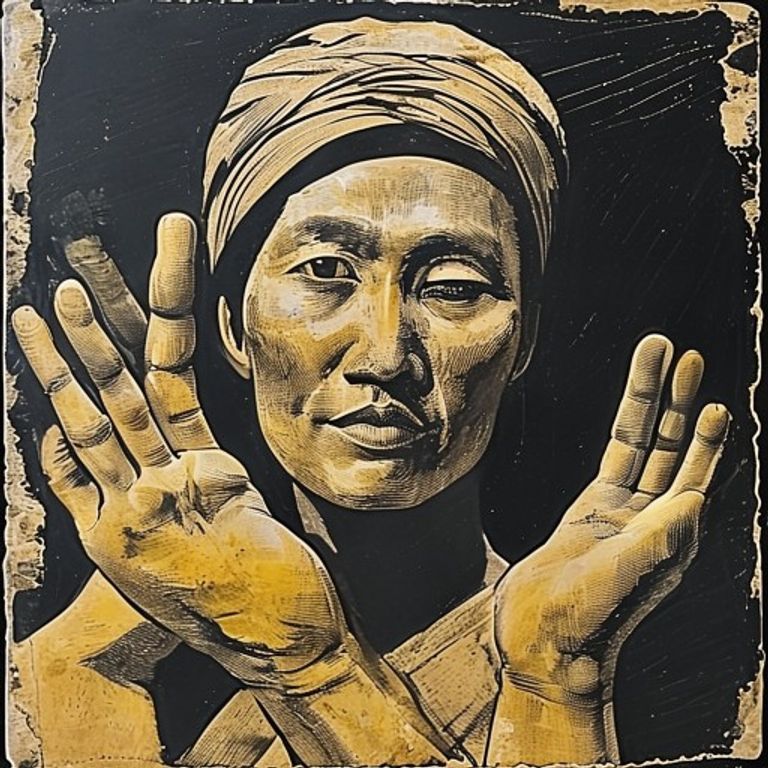
The prompt
Re-render this image as a Viet Cong period propaganda woodcut produced in the tunnel complexes of Cu Chi or Iron Triangle, roughly 1965 through 1972, intended for cadre distribution rather than international audience. Carved wood-block aesthetic, hand-printed on rough recycled paper or kraft, single ink pass per color. Restricted palette: deep red, black, and unbleached paper cream, with occasional yellow ochre as a third color used sparingly for a single accent element. Bold simplified shapes built from gouged lines, large areas of flat color with hard chiseled edges, no halftone, no gradient, no shading beyond bold cross-hatching where shadow is needed. Lines deliberately confident and economical: the carver had limited time underground and limited light, and the print shows the constraints honestly. Subject rendered with iconic compression: enlarged hands and feet for working figures, simplified faces with strong jaw and brow, posture conveying purposeful labor or vigilance rather than heroic posing. Composition: low horizon line, subject anchored in lower two-thirds of frame, often paired with secondary smaller figures or symbolic agricultural-mechanical elements (a rice stalk, a tool, a tire-tread sandal). Surface: paper grain visible in flat fields, slight registration drift between black plate and red plate, ink pooling at carved edge undercuts, occasional fingerprint or smudge from underground printing conditions. Mood: patient endurance, cellular discipline, the long campaign rendered as daily labor rather than spectacle. Strictly no on-canvas text, no Vietnamese script, no NLF star insignia, no Ho Chi Minh portrait, no specific party symbols, no signature, no watermark. Preserve the subject, pose, and composition of the source image exactly, change only the medium and rendering. Aspect ratio matches source.
What it is doing
The Cu Chi tunnel complex was a subterranean parallel civilization with kitchens, hospitals, schools, and printing presses. The propaganda produced underground was art for an audience that lived underground. Philby's deep-cover principle applies to entire populations: when the parallel society is rendered as folk craft in a medium the cadre actually possesses, the image is not aspirational, it is descriptive. The viewer recognizes themselves at work.
Ways to change it
Pick any of these in the gallery and the choice is added to the prompt you copy.
- Year dial: 1965 early, crude thick gouges, only red and black, sparse composition vs 1968 Tet, urgent diagonal composition, heavy red fields, figures mid-stride vs 1971 late, finer cross-hatching, tighter registration, yellow ochre accent added
- Subject role dial: working figure with tool vs vigilant figure at post vs paired figures in coordination
- Palette dial: red and black only vs red, black, ochre accent vs ochre and black on cream
- Carving dial: crude rapid underground cut vs confident experienced hand vs near-relief detailed
- Composition dial: single figure portrait vs figure with tool central vs paired or group tableau
Style lineage
Learn the visual culture this draws from: Cu Chi tunnels complex (underground Viet Cong base).
Related prompts
See all 33 prompts in the Guerilla grammar