Late-1990s Game-Cover Character Sketch in Gestural Ink and Blue Wash
A gestural game-cover sketch in ink and blue-grey washes, with anatomy implied rather than labored. The illustrator who insisted on a credit line on the cover.
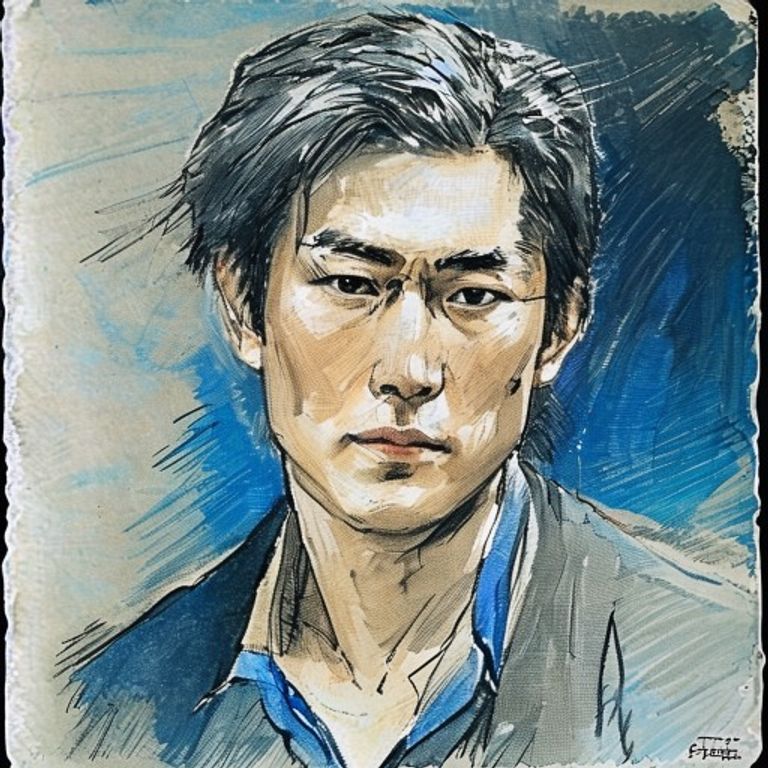
The prompt
Re-render this image in the visual register of late-1990s and early-2000s prestige character art for Japanese game packaging, the painterly-sketch tradition exemplified by illustrators who treated game cover commissions as fine-art portraiture. Medium: thick-bristled brush ink on uncoated rag paper, supplemented with grey and blue watercolor washes, a small amount of white gouache for highlight. Drawing register: gestural, confident, anatomy implied through three or four decisive brush strokes rather than labored line, negative space doing structural work, edges deliberately broken and re-found, the figure emerging from the page rather than placed on it. Palette: extremely restricted (off-white paper ground, payne's grey ink, indigo wash, single accent of pthalo blue or burnt sienna in a small area, otherwise monochrome), the limited palette as confidence. Composition: subject occupies center, generous breathing room, no environmental detail beyond suggested ground-shadow, the figure as standalone object on the page. Background: the rag paper itself, with slight cold-press texture visible, occasional ink spatter or stray brush mark left in (the artist not cleaning up after themselves, the trace of process as part of the work). Surface treatment: matte, no varnish, the printed package treating the original painting as a fine-art reproduction rather than a marketing image. No on-canvas text, no logos, no franchise lettering, no signature (the illustrator's hand is the signature). Mood: the prestige-illustrator commission, the painter who treated the cover as a portrait, the package that respected the buyer enough to put art on the front instead of a 3D render of the player-character. Preserve the subject, pose, and composition of the source image exactly, change only the medium and rendering. Aspect ratio is standard package vertical portrait (roughly 5:7).
What it is doing
There used to be illustrators with credit lines on game packages. The makers of loose brush portraits, fine-line fantasy watercolors, hard-edged industrial concept art, and glossy heroic fantasy. They were paid as fine artists and the package was treated as a commission rather than as a marketing deliverable from an in-house studio. The cover was a painting. Now the cover is a render of the protagonist looking at the camera, designed by committee, signed by no one. The painterly-sketch register asserts: the illustrator with a name is the truer cover than the anonymous studio output. A forensic craft reading would say: respect the craftsman who signs the work.
Tuning knobs
- Ink register: `loose-gesture brush ink` (canonical) vs `fine-line ethereal watercolor` (alternate) vs `architectural hard-edge ink` (industrial)
- Wash dial: `indigo-and-grey restricted` (canonical brush sketch) vs `sepia-and-cream restricted` (fine-line watercolor) vs `ultramarine-and-ochre warm-cool` (variant)
- Paper-texture dial: `cold-press rag heavy texture` (canonical) vs `hot-press smooth` (refined) vs `kraft paper warm-tone` (raw)
- Process-trace dial: `spatter and stray marks visible` (canonical, the painter present) vs `cleaned-up reproduction` (off-style) vs `process-trace exaggerated` (raw)
- Composition framing: `standalone figure centered` (canonical) vs `figure with single object companion` (variant) vs `cropped-portrait close-up` (intimate)
Style lineage
Learn the visual culture this draws from: Wikipedia.
Related prompts
See all 26 prompts in the Video-Game-Case grammar · Open in the gallery