Tattoo-Flash / Style prompt
Chicano Black-and-Grey Fine-Line Frame
The East LA Chicano black-and-grey tradition. Single-needle line, smoke grey-wash modeling, photoreal portraiture from prison ingenuity refined into fine-art craft.
Customize this prompt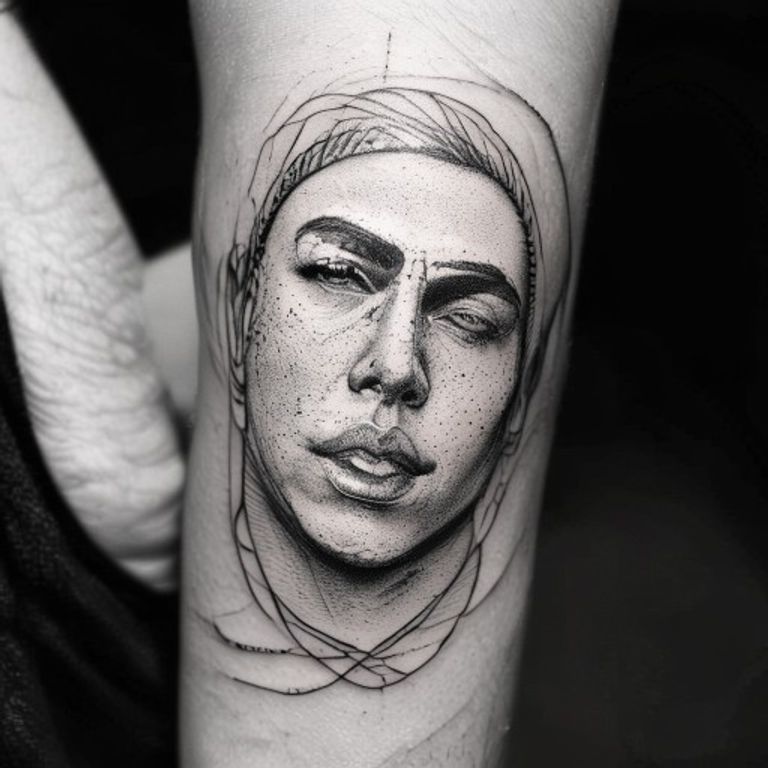
The prompt
Re-render this image in the visual register of the East Los Angeles Chicano black-and-grey tattoo tradition, the single-needle fine-line school associated with single-needle pioneers and prison-rooted gray-wash craft, and an East LA parlor lineage that refined prison-tattoo technique into fine-art photoreal portraiture. Medium: single-needle tattoo on skin, rendered as if photographed under soft natural light, the design treated as a finished tattoo on a slightly warm-toned skin ground rather than as a flat flash sheet. Line work: extremely thin single-needle outlines in black, the line varying from hairline to medium-fine, the contour delicate and architectural. Modeling: soft smoke-grey wash built up through stippling and smooth needle-shading, the grey ranging from near-white pale haze through medium graphite to deep velvet near-black, every transition smooth, no hard color edges, the modeling carrying the entire tonal range without any pure-black solid fill larger than a single small accent. Palette: black ink only, diluted to all grey values, no color anywhere, the entire visual language built on a single ink dilution scale. Texture register: photoreal where appropriate (smooth gradients for skin, soft modeled volume for fabric, crisp small detail for jewelry, hair as fine parallel lines), the technique borrowed from photorealist pencil drawing and translated into needle. Composition: subject centered, soft vignette of skin around the design, the tattoo treated as a portrait commission rather than a flash sheet. Background: the warm-skin-tone ground itself, smooth, faintly textured, occasional pore visible at extreme close range. Surface treatment: the look of a freshly-healed tattoo under soft natural light, slight sheen on the skin, no gloss varnish, no on-paper aesthetic. No on-canvas text, no script lettering, no studio signature, no franchise marks. Mood: the prison-rooted ingenuity refined into fine-art craft, the single-needle as patience, the grey-wash as the slowest and most disciplined technique in the tradition. Preserve the subject, pose, and composition of the source image exactly, change only the medium and rendering. Aspect ratio is portrait-orientation tattoo placement (roughly 4:5).
What it is doing
Chicano black-and-grey came out of prison cells where ingredients were limited to a single needle, motor parts, and pen ink diluted in cup water. The technique that emerged is the most patient in the tradition: smooth grey-wash modeling built up over many sessions, photoreal portraiture from the lowest-resource starting point in the craft. Single-needle pioneers refined it into fine-art at an East LA parlor. The lineage is the visible record that genuine mastery emerges from constraint, not from access. The fine-line single-needle register is the opposite of the fast trendy flash: it requires patience the customer rarely has and skill the artist must earn over years.
Ways to change it
Pick any of these in the gallery and the choice is added to the prompt you copy.
- Lineage register: classic East LA parlor craft (canonical) vs prison-rooted photoreal (origin) vs modern third-wave LA refinement (contemporary)
- Grey-wash range: full pale-to-velvet range (canonical photoreal) vs mid-grey only restrained (austere) vs high-contrast deep-shadow heavy (dramatic)
- Line-weight dial: single-needle hairline (canonical) vs three-needle slightly heavier line (variant) vs mixed-needle line-and-shade combo (refined)
- Subject-register dial: photoreal portraiture (canonical Chicano) vs religious-iconography Catholic (heritage) vs script-and-banner reference (vernacular)
- Skin-tone dial: warm light skin ground (one register) vs medium golden skin ground (alternate) vs deep skin ground with adjusted contrast (alternate)
- Healing-state dial: freshly-healed crisp (canonical reference) vs aged-and-settled soft (years-old) vs recent-fresh slightly raised (just-done)
Related prompts
See all 10 prompts in the Tattoo-Flash grammar