Tattoo-Flash / Style prompt
Japanese Irezumi Bodysuit Wave-and-Cloud Frame
Traditional Japanese Irezumi register. Wave, cloud, wind-bar background, multi-year horimono commitment. The mark of a relationship with one master.
Customize this prompt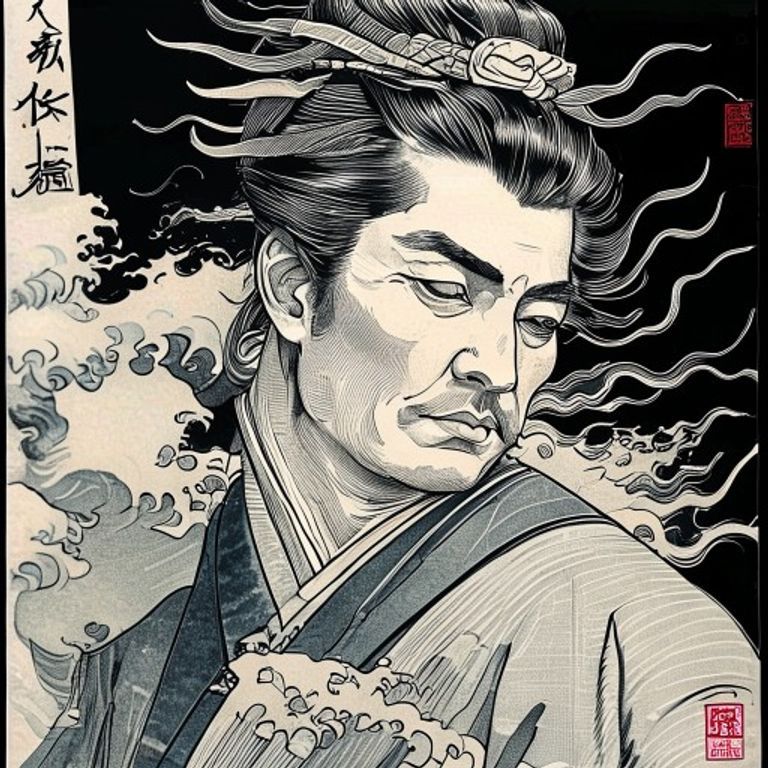
The prompt
Re-render this image in the visual register of traditional Japanese Irezumi (horimono) tattoo design, the canonical wabori register associated with master-led bodysuit work in the Edo through modern eras, drawn as it would appear on a sumi-and-watercolor reference scroll. Medium: brush ink (sumi) over washi rice-paper with selective Japanese watercolor pigment fills, finished as a reference drawing rather than a photograph of skin. Line work: brush-drawn outline in jet black sumi, variable line weight (the brush thickness modulating naturally across the stroke), confident long curves, no hesitation marks, the line work as calligraphic gesture rather than mechanical contour. Palette: traditional restricted set (sumi black, vermilion red, mineral green, indigo blue, ochre yellow, mineral grey for cloud-and-wave), every color a flat brush-applied watercolor wash inside the black line work, the white of the paper left for highlight. Background: the canonical Japanese tattoo background grammar consisting of stylized wind-bars (kaze), cloud (kumo), and wave (nami) drawn as flowing graphic shapes, no environmental realism, the background as a graphic field that visually unifies the figure with its surrounding skin. Wave register: stylized hokusai-derived foam-curl shapes, repeating wave-crest motifs. Cloud register: scrolling bracket-shaped cloud-forms with hollow centers. Wind-bar register: parallel curving lines suggesting motion. Composition: subject centered, background grammar flowing around the figure in continuous graphic motion, the whole composition reading as a unified panel of a multi-panel bodysuit. Paper: washi rice-paper texture visible, slight fiber irregularity, soft warm cream tone. No on-canvas text, no kanji legible script, no studio mark, no signature. Mood: the bodysuit as multi-year commitment to one master, the horimono as relationship rather than purchase, the craft tradition as older than the wearer. Preserve the subject, pose, and composition of the source image exactly, change only the medium and rendering. Aspect ratio is reference-scroll vertical portrait (roughly 3:5).
What it is doing
The Japanese Irezumi bodysuit is the longest commitment in tattoo culture. A traditional horimono bodysuit is a multi-year relationship with one horishi master, executed in dozens of sessions, often over a decade. The wave-cloud-wind background grammar is not decorative filler, it is the visual contract that all the panels belong to one work by one hand. Compare to the modern app-tested flash: a Pinterest screenshot taken to a stranger, no relationship, no tradition, no master. Irezumi is the craft tradition that says: the relationship to the master is part of the mark.
Ways to change it
Pick any of these in the gallery and the choice is added to the prompt you copy.
- Tradition register: Edo-classical wabori restrained (canonical) vs Meiji-revival ornate (decorative) vs modern-master synthesis (contemporary horishi)
- Background grammar: wave-cloud-wind canonical triad (full) vs wave-only minimal (austere) vs cloud-only restrained (intimate)
- Color dial: full traditional palette (canonical) vs sumi-only black-and-gray (austere horimono) vs vermilion-accent on monochrome (signature variant)
- Line-weight dial: variable brush gesture canonical (master-grade) vs uniform thick line (machine-translated) vs extra-fine restrained (refined)
- Paper-render dial: washi rice-paper canonical (reference-scroll) vs silk-scroll formal (presentation) vs kraft warm-tone (working-sketch)
- Composition-density: dense background canonical (true horimono) vs medium-density transitional vs sparse-background isolated-figure (off-tradition)
Style lineage
Learn the visual culture this draws from: Britannica.
Related prompts
See all 10 prompts in the Tattoo-Flash grammar