Tattoo-Flash / Style prompt
Blackwork Heavy-Solid Geometric Frame
Heavy solid-black tattoo register. Geometric, architectural, no grey, no half-measure. The most irreversible commitment ink can make.
Customize this prompt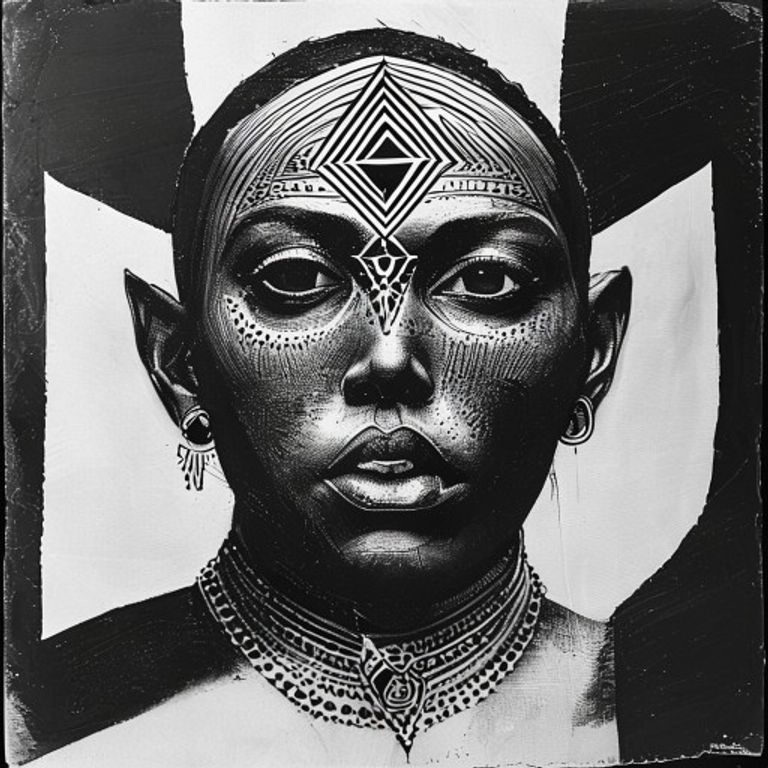
The prompt
Re-render this image in the visual register of contemporary heavy Blackwork tattoo design, the canonical solid-saturated-black tradition associated with European and Pacific blackwork masters, drawn as a flash reference sheet on white paper. Medium: pure black sumi or India ink on bright white smooth paper, no other color, no grey wash, no halftone, the entire visual language confined to solid black and the pure white of the paper. Drawing register: bold geometric abstraction, the subject reduced to a composition of solid-filled black shapes and clean negative-space whites, hard-edged knife-cut contours, no gradient, no shading, no soft transition. Where modeling is needed, it is achieved by either pure-black fill or pure-white negative space, never by grey or by line-density (no stippling, no parallel-line shading). Composition: figure centered, occupying most of the sheet, surrounded by clean white margin, the figure treated as a graphic monolith. Internal detail: where pattern is required, use crisp geometric motifs (sacred-geometry triangles, hexagonal tessellations, mandala-radial divisions, parallel-line bands), every motif executed with mechanical precision, the geometry as the only ornament. Edges: razor-clean, no fade, no soft transition, the black shape ending exactly where it ends. Paper: bright smooth white, slight cold-press texture, no aging, no off-white tint, the white as commitment-pure as the black. Surface treatment: matte ink on matte paper, no varnish, no gloss. No on-canvas text, no signature, no studio mark. Mood: the most irreversible commitment ink can make, the solid black as the least revisable choice, the geometric register as architecture rather than decoration, the figure as monolith. Preserve the subject, pose, and composition of the source image exactly, change only the medium and rendering. Aspect ratio is flash sheet vertical portrait (roughly 4:5).
What it is doing
Solid heavy blackwork is the most irreversible commitment a tattoo can make. Color tattoos can be lasered, grey-wash can be revised, fine-line can be covered. A solid-black geometric monolith on the skin is a near-permanent declaration. The blackwork register is the architectural mode of tattoo: form, not decoration. It treats the body as a building rather than a billboard. The choice to commit large solid black is a refusal of the revision economy that surrounds modern aesthetic decisions. It says: this choice does not get to be unmade.
Ways to change it
Pick any of these in the gallery and the choice is added to the prompt you copy.
- Coverage dial: solid heavy fill canonical (committed) vs solid-with-negative-space cutouts (architectural) vs large-solid-with-thin-line-detail (refined)
- Geometry register: sacred-geometry triangles (esoteric) vs Pacific-tribal pattern blocks (heritage) vs architectural plan-view grid (industrial)
- Edge treatment: razor-knife-clean (canonical) vs slightly-soft brushed (organic-blackwork) vs decorative-scalloped (ornamental)
- Pattern density: sparse-bold large shapes (monolith) vs medium-density tessellation vs dense-pattern field-fill (saturation)
- Negative-space role: negative space carries the figure (canonical positive-negative play) vs solid-dominant minimal-negative (heavy) vs equal positive-negative balance (graphic)
- Paper-register dial: bright-white reference-sheet (canonical) vs kraft-warm working sketch (raw) vs ivory-toned presentation paper (refined)
Related prompts
See all 10 prompts in the Tattoo-Flash grammar