Tattoo-Flash / Style prompt
American Traditional Sailor-Jerry Flash Frame
Norman Collins' American Traditional register. Bold black outline, five-spot palette, the flash sheet as canon. The body as the only non-rentable asset.
Customize this prompt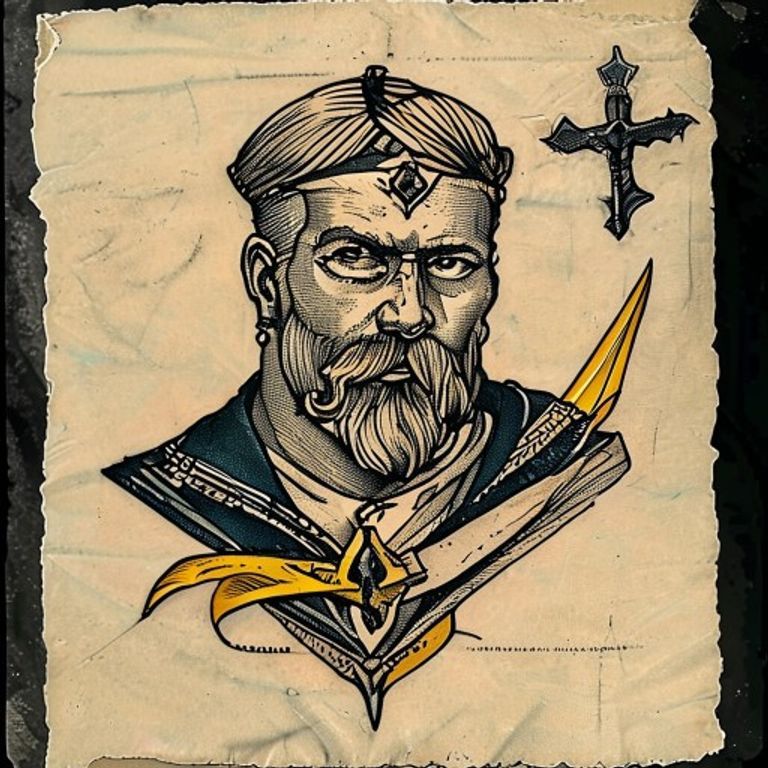
The prompt
Re-render this image as a tattoo design in the American Traditional flash register associated with Norman "Sailor Jerry" Collins, bold-outline, saturated-color traditional flash, and the canonical Honolulu and East Coast naval-era flash sheets of the 1930s to 1960s. Medium: tattoo flash on aged off-white card stock, hand-drawn and hand-colored, treated as a sheet illustration intended for reference on a parlor wall. Line work: bold black outline at uniform thick weight, the contour line carrying all structural information, internal detail rendered as thinner secondary black lines, no halftone, no shading by line-weight modulation, the line as solid commitment. Palette: extremely restricted (signature five-spot: olive green, mustard yellow, brick red, navy blue, brown-black), every color rendered as a flat fill inside black outlines, no gradients, no airbrush, white left as the paper showing through for highlight. Modeling: where shadow is needed, a single flat darker color of the same hue is laid inside the line work, never a true black shadow, the limited palette doing all the work. Composition: subject occupies center of the sheet, bold dramatic posture, banner or anchor or decorative element implied as a graphic device (render as undifferentiated colored ribbons or shapes, no legible lettering on any banner, no readable script). Background: the aged card stock itself, slightly cream-toned, soft paper-grain texture visible, occasional age-spotting or coffee-stain at the edges. Surface treatment: matte, the printed paper of a 1950s parlor flash sheet, slight ink-bleed at line edges suggesting the original was hand-drawn with brush-tipped pen and watercolor. No on-canvas legible text, no banner script, no studio-name signature, no franchise marks. Mood: the tattoo as commitment in ink under skin, the flash sheet as parlor canon, the bold outline as the visible spine of a tradition. Preserve the subject, pose, and composition of the source image exactly, change only the medium and rendering. Aspect ratio is standard flash sheet vertical portrait (roughly 4:5).
What it is doing
The tattoo is the only fully non-rentable asset most people will ever own. The body is the permanent shelf. Sailor Jerry's American Traditional grammar is the most disciplined form of this commitment: five colors, bold line, no clever shading, no trend-chase. The tradition is the asset, the commitment is the asset, the visible mark is the contract that some choices cannot be patched. Modern fine-line trend-following tattoos are the opposite: rentable-feeling, app-tested aesthetics that will date in five years. American Traditional is the vitalist position: mark the body the way warriors and sailors did, with a tradition older than the customer.
Ways to change it
Pick any of these in the gallery and the choice is added to the prompt you copy.
- Era register: 1940s naval-port classic (canonical Jerry) vs 1960s East Coast revival (bold-outline era) vs 1990s Texas-revival third-wave (modern American Traditional)
- Palette dial: signature five-spot Jerry (canonical) vs three-spot austere (early American) vs seven-spot expanded (modern Traditional)
- Line-weight dial: uniform thick canonical (Jerry) vs variable-weight traditional variant vs extra-bold third-wave
- Composition dial: single icon centered (canonical) vs paired icon with banner (classic-flash) vs tableau-with-multiple-elements (custom)
- Banner-shape dial: classic ribbon-banner (canonical, no text) vs scroll-rolled banner (variant) vs omitted (austere)
- Paper-aging dial: mint clean card (collector) vs parlor-wall yellowed (canonical) vs coffee-stained age-spotted (relic)
Style lineage
Learn the visual culture this draws from: Official Sailor Jerry Brand.
Related prompts
See all 10 prompts in the Tattoo-Flash grammar