Intimate Riso Zine Portrait (Style-Only, Image-Conditioned)
Style register: an observational portrait reproduced for a small personal art edition, with restrained shadow screening and visible print softness.
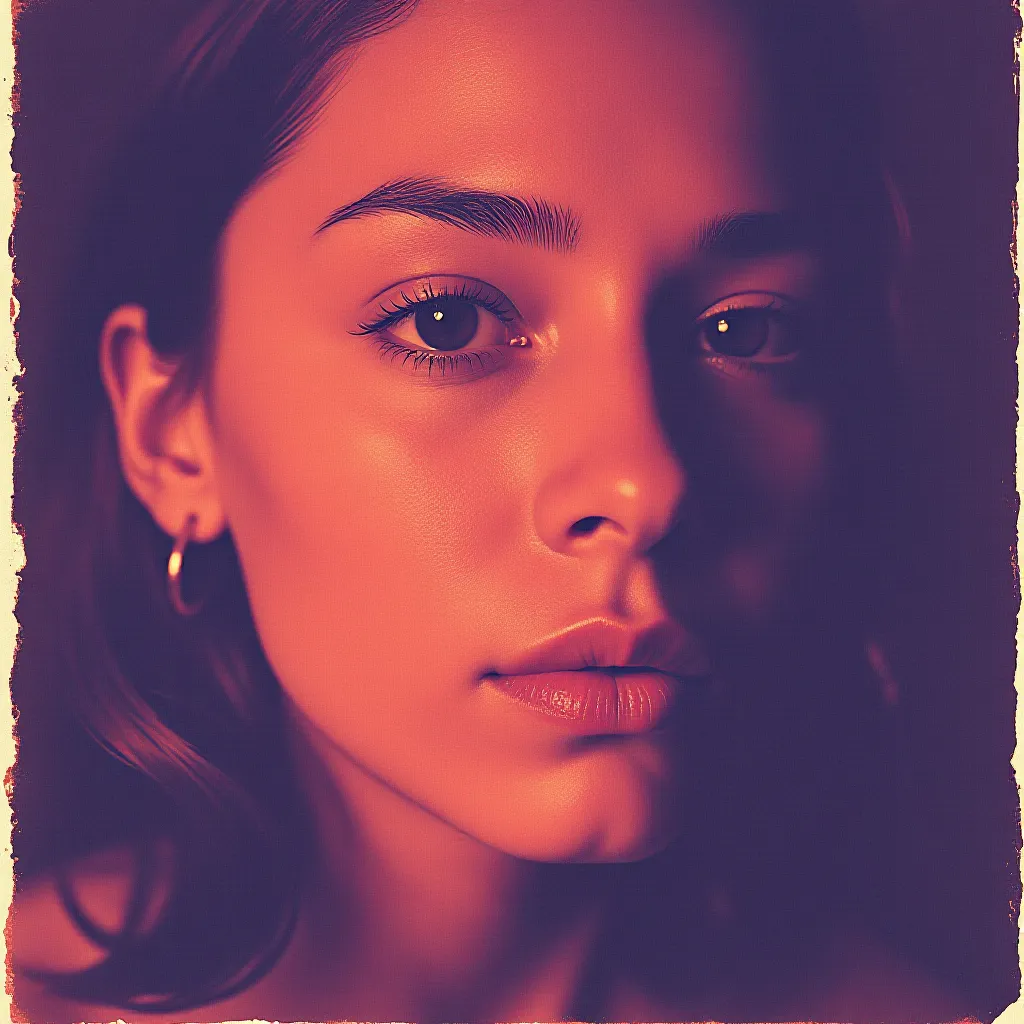
The prompt
Re-render this image as a quiet risograph portrait for a small-edition photographic zine, drawing on intimate color snapshots with direct flash, candid subjects, lived-in interiors, and the softened tonal separations of contemporary riso artists. If the source contains a person, keep their expression, pose, age cues, and identity intact; if it does not, treat its existing central form with the same observational care. Convert luminous planes into open uncoated cream paper. Use a deep plum stencil for facial or object contours, shadow masses, and the few marks that establish likeness, with a muted salmon stencil carrying middle tones as fine irregular grain. Let these two passes overlap into a dark warm shadow only where the source already has one. Give the eye, hand, or other existing focal detail more tonal clarity than the peripheral background, but do not invent a new pose, prop, or setting. The paper feed is almost aligned: only a slight salmon fringe escapes at selected large contours. Preserve air around the figure and keep the original crop, rather than surrounding it with cutout scraps or protest graphics. Soft stencil edges, absorbent paper, and slight unevenness in dense plum reveal an affordable duplicator print made to be held close. The mood is attentive rather than heroic. Leave a calm, uncluttered band of negative space along the top or bottom edge where a title could sit. Strictly no on-canvas text, no legible lettering, no signature, no watermark, no logos. Preserve the subject, pose, and composition of the source image exactly, change only the medium and rendering. Aspect ratio matches source.
What it is doing
The small-edition portrait is not a mass slogan. Its inexpensive reproduction brings a private likeness into reach while preserving the uncertainty of a personal encounter. Printing texture becomes a kind of attention instead of a badge of rebellion.
Tuning knobs
- Shadow ink: `deep plum` (signature) vs `soft black` vs `indigo`
- Middle tone: `salmon grain` (signature) vs `peach screen` vs `pale lilac screen`
- Detail emphasis: `source focal feature` (signature) vs `even detail throughout` vs `only major shapes`
- Registration: `almost aligned` (signature) vs `tight alignment` vs `visible salmon fringe`
- Background: `open cream paper` (signature) vs `very light tint` vs `soft sparse grain`
Related prompts
See all 10 prompts in the Risograph grammar · Open in the gallery
Get the free sample. The intro plus the first three chapters of The Liberation Engine, delivered as a PDF. The full book and the complete 642-prompt method are the paid edition.