Three Drum Overprint Trapping (Style-Only, Image-Conditioned)
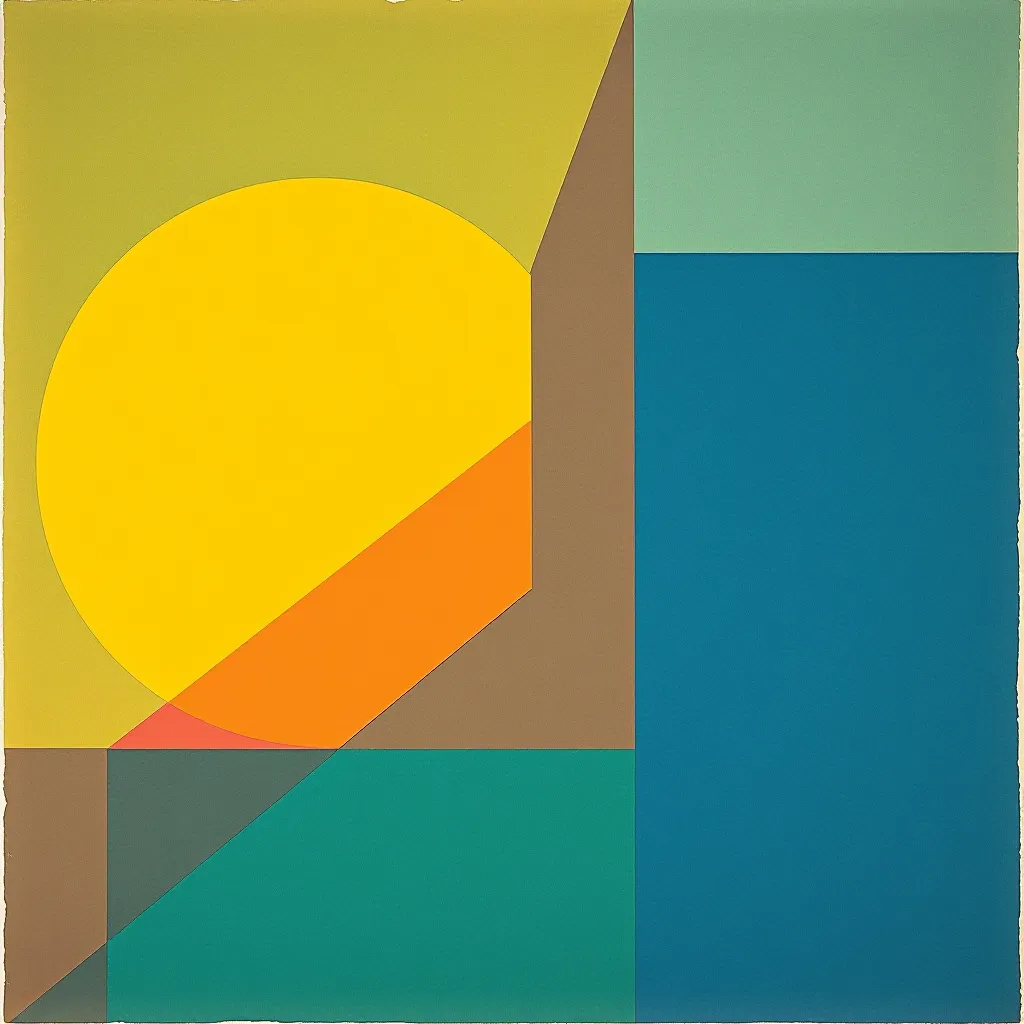
Style register: three transparent spot-color drums, deliberately expanded plate edges and carefully staged secondary colors at every intersection.
The prompt
Re-render this image as a three-drum risograph print designed around ink trapping, in the systematic color experiments of Josef Albers and contemporary small-press riso printmakers. Separate the source into three stencil masters: golden yellow for the light planes, marine teal for the middle planes, and saturated coral for the deepest accents. Print yellow first, teal second, coral last. Where two colors meet, extend the lighter plate a narrow distance underneath the darker one so paper feed drift does not open a white seam. Make those trap margins occasionally visible as tiny mixed-color shoulders around large shapes. Let translucent inks combine physically: teal over yellow creates green, coral over yellow warms to orange, and all three layers converge in a dense neutral at only the focal point. Keep the underlying image and its geometry clear. Use broad color fields and a few decisive shadows, not an ornamental pattern of random intersections. Stencil grain, mild edge feathering, and very slight roller pressure differences should reveal three distinct passes over absorbent uncoated stock. The mood is deliberate workshop experimentation: color emerging from sequence rather than a finished digital palette. Leave a calm, uncluttered band of negative space along the top or bottom edge where a title could sit. Strictly no on-canvas text, no legible lettering, no signature, no watermark, no logos. Preserve the subject, pose, and composition of the source image exactly, change only the medium and rendering. Aspect ratio matches source.
What it is doing
The third color is not one more paint chip. It changes the combinatorial possibilities of the entire print. Trapping exposes the labor usually hidden inside a crisp boundary: separate masters must negotiate where color touches color.
Tuning knobs
- Drum order: `yellow then teal then coral` (signature) vs `teal then yellow then coral` vs `coral printed first`
- Trap width: `narrow mixed shoulders` (signature) vs `barely visible trap` vs `wide purposeful overlap`
- Third-color area: `restricted coral accents` (signature) vs `equal-area coral` vs `single coral focal shape`
- Combined neutral: `one dense focal convergence` (signature) vs `several scattered darks` vs `no triple overlap`
- Registration: `slight feed drift` (signature) vs `tight alignment` vs `loose plate drift`
Related prompts
See all 10 prompts in the Risograph grammar · Open in the gallery
Get the free sample. The intro plus the first three chapters of The Liberation Engine, delivered as a PDF. The full book and the complete 642-prompt method are the paid edition.