Numismatic-Coin-Medal / Style prompt
Roman Imperial Sestertius Bronze Profile
The struck bronze sestertius of 1st to 3rd century Rome, the state portrait coin that circulated empire-wide. All official faces were identical across mints. The only mass-produced surveillance medium Rome had.
Customize this prompt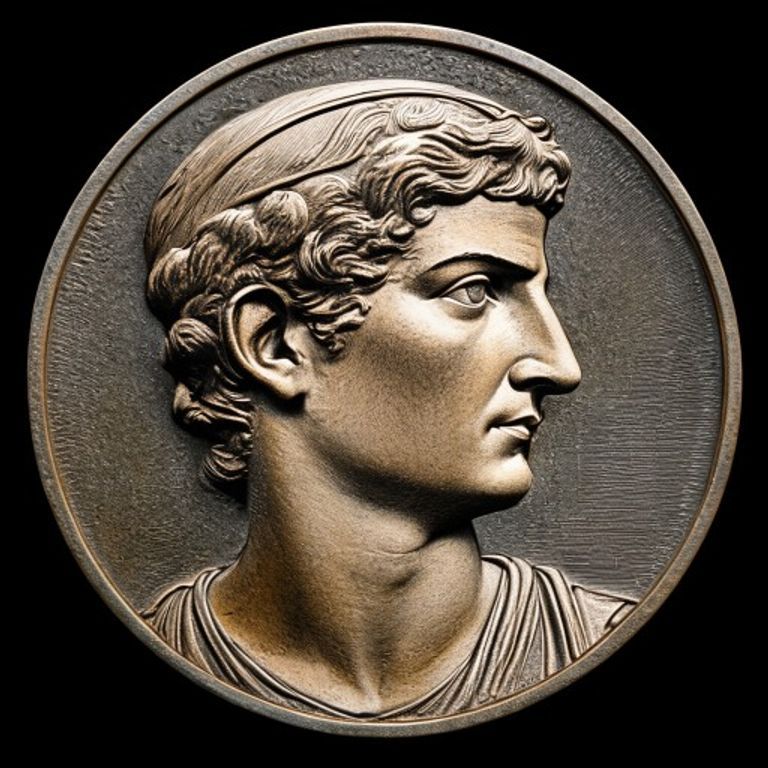
The prompt
Re-render this image as a Roman Imperial sestertius, a large bronze coin (approximately 25 to 35mm diameter) struck between 1st and 3rd century AD. Obverse: a high-relief portrait head in strict profile facing right, the hair rendered with fine linear striations and a formal crown or curled arrangement typical of the named emperor's coinage. The portrait itself follows the state formula: idealized but recognizable, with careful attention to cheekbone structure, the angle of the jaw, and the nose rendered in sharp relief against the field. The eye is incised with a simple line (no pupil detail, too small to strike). Legend around the obverse rim: render as a text-free cartouche band (no legible lettering). Reverse: an allegorical figure or symbolic object (goddess, victory, military standard, supply ship) rendered in two-plane relief, the background field left open with fine granular texture from the ancient casting and striking process. Rim: raised bead-line border, slightly irregular from hammer-strike variation. Surface finish: oxidized bronze patina with the green-black verdigris typical of museum-excavated coins, showing slight wear on the highest points (nose, cheekbone, hair curls) where circulation smoothed the relief. Strike quality: intentional and formal, the kind of official consistency that speaks to centralized control. Aspect ratio 1:1 circle. Preserve the subject, pose, and composition of the source image exactly, change only the medium and rendering.
What it is doing
The sestertius was the first mass-produced image technology. Rome cast millions of them. A portrait of the emperor struck into bronze then distributed across the Mediterranean guaranteed that every subject in every province saw the same face, the same exact proportions, the same assertion of who held power. Modern faces on coins are legal fiction. Roman faces on coins were monopoly. The sestertius is not a financial instrument, it is a bandwidth constraint turned into metal. The state controlled the image-distribution network because it controlled the die and the mint. This is why numismatists can date a coin to a reign and often to a precise year. The Roman portrait is the precursor to the photograph, the wanted-poster, and the passport. It is sovereign control made circular.
Ways to change it
Pick any of these in the gallery and the choice is added to the prompt you copy.
- Patina-era dial: bright freshly-struck bronze (military campaign era) vs dark green oxidation (museum excavated) vs dark brown field-find patina (plowed furrow)
- Portrait-style dial: early Julio-Claudian formal (1st century) vs Antonine realistic (2nd century) vs late Severan dramatic (3rd century)
- Reverse-motif dial: Nike figure holding victory palm vs military standard or eagle vs supply ship under sail
- Strike-quality dial: perfect centering (official die) vs slight off-center (normal ancient variation) vs double-strike visible (die clash)
- Rim-finish dial: tight consistent bead-border (early striking) vs rough irregular edge (worn die or late strike) vs edge damage from handling
- Surface-texture dial: light circulation wear, details sharp vs heavy wear, cheekbone flattened vs encrustation, field texture granular
Related prompts
See all 7 prompts in the Numismatic-Coin-Medal grammar