Numismatic-Coin-Medal / Style prompt
Renaissance Cast Portrait Medal (Pisanello Style)
The bronze-cast portrait medal of 15th-century Florence and Padua, the humanist invention that turned the coin into an art object. Thicker, larger, fewer struck at a time. Cast not struck. The subject could now be alive to see it.
Customize this prompt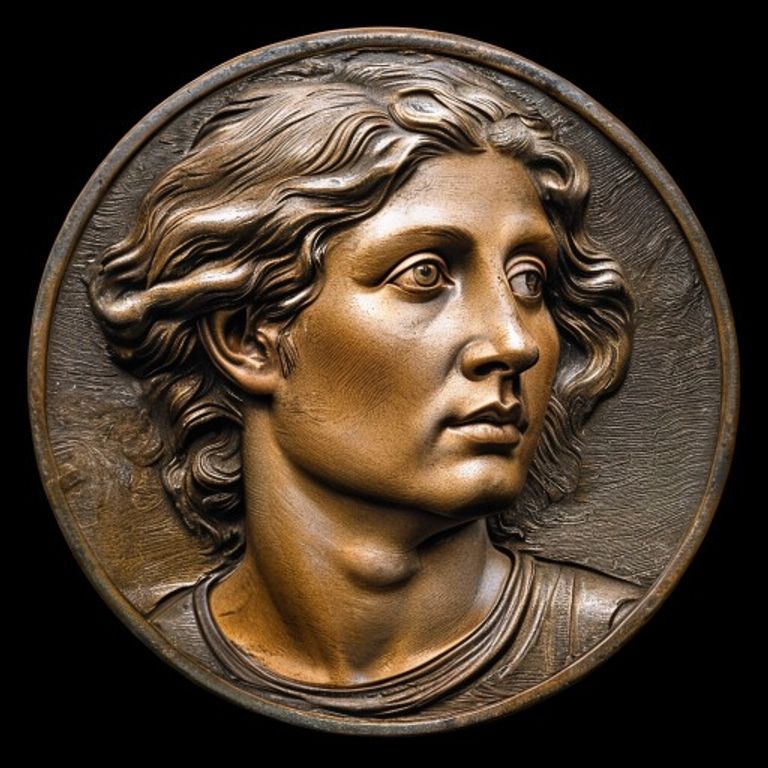
The prompt
Re-render this image as a 15th-century Renaissance portrait medal in bronze, approximately 50 to 80mm diameter, cast in high relief (not struck, cast). Obverse: a portrait head in high three-quarter relief, the hair rendered with sculptural attention to individual curls and tresses, the facial features idealized with humanist precision, the eye showing actual pupil incision and a sense of gaze direction (unlike the flat incised eye of ancient coins). The cheekbones and chin rendered with anatomical accuracy and subtle modeling. A thin inscribed band or cartouche around the rim with no legible lettering, just formal incised text-space. Reverse: an allegorical scene or symbolic emblem, often an impresa or vignette (a unicorn, a phoenix, a ship under full sail, a classical figure performing an action), rendered in lower relief than the portrait, the background field open and sculptural. The reverse may include a signature mark or foundry initial (render as a small symbol, no legible name). Cast surface: evident casting-marks and minor surface irregularities, showing the bronze was poured from a mold, not hammered from a die. The patina: rich chocolate-brown to dark olive bronze with slight green oxidation in protected recesses, the kind of color that comes from 500 years of oxidation and selective polishing. Edge: irregular and natural from the casting sprue, not a struck rim. Aspect ratio 1:1 circle. Preserve the subject, pose, and composition of the source image exactly, change only the medium and rendering.
What it is doing
The medieval coin and the Renaissance medal are different technologies for different reasons. The coin was struck in quantity, distributed as currency, unseen by the subject. The medal was cast in limited quantity, given as a gift, and the subject could hold it in their hand while alive. The medal is the first art object that proved humanist patronage. A merchant or prince commissioning a medal from Pisanello was buying immortality but also buying evidence of his humanist refinement. The medal became the portfolio piece of the sculptor, not the stamped image of the state. This is why Renaissance medals are almost always larger than coins, thicker, more sculptural, more difficult to fake. They were never meant to circulate. They were meant to sit in a cabinet and prove the patron's taste.
Ways to change it
Pick any of these in the gallery and the choice is added to the prompt you copy.
- Portrait-era dial: early Quattrocento formal (1440s Pisanello) vs mid-century elegant realism (1460s) vs late Renaissance idealized (1480s)
- Reverse-motif dial: allegorical figure or virtue vs impresa emblem or device vs classical architectural vignette
- Surface-patina dial: dark chocolate-brown with green recesses vs bright polished bronze showing streaks vs crusty unpolished excavation patina
- Portrait-angle dial: strict profile (most common) vs three-quarter view vs full-face formal
- Rim-treatment dial: irregular casting-sprue edge vs filed smooth edge vs decorative beaded border added in finishing
- Scale-suggestion dial: small 40mm intimate vs large 70mm statement piece vs thick heavy substantial feel
Related prompts
See all 7 prompts in the Numismatic-Coin-Medal grammar