Numismatic-Coin-Medal / Style prompt
US Mint Proof Silver Dollar (Struck Relief)
The American proof dollar, struck from polished dies onto polished blanks, the 19th-century version of a luxury object. All detail is legible. No circulation was ever intended. The mirror field and frosted relief are deliberate.
Customize this prompt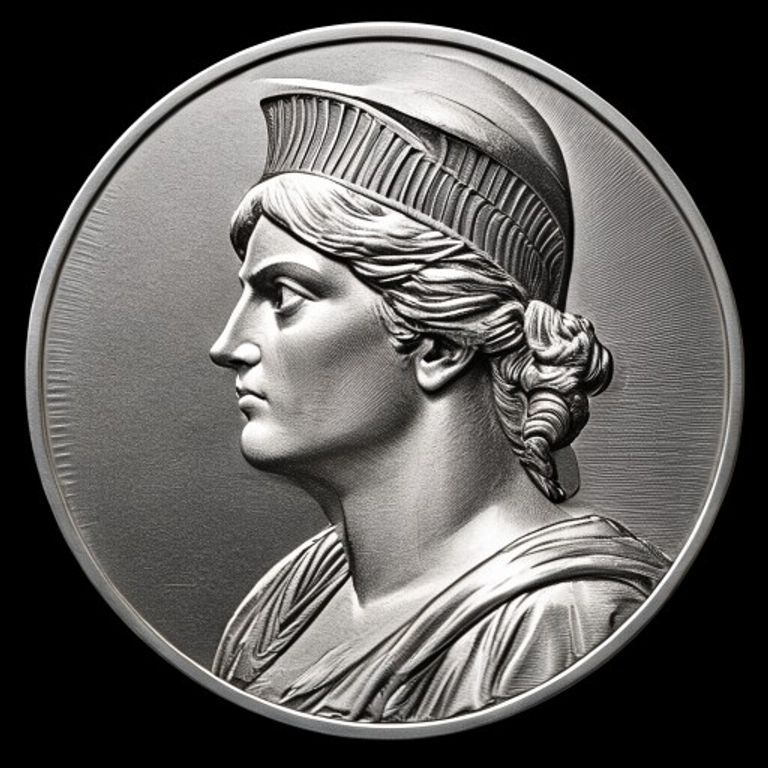
The prompt
Re-render this image as a US Mint proof silver dollar, struck between 1878 and 1921, approximately 38mm diameter, 90-percent silver content. Obverse: a profile portrait of Liberty facing left, the hair rendered with individual curl striations, a tiara or liberty cap, the facial features rendered with extreme detail intended for the collector's hand-held inspection, not circulation wear. The cheekbone and jaw show the crisp relief that comes from striking soft silver against polished dies. Legend around the obverse: render as an incised band with no legible lettering. Reverse: an eagle with wings spread, shield on the breast, arrows in one talon, olive branch in the other, a scroll in the mouth reading "E Pluribus Unum" (render as a blank scroll, no legible text). The field of both sides shows a mirror-like polish (proof finish), reflecting light evenly across the flat surface. The relief (the portrait and eagle) shows a frosted matte texture that contrasts sharply with the mirror field. This contrast (mirror-field, frosted-relief) is the defining characteristic of a proof coin. Rim: knife-edge sharp from striking into a polished blank, no beveling. Edge: reeded (parallel lines running around the circumference) from the collar die. Surface: absolutely no circulation wear, no bag marks, no scratches, the kind of perfection that comes from never entering commerce. The patina: original bright silver with perhaps the faintest oxidation beginning on the reverse eagle wing, or maintained bright if stored in original paper envelope. Aspect ratio 1:1 circle. Preserve the subject, pose, and composition of the source image exactly, change only the medium and rendering.
What it is doing
The proof dollar is not currency, it is a collectible from the moment of striking. The US Mint understood that some people would pay premium for a coin that had no intention of circulating. The mirror field and frosted relief are deliberate engineering choices that make the coin un-spendable without damage. A proof dollar is slabbed and locked into a holder worth more than the silver. The collector becomes the curator. This is the moment when numismatics splits from commerce. A proof coin has a narrative that a circulated coin cannot have: the story of the mint's intention to create a perfect object. This is why proof coins are graded so obsessively. Every microscopic touch changes the value.
Ways to change it
Pick any of these in the gallery and the choice is added to the prompt you copy.
- Liberty-portrait-era dial: Morgan Liberty (1878-1904) vs Peace Liberty (1921-1925) vs Susan B. Anthony late-era
- Proof-finish-intensity dial: deep-mirror field with heavy frosted relief (classic proof contrast) vs shallow mirror, barely frosted relief (later lighter proofs) vs semi-prooflike, field not perfectly mirrored
- Oxidation-patina dial: brilliant silver, nearly original vs light golden toning on reverse eagle vs deep blue and purple toning in field
- Edge-condition dial: knife-edge sharp from the strike vs slight filing marks on the edge reeding vs minor edge bumps from handling
- Legend-treatment dial: bold, deeply incised vs delicate, finely incised vs slightly mushy from soft metal deformation
- Presentation: coin held between fingertips against a dark background, showing true 38mm scale vs tight macro on the portrait, mirror field reflecting a soft window vs coin lying flat in an open velvet proof case, angled light vs coin standing on edge, reeded rim and both faces catching light
Style lineage
Learn the visual culture this draws from: US Mint official site.
Related prompts
See all 7 prompts in the Numismatic-Coin-Medal grammar