Movie-Poster / Style prompt
Soviet Montage Constructivist Film Poster (Stenberg Brothers Register)
Rendering register: a 1925 to 1930 Stenberg Brothers film poster, hand-built from cut paper, mechanical lettering blocks, and diagonal red-black geometry, designed when cinema was the most lethal weapon the state owned.
Customize this prompt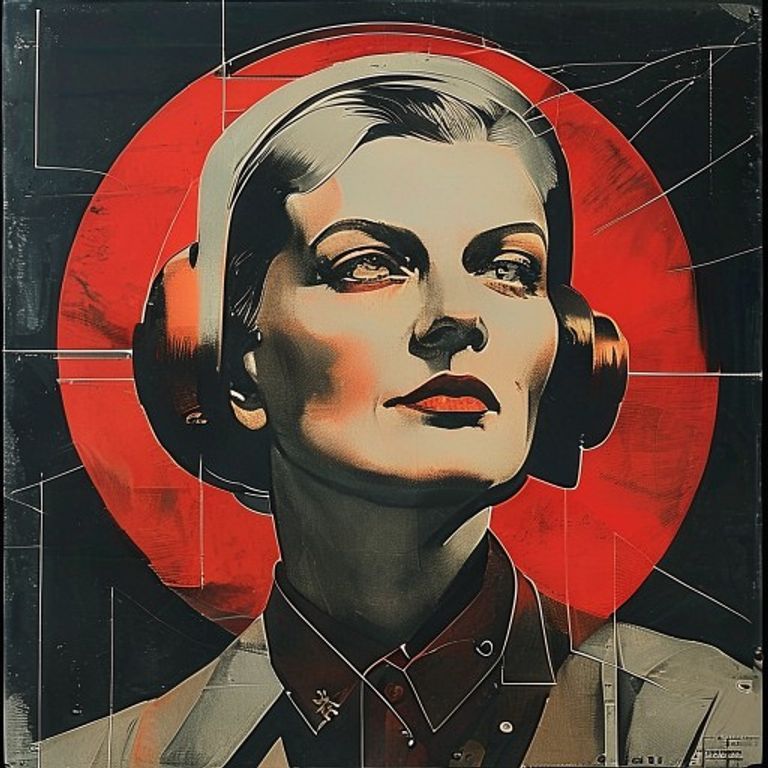
The prompt
Render this image as a 1925 to 1930 Soviet Constructivist film poster in the visual register of Vladimir and Georgii Stenberg, executed in cut paper and gouache with mechanical precision. Restrict the palette to dense black, paper white, blood red, and one accent of ochre or industrial blue, with no half tones and no gradient softness. Compose around forceful diagonal axes, circular geometric framing devices, and abrupt scale ruptures, as if the design were assembled from architectural blueprints and propaganda offcuts. Render the subject in flat poster planes with hard photomechanical edges, a slight halftone screen visible only inside the darkest red zones, and a faint registration misalignment at the color boundaries to suggest hand-pulled lithography. The atmosphere is collective, mechanized, kinetic, recruiting the eye into forward motion rather than contemplation. Strictly no on-canvas text, no title lettering, no legible type, no studio marks, no watermark. Preserve the subject, pose, and composition of the source image exactly, change only the medium and rendering. Aspect ratio matches source.
What it is doing
The Stenberg Brothers were not designing posters, they were engineering a population. Constructivism dressed agitprop in the language of pure form so the viewer would mistake mobilization for modernity. Every diagonal axis is a vector pointing the citizen toward the theater, then toward the factory, then toward the front. The flat planes and severed palette strip away the bourgeois illusion of depth precisely because depth invites private contemplation, and private contemplation is the enemy of the collective. When this register is borrowed by Western designers a century later, the agitprop chassis remains intact and is simply pointed at the new product, which is the design itself.
Ways to change it
Pick any of these in the gallery and the choice is added to the prompt you copy.
- Diagonal force: forceful diagonal axes recruiting the eye into forward motion vs a circular geometric framing device vs an abrupt scale rupture
- Palette: dense black, paper white and blood red vs the same with one ochre accent vs the same with one industrial-blue accent
- Plane treatment: flat poster planes with hard photomechanical edges vs a slight halftone inside the darkest red vs cut-paper gouache flatness
- Litho artifact: a faint registration misalignment at the color boundaries vs a crisp hand-pulled pull vs a heavy offset dot-screen
- Tempo: collective, mechanized, kinetic forward-pull vs static and monumental vs a vertiginous montage collision
Style lineage
Learn the visual culture this draws from: MoMA.
Related prompts
See all 34 prompts in the Movie-Poster grammar