Movie-Poster / Style prompt
Saul Bass Midcentury Cutpaper Graphic
The design grammar of Vertigo, Anatomy of a Murder, The Man With the Golden Arm. Reduce the subject to one shape, one color shift, one wound in the page.
Customize this prompt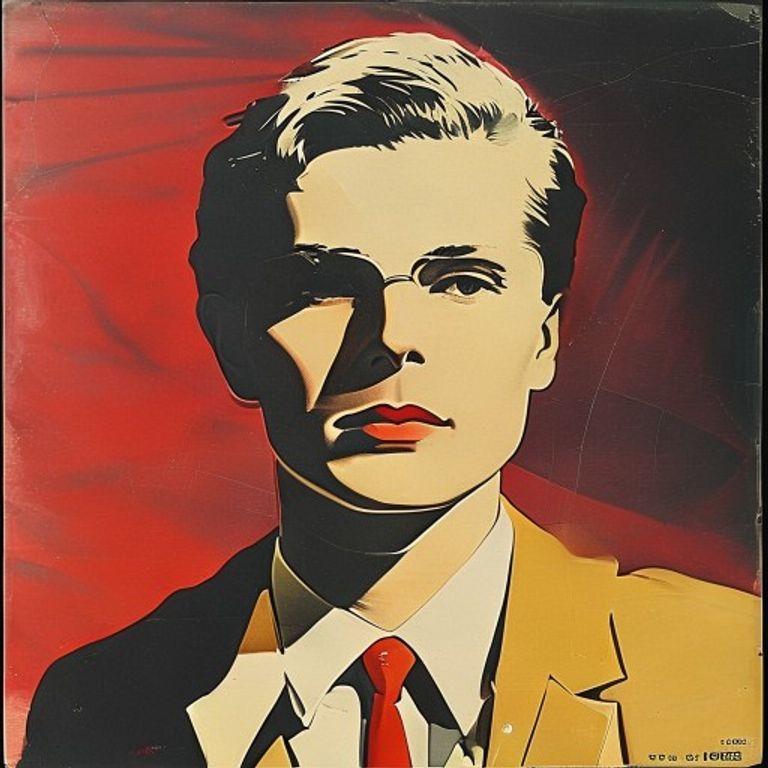
The prompt
Re-render this image in the visual register of Saul Bass midcentury film-poster graphic design (late 1950s through mid 1960s, Anatomy of a Murder, The Man With the Golden Arm, Vertigo, Bonjour Tristesse era). Treat the source as a cut-paper collage on flat colored ground. Reduce the subject to its silhouette and one or two interior planes, no rendering of texture, no shading, no gradients. Flat opaque color fields with hand-cut paper edges, slightly irregular, scissor-cut not laser-cut, the human hand visible at every contour. Limited palette: choose three colors maximum from a midcentury graphic register (cadmium red, deep mustard ochre, ivory black, cream paper-white, or a single saturated emerald or cobalt against warm off-white). One color dominates the field, one color carries the subject, one color punctuates a single critical element. Composition holds large negative space as active design, the subject does not fill the frame, the empty paper is part of the argument. Texture: subtle paper grain visible in the flat fields, slight off-register printing as a single ink pass, no halftone, no photographic detail. Mood: psychological tension reduced to geometry, the subject as symptom rather than person, the poster as the smallest unit of recruitment. Strictly no on-canvas text, no title cards, no legible lettering, no signature, no studio marks, no watermark. Preserve the subject, pose, and composition of the source image exactly, change only the medium and rendering. Aspect ratio matches source.
What it is doing
Bernays understood that a public is recruited by a single image it cannot un-see. Bass collapsed entire films into one shape, one color, one wound, then trusted the audience to do the work of meaning. The poster is the smallest unit of influence; if your symbol survives at thumbnail scale on a passing bus, the film is already inside the viewer before the projector turns on.
Ways to change it
Pick any of these in the gallery and the choice is added to the prompt you copy.
- Era dial: 1955 early angular vs 1960 mature curvilinear vs 1962 late minimalist
- Palette dial: red-black-cream Anatomy register vs ochre-black Golden Arm register vs cobalt-cream Vertigo register
- Negative space dial: 50% empty vs 70% empty vs subject almost-vanished at 85% empty
- Edge dial: crisp scissor cut vs slightly torn paper edge vs clean knife cut
- Texture dial: flat ink vs subtle paper grain vs visible off-register second pass
Style lineage
Learn the visual culture this draws from: IndieWire.
Related prompts
See all 34 prompts in the Movie-Poster grammar
Read the full free book. All thirty-six chapters and the companion 657-prompt image library are free.