Movie-Poster / Style prompt
Noir 1940s High-Contrast Venetian Blind Shadow
Postwar American noir poster register (1945-1952, Double Indemnity, Out of the Past, The Big Sleep). German Expressionist lighting on a Hollywood B-movie budget.
Customize this prompt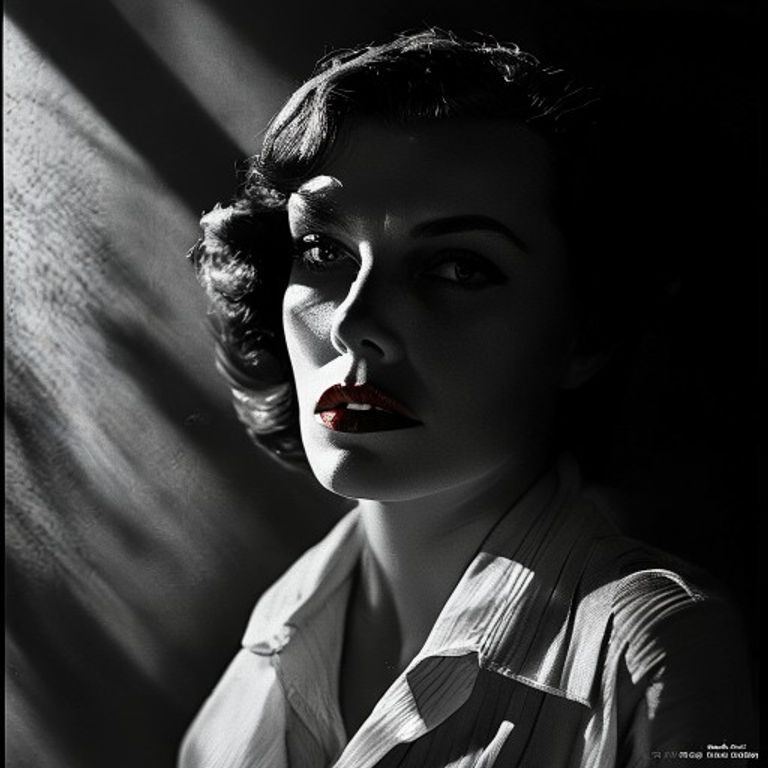
The prompt
Re-render this image in the visual register of late-1940s American film-noir movie-poster art and the source-film cinematography it descended from (Double Indemnity, Out of the Past, The Big Sleep, Detour, Murder My Sweet, roughly 1945 through 1952). High-contrast chiaroscuro: deep blacks dominate two-thirds or more of the frame, with light carved into the composition as hard slashing diagonals. Venetian-blind shadow patterns striping across the subject and the background wall, the geometry of light doing the work of expensive sets. Palette restricted: ivory black, paper cream, hot specular white, and one warm muted accent (cigarette ember, blood-red, brass-yellow, faded teal). No full color photographic register, this reads as duotone or hand-tinted black-and-white. Composition asymmetric and unstable: low or high camera angle, subject pushed to one side, dominant negative space filled with shadow rather than emptiness, hard diagonal sight lines, off-balance horizons. Surface: lithographic poster grain, slight registration drift between black plate and accent color, paper texture visible in the cream highlights, the print quality of a 1948 one-sheet. Mood: existential dread, postwar disillusionment, moral ambiguity rendered as lighting choice. Strictly no on-canvas text, no taglines, no title typography, no studio marks, no legible lettering, no watermark. Preserve the subject, pose, and composition of the source image exactly, change only the medium and rendering. Aspect ratio matches source.
What it is doing
The B-noir studios could not afford the lavish sets MGM built, so they substituted shadow for production design. A single sodium lamp through a venetian blind cost a few dollars and built more atmosphere than a million-dollar backlot. Skorzeny would recognize the asymmetric trade. Lighting is the cheapest weapon in the kit, and noir weaponized it. The shadow is the budget the producers refused to spend.
Ways to change it
Pick any of these in the gallery and the choice is added to the prompt you copy.
- Era dial: softer gray tones, gentle studio key light, restrained shadows, more cream vs hard venetian-blind slashes, blacks filling two-thirds of frame, one ember accent (signature) vs extreme tilted angle, wide-lens distortion, crushed blacks, rain-slick neon reflections
- Lighting dial: single source from upper left vs dual rim with deep central shadow vs silhouette against bright field
- Accent dial: cigarette ember warm vs blood-red wound vs brass-yellow streetlamp vs faded teal night-window
- Shadow pattern dial: venetian blind horizontal vs staircase banister cast vs window cross-frame
- Crowding dial: single figure isolated vs figure with shadow doubled on wall vs two figures with one in deep shadow
Style lineage
Learn the visual culture this draws from: Filmmakers Academy.
Related prompts
See all 34 prompts in the Movie-Poster grammar