Guerilla / Style prompt
Tamil Tiger Jungle Cadre
1983 to 2009 LTTE register: Vanni and Jaffna peninsula jungle-cadre documentary aesthetic, Tamil Eelam parallel-state apparatus, distinctive tiger-stripe camouflage and cyanide-capsule cadre discipline.
Customize this prompt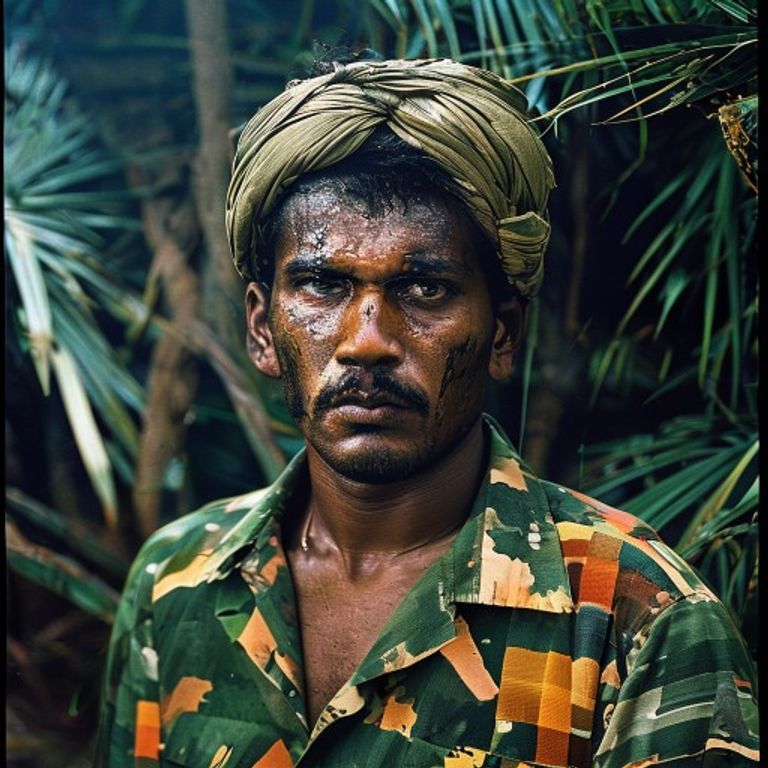
The prompt
Re-render this image in the visual register of 1983 through 2009 Liberation Tigers of Tamil Eelam (LTTE) documentary and combat photography (the body of in-house cadre-photography and foreign-press work depicting the Tamil Tiger formations operating across the Northern and Eastern provinces of Sri Lanka, particularly the Vanni jungle interior and the Jaffna peninsula, during a 26-year armed campaign that constructed a functional parallel-state apparatus complete with police force, judiciary, taxation, currency, and standing army before being militarily defeated in May 2009). Late-1980s through 2000s mixed-format documentary photograph aesthetic, transitioning from 1980s color-slide and monochrome film through 1990s consumer color print to early-2000s early-digital photography, the period span itself producing a tonal-register evolution within the larger style. Palette dominated by tropical jungle and Indian Ocean coastal landscape: deep canopy green, mangrove black-green, palmyra ochre, ocean horizon teal, beach-sand cream, with cadre uniforms in characteristic LTTE tiger-stripe camouflage (rendered as broken horizontal bands of leaf-green, olive, and dark brown, distinct from US woodland or DPM patterns), red-and-yellow Eelam flag color implied without legible display. Subject and surface architecture: Vanni interior jungle (palmyra palm, mangrove swamp, low-canopy scrub forest, jungle-cleared cadre encampment with thatched roof), Jaffna peninsula coastal architecture (Hindu temple kovil silhouette, palmyra-leaf hut, lagoon edge), captured Sri Lankan army equipment, LTTE-manufactured weapons (the cadre having developed in-house artillery and improvised armored vehicles), women-cadre with distinctive long braided hair tucked under cap, ceremonial cyanide-capsule cord visible at the collar. Surface: period film-grain to early-digital noise depending on year, occasional motion blur from combat conditions, slight focus drift, sun-fade common. Light: harsh equatorial midday raking through jungle canopy (bright variant) or golden-hour coastal side-light long figure-shadows (golden variant) or low-light evening jungle-encampment lantern warmth (intimate variant) or monsoon overcast muted (atmospheric variant). Composition: cadre formations in disciplined ranks (the LTTE distinguished itself from other guerrilla movements by parade-ground formal discipline), small jungle-patrol squads, ceremonial-portrait composition of single cadre with characteristic stare-into-middle-distance, women-cadre paired or in formation, occasional medium-range jungle-encampment scene with multiple cadres in mixed activity. Mood: total-cadre discipline, parallel-state seriousness, the cyanide-capsule denoting an absolute commitment level Skorzeny would have recognized from his commando training emphasis (the cadre that will not be captured cannot be interrogated, the operational security is the discipline). Strictly no on-canvas text, no Tamil or Sinhala lettering, no LTTE or Tiger letter-marks, no roaring-tiger emblem fully legible, no slogans, no signature, no village-sign legibility, no later commemorative dates, no watermark. Preserve the subject, pose, and composition of the source image exactly, change only the medium, register, and tonal treatment. Aspect ratio matches source.
What it is doing
The LTTE between 1983 and 2009 is the canonical case of total-cadre-discipline as state-substitute: a guerrilla formation that constructed an actual functioning parallel state (police, courts, banks, navy, ground forces, in-house artillery production) and held it for over two decades against a sovereign government before being militarily destroyed in 2009. The cyanide capsule worn at the collar is the discipline-mechanism Skorzeny would have built into a commando unit if he had been planning for a 25-year war rather than a single audacious raid. The aesthetic encodes this duality, the parade-ground formal-discipline composition adjacent to the jungle-encampment intimacy, the cadre is simultaneously soldier and citizen of a state that exists only because she is willing to die for it.
Ways to change it
Pick any of these in the gallery and the choice is added to the prompt you copy.
- Region dial: Vanni interior deep jungle vs Jaffna peninsula coastal vs Eastern province lagoon-edge vs Mullaitivu final-redoubt 2009
- Era look: grainy 1980s monochrome film, small bands in civilian sarongs with mixed rifles vs 1990s consumer color print, uniformed tiger-stripe cadres in disciplined jungle formation vs early-digital 2000s snapshots, ceasefire checkpoints and political offices in bright sun vs harsh early-digital frames, drifting smoke, shattered palmyra groves, exhausted cadres on sand
- Composition dial: disciplined formation ranks vs lone cadre ceremonial portrait vs small jungle patrol squad vs women cadre paired or formation vs mixed jungle encampment scene
- Light dial: harsh equatorial midday jungle-canopy raking vs golden hour coastal side-light vs evening jungle lantern intimate vs monsoon overcast muted
- Era dial: 1980s color-slide period vs 1990s consumer color print vs early-2000s early-digital vs mixed-period composite
Style lineage
Learn the visual culture this draws from: Liberation Tigers of Tamil Eelam (LTTE).
Related prompts
See all 33 prompts in the Guerilla grammar