Guerilla / Style prompt
Afghan Mujahideen Mountain 1980s
1979 to 1989 Afghan mujahideen register: Panjshir Valley and Hindu Kush mountain-cadre documentary photography, Massoud-era Northern Alliance precursor, the Soviet-Afghan war decade.
Customize this prompt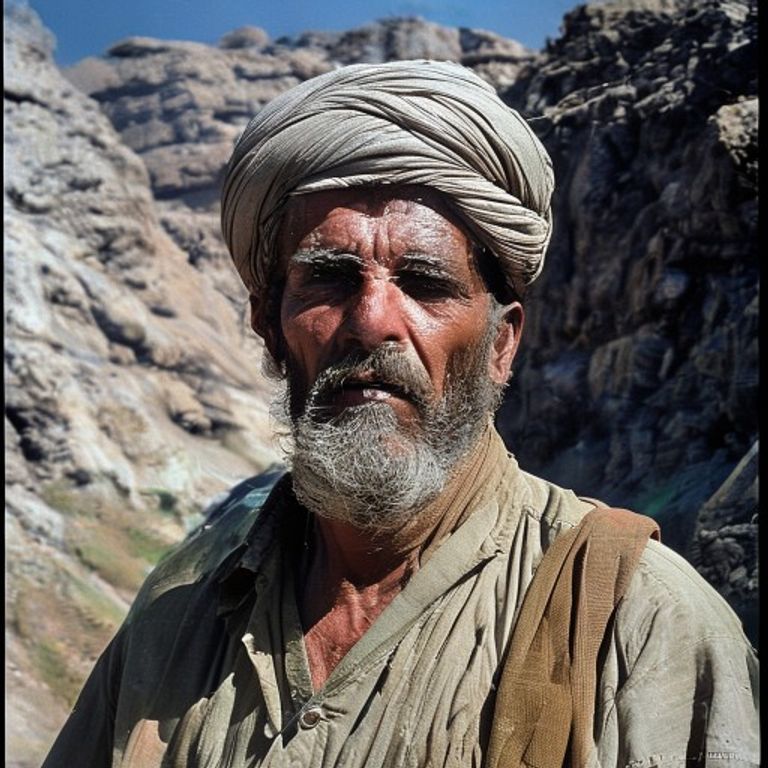
The prompt
Re-render this image in the visual register of 1979 through 1989 Afghan mujahideen documentary photography (the body of photojournalism produced by foreign correspondents and Afghan photographers embedded with mujahideen formations during the Soviet-Afghan war, including the Jamiat-e Islami Panjshir Valley cadres under Ahmad Shah Massoud, Hezb-e Islami formations under an Afghan political and military leader, and the various ethnically and ideologically distinct fronts operating across the Hindu Kush, the eastern border ranges, and the Pashtun south). Late-1970s and 1980s 35mm color-slide field documentary photograph aesthetic, Kodachrome and Ektachrome color register with characteristic period color palette (warm earth tones, faded sky blues, dusty greens, the specific magenta-shifted shadows of Kodachrome 64). Palette dominated by Afghan-landscape earth tones: stone gray, dust ochre, mountain-sky pale cerulean, deep shadow blue-black, with accents of fighter dress (pakol cap brown or gray wool, shalwar kameez off-white or tan, patu wool blanket-cloak gray or brown), occasional captured-Soviet-uniform olive green or arterial-red of a sash. Subject and surface architecture: Hindu Kush and Panjshir mountain landscape (sheer rock-face, terraced agricultural valley, mud-brick village clinging to mountainside, Soviet armor wreckage scattered along valley roads, mountain-pass switchback trail), mujahideen figures in characteristic dress (pakol cap, shalwar kameez, patu blanket, bandolier, beard length signaling formation affiliation), weapons mix (Lee-Enfield rifles from interwar British-Indian stocks, AK-47 and AKM captured from Soviet supply, RPG-7 rocket launcher, US-supplied FIM-92 Stinger surface-to-air missile launcher in late-1980s photographs as recognized iconic element). Surface: Kodachrome film grain, occasional slide-mount scratch or projection-burn at corner, sun-fade on long-exposed slides, slight magenta shift in deep shadow. Light: harsh high-altitude sun raking across rock and dust (bright variant) or golden-hour mountain side-light casting long figure-shadows (golden variant) or low-light cave-or-village-interior tungsten-lamp warmth (intimate variant) or overcast mountain weather muted (atmospheric variant). Composition: small-cadre groups of three to fifteen figures dwarfed by Hindu Kush landscape, occasional medium-range portrait of single fighter with pakol and rifle, Stinger-launch composition with figure shouldering the tube against sky (late-1980s iconic), 1980s staff-meeting composition with multiple commanders in dialogue. Mood: mountain-cadre confidence backed by external supply chain, the asymmetric force-multiplier of CIA-Saudi-Pakistani-ISI Operation Cyclone making the resistance materially viable in a way Vietnam-era guerrilla movements rarely achieved, the Hindu Kush as both base area and supply-route terminal. Strictly no on-canvas text, no Pashto or Dari lettering, no faction letter-marks (no Jamiat or Hezb or Hezb-e-Wahdat letter-marks), no slogans, no signature, no village-sign legibility, no later commemorative dates, no watermark. Preserve the subject, pose, and composition of the source image exactly, change only the medium, register, and tonal treatment. Aspect ratio matches source.
What it is doing
The 1979-89 Afghan mujahideen are the canonical case of external-supply-chain as asymmetric force-multiplier: Operation Cyclone funneled Saudi cash through Pakistani ISI to mountain cadres in quantities that made the resistance materially viable on a scale Wingate could only have dreamed of in Burma 1943. The Stinger missile in particular collapsed Soviet helicopter-mobility doctrine and forced the war's terminal phase. The aesthetic encodes this duality, the mujahid in his pakol and patu blanket holds a US-engineered surface-to-air missile that costs more than his village. The asymmetric mountain cadre and the deep-pocket external sponsor are simultaneously visible in the same frame.
Ways to change it
Pick any of these in the gallery and the choice is added to the prompt you copy.
- Region dial: Panjshir Valley Tajik cadres vs Hindu Kush central vs eastern border Khyber Pashtun vs southern Kandahar desert-edge
- War phase: early invasion, fighters with old bolt-action rifles, few heavy weapons, fresh rubble (signature) vs mid-war attrition, burned Soviet armor wrecks lining valley roads, worn gear vs late war, shoulder-fired missile launchers, mule supply caravans on mountain passes
- Composition dial: lone fighter pakol portrait vs small squad three to seven vs Stinger-launch shouldered against sky vs 1980s staff meeting multiple commanders vs mountain-pass column on switchback trail
- Light dial: harsh high-altitude midday raking vs golden hour mountain side-light vs cave-or-village interior tungsten warmth vs overcast Hindu Kush mountain weather
- Color dial: Kodachrome 64 magenta-shifted warm vs Ektachrome cooler greener vs monochrome black-and-white period vs desaturated faded-archival
Style lineage
Learn the visual culture this draws from: Britannica.
Related prompts
See all 33 prompts in the Guerilla grammar