Guerilla / Style prompt
Maquis Spanish Anti-Franco Mountain
1944 through 1965 Spanish maquis register: anti-Franco guerrilla mountain-cadre operating in the Pyrenees, Asturias, and central Iberian sierras after the 1939 defeat, documentary monochrome.
Customize this prompt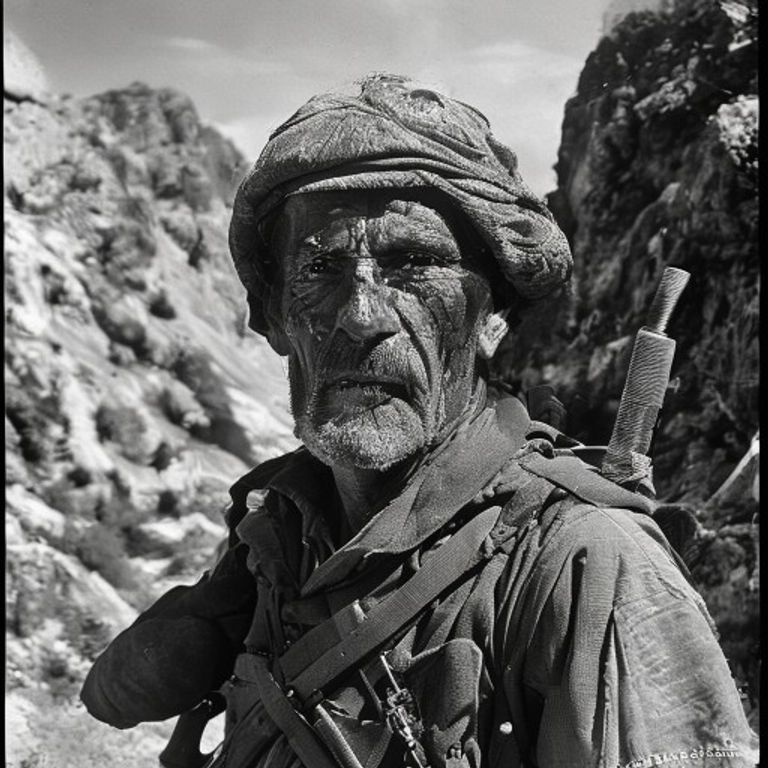
The prompt
Re-render this image in the visual register of 1944 through 1965 Spanish maquis (the anti-Franco rural guerrilla formations made up largely of Republican exiles returning across the Pyrenees after liberation of southern France, plus internal Communist Party of Spain PCE-aligned mountain cadres operating in the Cantabrian range, Galician hills, central Sierra de Cordoba, and Levante mountains, a campaign that bled out through the late 1950s into early 1960s). Mid-twentieth-century 35mm field documentary photograph aesthetic in monochrome panchromatic black and white, with secondary clandestine-press leaflet engraving register available as alternate treatment. Palette pure monochrome with high-contrast tonal range, deep Pyrenean shadow blacks and harsh midday-sun highlights, sun-bleached white shirts and dark wool-jacket mid-tones. Subject and surface architecture: Pyrenean and Cantabrian mountain landscape (pine forest, beech wood, limestone karst, abandoned shepherd cabins, mountain-village stone architecture), maquis figures in mixed civilian-military dress (worn wool jacket or peasant blouse, bandolier crossed over chest, rope-soled alpargatas or military boots, beret or pulled wool cap), captured German Mausers and French MAS-36 carbines from the cross-border supply chain, occasional Sten gun. Surface: 1940s and 1950s panchromatic film grain, occasional emulsion mottling from clandestine processing, slight motion blur, period-camera focus drift. Light: harsh Iberian summer sun raking across mountain rock (bright variant) or low-angle dawn or dusk casting long figure-shadows (golden variant) or muted overcast Cantabrian autumn (atmospheric variant) or campfire night clustered in pine forest clearing (intimate variant). Composition: small-cadre groups of three to seven figures dwarfed by mountain landscape, occasional medium-range portrait of a lone maqui carrying a rifle along a mountain trail, paired-figure compositions of maqui-and-village-contact handover. Mood: defeated-vanguard endurance, the 1939 loss carried into the mountains and prolonged for two decades, deep-penetration cadre logic surviving long after operational defeat, the maqui as living political time-bomb the regime cannot stop ticking. Strictly no on-canvas text, no Spanish or Catalan lettering, no PCE or CNT or UNE letter-marks, no Republican tricolor that is fully legible, no slogans, no signature, no village-sign legibility, no watermark. Preserve the subject, pose, and composition of the source image exactly, change only the medium, register, and tonal treatment. Aspect ratio matches source.
What it is doing
The Spanish maquis are the canonical case of a defeated-vanguard long-tail functioning as political time-bomb: a force that lost its war in 1939 prolonged armed resistance another two decades, in conditions of essentially zero realistic chance of overthrowing the regime, because the persistence itself was the political message. Wingate would have recognized the deep-penetration logic, small cadres operating far behind a permanently hardened front, the operational defeat irrelevant to the strategic signal. The aesthetic encodes endurance over hope, the photograph of a maqui in 1958 is the photograph of a man who has been wrong for twenty years and refuses to stop.
Ways to change it
Pick any of these in the gallery and the choice is added to the prompt you copy.
- Range dial: Pyrenean high mountain vs Cantabrian Asturias forested vs Galician rural hills vs Levante Levantine sierra vs Sierra de Cordoba central
- Campaign phase: 1944 return: large armed column crossing a snowy Pyrenean pass, fresh gear vs peak years: small band resting in beech wood, rifles stacked, bandoliers full vs attrition years: gaunt men in patched jackets hiding in a limestone cave vs last holdout: one bearded fighter with a worn rifle beside an abandoned cabin
- Cadre-composition dial: lone maqui mountain trail vs small squad three to seven vs maqui-and-village-contact handover paired vs interception encounter with civil guards implied
- Register dial: documentary panchromatic photograph vs period leaflet engraving illustration vs period-magazine photo-illustration mixed vs post-war reconstructed survivor-testimony portrait
- Light dial: harsh Iberian summer raking vs golden hour long shadows vs Cantabrian overcast muted vs pine-forest campfire night intimate
Style lineage
Learn the visual culture this draws from: Spanish Maquis (anti-Franco guerrillas 1939-1965).
Related prompts
See all 33 prompts in the Guerilla grammar