Guerilla / Style prompt
Greek ELAS Andartes Mountain
1941 to 1944 Greek Resistance ELAS andartes register: Pindus and Olympos mountain-cadre documentary photography, klepht-lineage bandoliers and shepherd-camp campfires.
Customize this prompt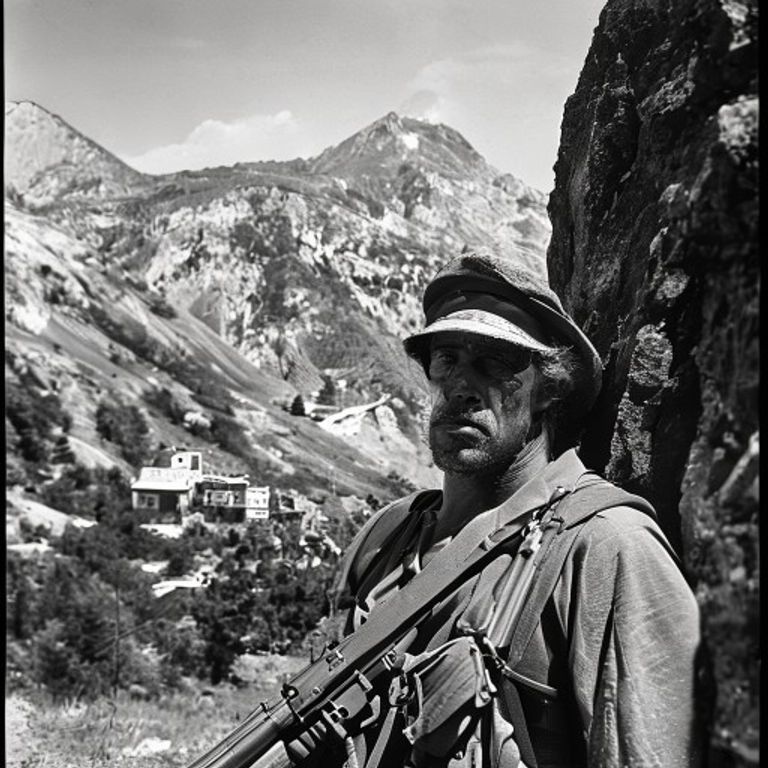
The prompt
Re-render this image in the visual register of 1941 through 1944 Greek Resistance (Ethniko Apeleftherotiko Metopo and its military wing Ellinikos Laikos Apeleftherotikos Stratos, EAM-ELAS) mountain-andartes documentary photography (the body of photographic and illustrated work depicting the andartes formations operating in the Pindus, Olympos, and Roumeli mountain ranges against Axis occupation, drawing visual lineage from nineteenth-century klepht-and-armatoloi tradition into wartime cadre photography). Mid-twentieth-century 35mm field-photography aesthetic in monochrome panchromatic black and white, with secondary stylized illustration register (period propaganda-leaflet woodcut) available as an alternate treatment. Palette pure monochrome with rich tonal range, deep mountain-shadow blacks and high-contrast Aegean-light highlights, the gray-scale skewing toward dramatic chiaroscuro from harsh southern Mediterranean light. Subject and surface architecture: Pindus mountain landscape (steep limestone karst, scrub-oak and juniper, mountain-village stone architecture in the middle distance), andartes figures in mixed klepht-and-modern dress (bandolier crossed over chest, fustanella kilt in older cadres replaced by military trousers in younger, mountain-village waistcoat, kalpaki cap or sheepskin hat), Mannlicher carbines and captured Italian Carcanos slung at the shoulder. Surface: 1940s film grain, occasional emulsion mottling from field development, slight focus drift from cold-handled cameras, sun-fade on high-key passages. Light: harsh Aegean midday sun raking across mountain rock (bright variant) or low-angle dawn or dusk casting long figure-shadows down the mountain slope (golden variant) or campfire firelight at night with figures clustered in close ring (intimate variant). Composition: figures often shown in small groups against monumental mountain landscape (the mountain as scale-reference and as base-area), occasional medium-range portrait of single andarte with rifle and characteristic moustache, ELAS armband or hammer-and-sickle insignia rendered as a flat band without legible detail. Mood: klepht-lineage mountain-cadre confidence, political-formation furnace where the resistance became a parallel-state apparatus, the andartes as both military formation and political seminar. Strictly no on-canvas text, no Greek lettering, no ELAS or EAM letter-marks, no hammer-and-sickle that is fully legible, no slogans, no signature, no village-sign legibility, no watermark. Preserve the subject, pose, and composition of the source image exactly, change only the medium, register, and tonal treatment. Aspect ratio matches source.
What it is doing
ELAS in the Pindus mountains between 1942 and 1944 was a political-formation furnace as much as a military formation: the andarte cadres descended the mountain in 1944 as a parallel-state apparatus the British were unable to absorb, which is why the Greek Civil War followed. Collins would recognize the flying-column pattern (mobile mountain cadres hitting Axis garrison towns at dawn) and the deeper logic: the mountain camp is a seminar room as well as a barracks, the andarte returns to the plain as both fighter and political worker. The visual register encodes this duality, klepht-bandolier over a political-cadre face.
Ways to change it
Pick any of these in the gallery and the choice is added to the prompt you copy.
- Range dial: Pindus high-mountain karst vs Olympos pine-forested slope vs Roumeli central-Greek scrub vs Cretan mountain village
- Light dial: harsh Aegean midday raking vs golden hour figure-shadows long vs campfire night intimate ring vs overcast mountain mist atmospheric
- Cadre-composition dial: lone andarte portrait vs small squad five to seven figures vs village-andarte alliance mixed civilian vs formation marching column on mountain trail
- Register dial: documentary panchromatic photograph vs period leaflet woodcut illustration vs mixed photo with woodcut composite vs hand-tinted period portrait
- Dress dial: older klepht traditional fustanella vs younger mixed-modern trousers vs captured-Italian uniform repurposed vs civilian shepherd dress with bandolier
Style lineage
Learn the visual culture this draws from: Britannica.
Related prompts
See all 33 prompts in the Guerilla grammar