Graffiti-Mural / Style prompt
Brazilian Pixacao Cryptic Vertical Tag
Sao Paulo pixacao register: roller-and-house-paint vertical glyph-runes climbing impossible building facades, cryptic alphabet bridging runic and gothic blackletter ancestry.
Customize this prompt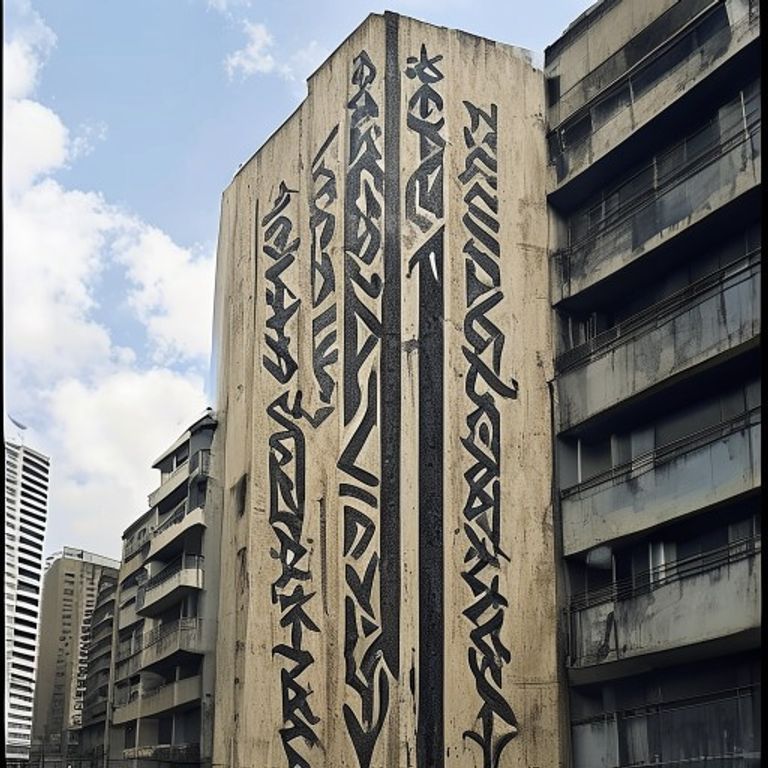
The prompt
Re-render this image in the visual register of Sao Paulo pixacao (the body of cryptic-glyph wall and facade tagging that developed in Sao Paulo and Belo Horizonte from the 1980s onward, distinct from latino-american graffiti tradition, characterized by tall narrow angular glyph forms with Norse-runic and gothic-blackletter ancestry, climbed onto impossible vertical surfaces by tag crews competing for height and danger). House-paint and roller-pole aesthetic on concrete and painted-render building facade. Palette severely restricted: matte black house-paint on cream or off-white painted-concrete facade, occasional white tag over a dark surface, almost never any color beyond this binary, the binary itself reading as anti-decorative protest. Letter-form architecture: tall narrow vertical glyphs occupying a 1-to-4 or 1-to-5 height-to-width ratio per character, hard angular construction with NO curves, sharp 45 and 90 degree angles only, glyphs ancestrally derived from Norse runes, Greek lambdas, gothic blackletter, and concert-flyer heavy-metal lettering of the early 1980s. Surface: painted-concrete facade with vertical drip-streaks down from the tag-line, rain-wash erosion at the bottom of the wall, occasional building-feature (window frame, balcony rail, fire-escape) intersecting the tag without breaking its flow, the tagger having worked around the obstacle. Light: flat documentary daylight, shot from the street looking up at the facade, slight foreshortening from the upward angle, occasional vertigo of the climbing-height implicit in the photograph. Composition: the tag runs as a long horizontal banner across the facade at impossible height (rooftop edge, fifteenth-floor balcony, between two windows), or as a single full-height vertical glyph climbing the entire side of a building. Mood: cryptic, anti-tourist, anti-decorative, signature claimed by physical risk rather than artistic display, the glyph reading as protest against the city's polished facade. Strictly no on-canvas legible text in any language, no readable letters or words, the glyphs functionally illegible to anyone outside the pixacao community, no signature, no watermark, no advertising panels visible. Preserve the subject, pose, and composition of the source image exactly, change only the medium, surface, and glyph treatment. Aspect ratio matches source.
What it is doing
Pixacao is the purest deep-penetration signature in contemporary urban culture, Wingate would understand it instantly. The point is not the glyph, the point is reaching the glyph's location: the fifteenth-floor balcony, the impossible rooftop, the bridge underside no tourist will ever see. The cryptic illegibility filters audience by initiation, only the pixadores can read each other, the rest of the city sees ornament and feels threat. The aesthetic is the cover-story for the operational achievement of having climbed there at all.
Ways to change it
Pick any of these in the gallery and the choice is added to the prompt you copy.
- Height dial: street-level ground floor vs second-story balcony vs mid-rise sixth floor vs high-rise fifteenth floor vs rooftop crown impossible
- Coverage dial: single vertical full-height glyph vs horizontal banner across facade vs crew-tag clustered at one window vs whole-wall field of glyphs
- Surface dial: painted-concrete facade cream vs raw concrete brutalist gray vs tiled exterior vs painted-render bleached
- Density dial: single isolated tag vs paired tags two crews vs crowded multi-crew palimpsest vs single fresh tag over half-buffed older tags
- Light dial: flat midday upward angle vs low-angle golden hour casting glyph-shadow vs overcast flat documentary vs night with sodium-light spill
Related prompts
See all 15 prompts in the Graffiti-Mural grammar