Graffiti-Mural / Style prompt
NYC Subway Wildstyle 80s Bombing
Late-1970s through mid-1980s New York subway-car bombing register: full-car burner aesthetic from Dondi and the wildstyle era before the buff cycle ended the medium.
Customize this prompt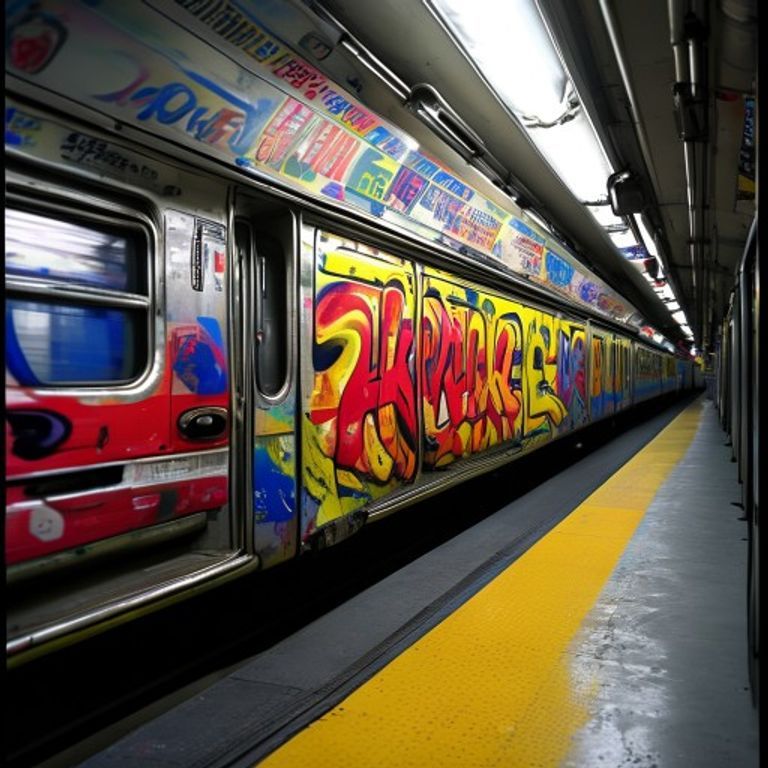
The prompt
Re-render this image in the visual register of late 1970s through mid 1980s New York City subway-car bombing (the body of full-car and whole-car burners painted on IRT and BMT rolling stock between roughly 1977 and 1985, the period documented in archival side-on subway graffiti photographs and the film Style Wars). Aerosol on steel and primer aesthetic, Krylon and Rustoleum era color set, hard arrow-laden interlocking letter architecture even where no letters are legible (the visual grammar of wildstyle remains: 3D drop shadow, force-field outline, arrow extensions, star accents). Palette saturated playground color, the Krylon stock list of the period: cherry red, sunburst yellow, regal blue, leaf green, hot pink, and chrome silver fill, every fill outlined in black with a second offset color force-field. Surface: dirty steel subway-car panel, factory primer beige underneath, prior tags partially buffed and bleeding through, sliding-door rubber gasket visible at edges, riveted seams, occasional rust freckles around the bolts. Rendering: confident aerosol line, fat cap fills with slight cloud at the edge, can drips controlled and intentional, characters (if any) painted in the bubble-character style of the era. Light: flat fluorescent yard light or yellow tungsten platform light, low contrast, the car photographed from a platform across the track, slight motion blur if the train is rolling. Composition: the subject occupies a single car panel or runs across multiple panels with the door breaks treated as compositional features not problems. Mood: territorial confidence, signature without legible name, the network-publication of a teenager who has just gone city-wide. Strictly no on-canvas legible text, no readable tag names, no Dondi lettering or other named graffiti-writer lettering, no station signs, no MTA marks, no advertising panels, no watermark. Preserve the subject, pose, and composition of the source image exactly, change only the medium, surface, and rendering. Aspect ratio matches source.
What it is doing
The 1977 to 1985 subway bombing era was the first network-publication medium in popular culture: a kid in the Bronx painted a car at midnight and by morning his name had traveled through every borough above ground. Collins would recognize the flying-column logic, small mobile teams, deep yard penetration, hit and disappear, the network amplifies the message at zero marginal cost. The aesthetic was the cover-fire, the throw-up was the dispatch.
Ways to change it
Pick any of these in the gallery and the choice is added to the prompt you copy.
- Coverage dial: tag vs throw-up vs top-to-bottom panel vs whole-car burner vs whole-train
- Style dial: bubble simple vs mechanical-letter vs wildstyle interlocking vs softie character-heavy
- Yard dial: Ghost Yard Bronx night vs Coney Island layup vs 159th street yard vs platform across the track daytime
- Wear dial: fresh fat-cap clean vs buffed and re-tagged over vs weathered six months vs MTA acid-buff ghost
- Era dial: 1977 early: simple bubble letters, few colors, thin outlines, heavy tag clutter vs 1980 peak: dense interlocking wildstyle, arrows, 3D drop shadow, rainbow fills vs 1983 Style Wars: whole-car burner, cartoon characters, chrome fills, sky backgrounds (signature) vs 1985 late: half-buffed faded pieces, chemical wash streaks, sparse tags over grime
Style lineage
Learn the visual culture this draws from: New York City subway graffiti movement (1977-1989 peak).
Related prompts
See all 15 prompts in the Graffiti-Mural grammar