Fine-Art / Style prompt
Matisse Cutout Color Field (Style-Only, Image-Conditioned)
Style register: Henri Matisse late period (1950s onward), the subject rendered entirely as flat gouache-painted paper cutouts in pure color fields, the grammar of scissors and joy over oil and centuries.
Customize this prompt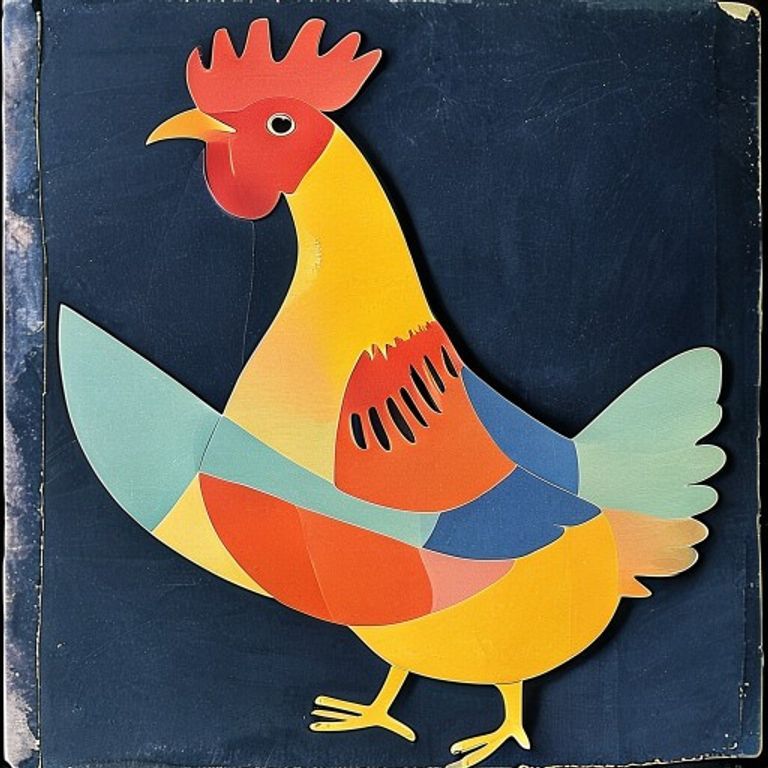
The prompt
Re-render this image as a Henri Matisse colored-paper cutout from the Jazz or Creoles series, circa 1950 to 1954. The entire composition executed as flat shapes cut directly from pre-painted gouache paper in pure, singing colors: cadmium yellow, ultramarine blue, alizarin red, cadmium orange, viridian green, ivory black used sparingly, white reserved for breathing room and accidental edge-reversal. No modeling, no internal line, no shadow, no perspective, pure silhouette cutouts arranged in a shallow stacked composition. Edges clean and decisive where the scissors cut, the line a primary compositional element itself, not a boundary. Colors chosen for optical vibration against their neighbors, complementary pairs creating a visual hum. Overall composition rhythmic and musical, with occasional gaps of white ground breathing between shapes, allowing the viewer eye to rest. The subject simplified into its essential form, recognizable but abstracted toward pure shape. Aspect: joyful, declarative, the energy of reducing complexity to its irreducible visual core. No on-canvas text, no signature legible, no frame. Preserve the subject, pose, and composition of the source image exactly, change only the medium and rendering.
What it is doing
Matisse said he was "fishing" with scissors. At eighty years old, having painted through Fauves, Cubism, and decades of studio discipline, he discovered that the smallest gesture (a gesture that took his whole life to earn the right to make) could speak louder than a thousand brushstrokes. The cutouts are the apotheosis of color as primary material, not as decoration of form. The color IS the form. This is what joy looks like when it has nothing left to prove.
Ways to change it
Pick any of these in the gallery and the choice is added to the prompt you copy.
- Color saturation: singing pure chromatic color (signature) vs muted earth-tone palette vs monochromatic single-hue
- Shape complexity: biomorphic flowing curves (signature) vs geometric angular vs scattered organic blobs
- Composition density: sparse with breathing white ground (signature) vs tightly interlocking vs radiating from center
- Edge treatment: clean scissors line, no feather (signature) vs soft blur vs visible overlap shadow
- Scale of shapes: large dominant forms with smaller accents (signature) vs uniform medium size vs many tiny shapes
- Ground: white paper breathing (signature) vs solid colored field vs mixed ground tones
Style lineage
Learn the visual culture this draws from: French Fauvist/Modernist (1869–1954).
Related prompts
See all 20 prompts in the Fine-Art grammar