Fine-Art / Style prompt
Miró Surrealist Abstraction (Style-Only, Image-Conditioned)
Style register: Joan Miró 1920s-1950s, the subject dissolved into biomorphic forms, floating eyes, stuttering curves, and primary colors on white ground, the unconscious given a calendar and a color swatch.
Customize this prompt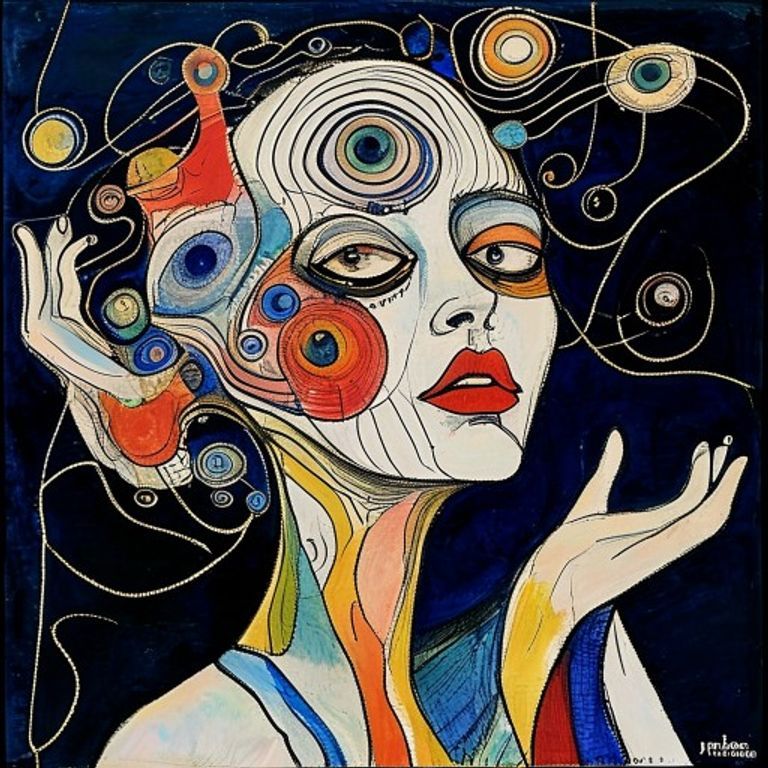
The prompt
Re-render this image as a Joan Miró surrealist abstraction from the 1930s to 1950s, in the visual register of "Harlequin's Carnival" and "Birth of the World." The subject abstracted into floating biomorphic forms, amoeboid curves, spirals, and occasional recognizable fragments (an eye, a breasted form, a reaching arm) rendered as pure outline or silhouette against a luminous white field. Color restricted to ultramarine blue, alizarin red, cadmium yellow, viridian green, sumi black, with occasional rust or ochre. Composition shallow and dreamy, forms floating without gravity, overlapping but never obscuring through deep shadow, all layers readable simultaneously. Lines hand-drawn in sumi ink or charcoal, broken and stuttering, with occasional doodle-like repetition. Whimsy as a legitimate compositional principle, nothing heavy, nothing that looks like work. The surface retains the gesture of making, pentimenti visible, the artist's hand audible. Aspect: nocturnal, fecund, slightly hallucinatory, the logic of dream over the logic of form. No on-canvas text, no legible language, no symbolic declaration. Preserve the subject, pose, and composition of the source image exactly, change only the medium and rendering.
What it is doing
Miró painted his libido onto the canvas with absolute permission. The biomorphic forms ARE bodies without the body's obligation to make sense. The eye floating between breasts and sky, the stuttering curve that might be a smile or a phallus or neither. Surrealism gets theorized as Freudian dreamwork, but Miró's achievement is simpler: he made the repressed visible and playful at the same time. The painting is not here to explain itself.
Ways to change it
Pick any of these in the gallery and the choice is added to the prompt you copy.
- Biomorphic complexity: elaborately writhing organic forms (signature) vs simple floating shapes vs geometric grid underlying
- Color deployment: four-color restricted palette (signature) vs fuller spectrum vs single dominant hue
- Line character: stuttering broken mark-making (signature) vs confident continuous line vs no line, pure shape
- Recognizable fragments: occasional figure parts (eye, breast) (signature) vs pure abstraction, no legible anatomy vs obvious characters
- Composition anchor: floating weightless (signature) vs ground implied below vs centered mandala
- Surface gesture: visible pentimenti and hand-marking (signature) vs smooth final surface vs heavily worked
Style lineage
Learn the visual culture this draws from: Spanish Surrealist (1893–1983).
Related prompts
See all 20 prompts in the Fine-Art grammar