Ex-Voto-Retablo-Devotional / Style prompt
Ethiopian Coptic Painted Icon
The Ethiopian icon: frontally gazing, big-eyed, the saint rendered with a clarity that says you are being seen. Flat planes, saturated color, the tradition of African sacred art.
Customize this prompt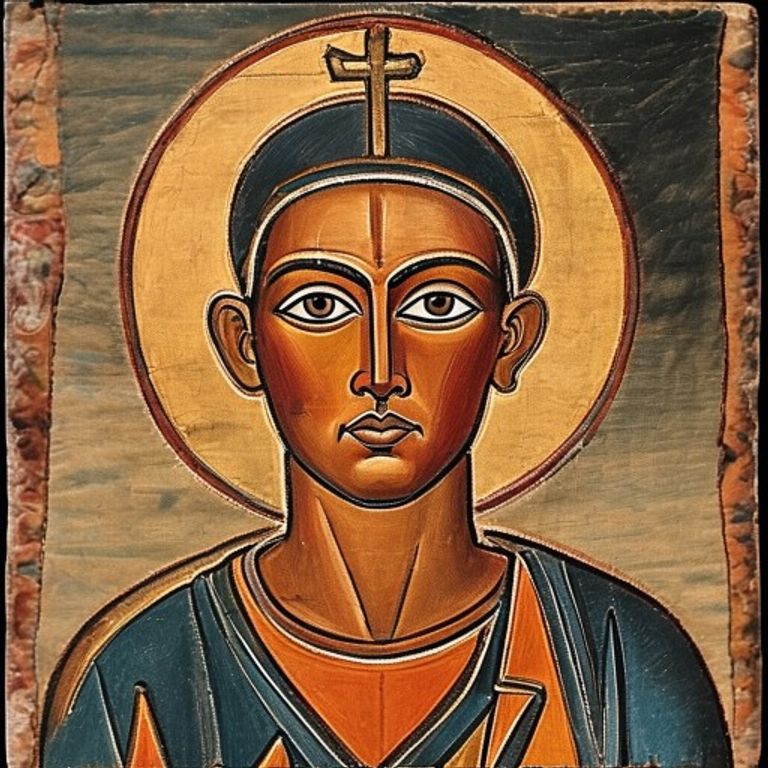
The prompt
Re-render this image as an Ethiopian or Coptic painted icon in the tradition of Aksumite and Ethiopian Orthodox Christianity (15th to 20th centuries). The figure rendered frontally on a painted cloth or hide ground, the composition showing a saint or sacred figure (or the Virgin and Child) centered in the frame, filling most of the compositional space. The face is rendered with emphatic proportions: eyes are very large and forward-gazing, the pupils rendered as dark heavy lines or simple round shapes, the expression direct and scrutinizing, as if the saint is looking at the viewer across an unbreakable boundary. The face is heart-shaped or elongated, the features rendered in firm linear definition. The halo is indicated by a thin dark line or a brightly colored outlined circle, often with a cross inscribed at the top (no legible text). The body is rendered in flat perspective, the clothing in saturated flat colors (deep reds, rich blues, ochres, oranges) with thin linear definition for the folds and fabric structure. The proportions are hieratic: the head is large relative to the body, the body narrow, the hands are small and expressive, the feet barely touch the ground. The background is a single flat color (often red, mustard, or cream) or a simple pattern (cross hatching, geometric motifs). If there are attendant figures (angels, saints, witnesses), they are rendered at smaller scale and positioned around the central figure. The paint surface is visible as hand-applied pigment on cloth or wood, the colors occasionally abraded or faded, the brushstrokes evident. The image conveyed urgency, directness, and an absolute refusal of softness. Aspect ratio square or portrait. Preserve the subject, pose, and composition of the source image exactly, change only the medium and rendering.
What it is doing
The Ethiopian icon does not invite; it stares. The eyes are huge and unblinking and they are looking at you with a clarity that says you cannot hide. This is the African sacred tradition, the refusal of the soft Italian pretty-saint, the insistence that the holy is not gentle, the holy is a direct gaze that will not look away. The proportions are not naturalistic because the body is less important than the eyes. The eyes do the work. The saints in the Ethiopian tradition are not available for veneration; they are accessible only through unflinching visual contact. This is the legacy of a Christianity that developed independently of Rome, that kept its own ways, that rendered the sacred in the visual language of the Aksumite kingdom and the Horn of Africa. The flat color and firm line are not primitive; they are direct. They are refusal of the illusion of depth. They are the assertion that the sacred is here, now, in front of you, and you are being watched.
Ways to change it
Pick any of these in the gallery and the choice is added to the prompt you copy.
- Eye-size dial: moderate large eyes, naturalistic scale vs very large forward-gazing eyes, dominating the face vs enormous eyes that fill the face proportionally
- Face-proportion dial: elongated narrow face vs heart-shaped face with wide cheekbones vs geometric stylized face with simplified features
- Color-palette dial: rich reds and deep blues with gold accents vs warm ochres and orange-reds vs cooler earth-tones with cream background
- Halo-treatment dial: simple thin line circle vs brightly colored outlined circle vs circle with cross at top and radiating detail
- Background-dial: single flat solid color vs geometric pattern or cross-hatching vs simple architectural notation or doorway
- Body-scale dial: head fills composition, body minimal vs figure fills composition, proportionally elongated vs head disproportionately large, body small
Related prompts
See all 7 prompts in the Ex-Voto-Retablo-Devotional grammar