Ex-Voto-Retablo-Devotional / Style prompt
Byzantine Gold-Ground Icon
The Eastern icon on gold leaf: the subject is real, the space is heaven, the light source is divine. Frontal, hieratic, the proportions obey theology, not vision.
Customize this prompt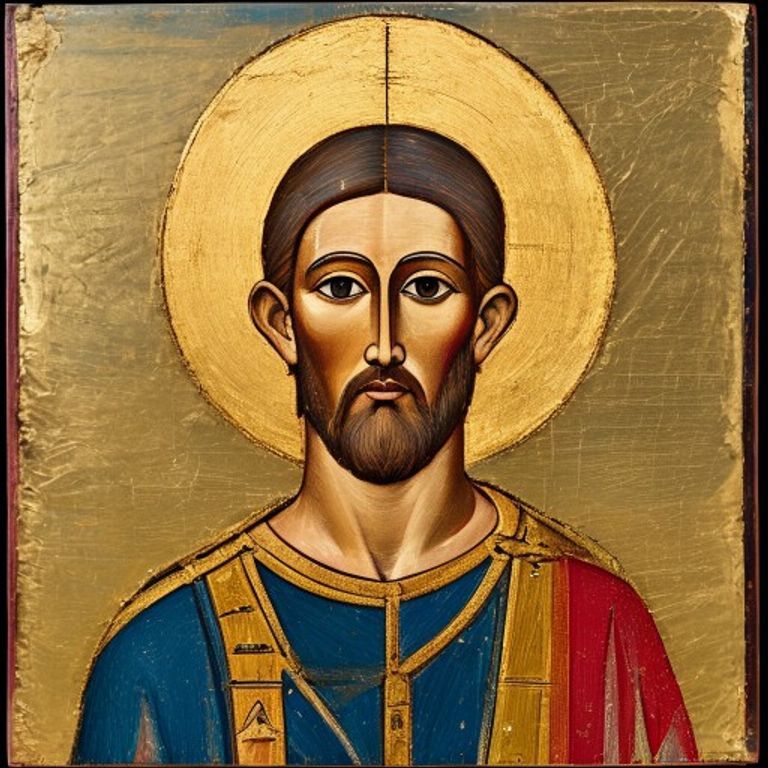
The prompt
Re-render this image as a Byzantine icon in the tradition of 6th to 15th century Eastern Christendom. The figure rendered frontally against a ground of pure gold leaf, the gold burnished to a high shine that reflects light and absorbs the viewer's gaze. The subject positioned centrally within the composition, the body rendered in strict hierarchical proportion (head and halo large, body narrow, feet small or barely touching the ground), the posture frontal and serene. The face rendered with the canonical Byzantine formula: eyes large and frontally gazing, nose rendered as a thin incised line, mouth small and closed, the expression conveying stillness rather than emotion. The halo is a thin incised or gold-leaf circle around the head, sometimes with a cross inscribed within it (no legible text). The clothing rendered in broad flat planes of color (deep blue, deep red, gold-thread highlights), the folds indicated by thin linear striations rather than volume, the fabric appearing to hang in geometric curves. If there are symbolic objects in the composition (a book, a staff, a lamb, a scroll), render them as flat color forms without perspective. The background is unvaried gold leaf except for a thin incised border-frame or minimal architectural notation (a thin line indicating a doorway or architectural niche). No narrative detail, no landscape recession, no atmospheric perspective. Surface finish: the bright, slightly irregular burnish of ancient gold leaf applied over gesso and pigment, showing minor losses and age-patina around the edges. The wood panel itself is visible as a thin dark frame. Aspect ratio variable but often square or portrait. Preserve the subject, pose, and composition of the source image exactly, change only the medium and rendering.
What it is doing
The Byzantine icon does not depict the subject; it presents the subject in the space of heaven. The gold leaf is not a background, it is the medium of divine light. The proportions are not realistic because the body in heaven does not follow the proportions of the body on earth. The frontal gaze is not a portrait convention; it is the subject looking directly at you across the boundary of the material world. The flat planes and geometric folds are not primitive perspective; they are the visual language of a theology that says the material world is less real than the spiritual one. The icon is not an image to be appreciated; it is a window. You do not stand before it; you stand in its presence. This is why icons were venerated in the early church and why some Christians still stand before them in silence.
Ways to change it
Pick any of these in the gallery and the choice is added to the prompt you copy.
- Gold-finish dial: bright high-burnish gold vs slightly muted gold with age patina vs gold with thin red bole underpainting visible
- Figure-scale dial: figure fills composition, minimal background vs figure centered in gold field with breathing space vs figure small and centered, gold dominates
- Proportional-style dial: strict hieratic proportions, head very large vs slightly more naturalistic proportions vs extreme flattened, hands and feet minimal
- Color-palette dial: deep blues and reds with gold highlights vs crimson and deep violet with gold vs muted earth-tones with gold accents
- Halo-treatment dial: simple thin circle vs circle with incised cross vs elaborate radiating rays or geometric pattern
- Border-frame dial: minimal wooden frame, dark wood vs ornate carved wood border with geometric pattern vs thin gold-leaf frame line
Style lineage
Learn the visual culture this draws from: National Galleries Scotland.
Related prompts
See all 7 prompts in the Ex-Voto-Retablo-Devotional grammar