Eastern European Wire Puppet Hybrid (Style-Only, Image-Conditioned)
Style register: Eastern European puppet theater in the orbit of Jiří Trnka, wood-and-cloth armatures brought into contact with expressive hand-worked clay.
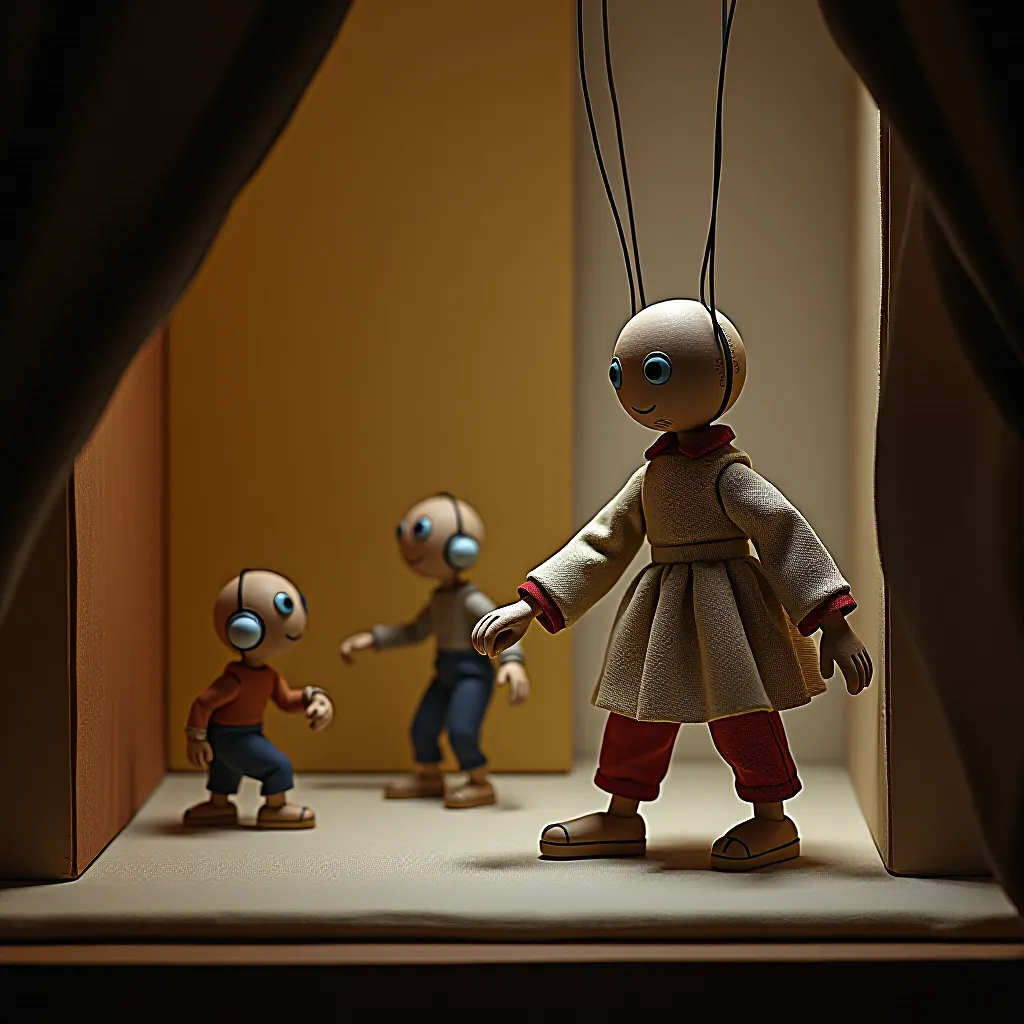
The prompt
Re-render this image as a photographed Eastern European puppet-clay stop-motion set, recalling the handcrafted theatrical sensibility of Jiří Trnka. Interpret each source form as a small articulated construction: carved wood for rigid planes, pinched modeling clay for expressive transitions, coarse cloth for flexible coverings, and discreet exposed wire at necessary joints. Preserve the existing pose so the construction appears engineered to hold exactly this one moment. Show little fastening stitches, paint rubbed thin at contact points, asymmetric thumb-shaped clay repairs, and one or two visibly bent armature ends where a limb meets its support. Do not add new figures or set pieces. Set the whole scene on a miniature stage with layered, slightly warped painted flats and a dusty felt floor. Use a muted palette of walnut brown, faded ultramarine, clay red, and parchment cream. A high warm spotlight picks out the puppet's face or focal object while a cool side lamp draws the delicate wire shadows onto the backdrop. Physical scale matters more than illusion: textured fiber, real wood grain, and clay smudges must survive at thumbnail size through bold areas, not tiny ornamental detail. Avoid flawless digital rigging and sterile 3D surfaces. Leave a calm, uncluttered band of negative space along the top or bottom edge where a title could sit. Strictly no on-canvas text, no legible lettering, no signature, no watermark, no logos. Preserve the subject, pose, and composition of the source image exactly, change only the medium and rendering. Aspect ratio matches source.
What it is doing
An exposed joint does not break the performance; it shows what the performance costs. Combining durable wood with repairable clay gives each gesture a visible mechanics. The image becomes more alive precisely because its supports are finite.
Tuning knobs
- Armature: `discreet exposed wire` (signature) vs `stitched cloth hinge` vs `small wooden peg`
- Clay share: `clay at expressive joins` (signature) vs `mostly clay shell` vs `clay repairs only`
- Stage: `warped painted flats` (signature) vs `black velvet void` vs `single paper backdrop`
- Light: `warm spot and cool side fill` (signature) vs `low footlights` vs `overhead workshop lamp`
Related prompts
See all 10 prompts in the Claymation grammar · Open in the gallery
Get the free sample. The intro plus the first three chapters of The Liberation Engine, delivered as a PDF. The full book and the complete 606-prompt method are the paid edition.