Cut Paper Clay Shadow Set (Style-Only, Image-Conditioned)
Style register: European mixed-media stop-motion theater, scissor-cut scenery beside sculpted clay volumes, with real shadows proving both occupy the same little stage.
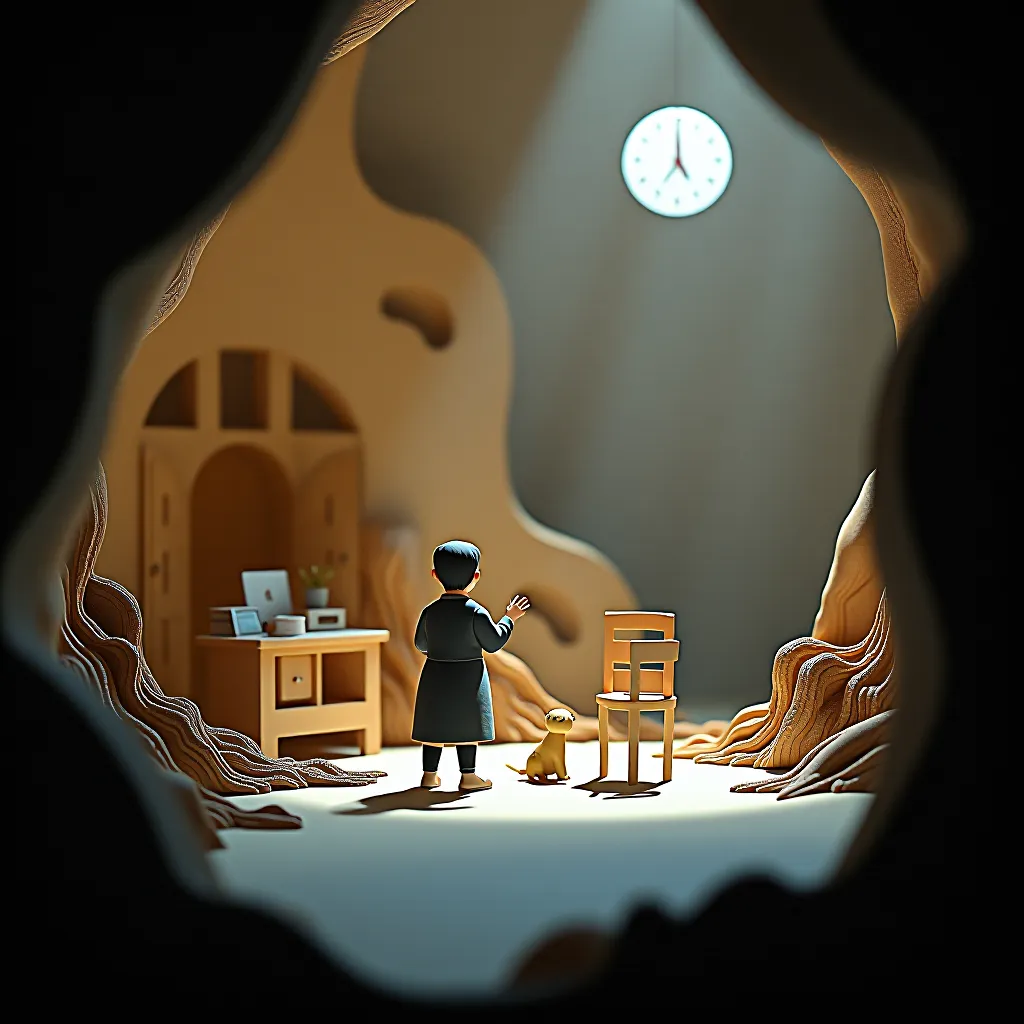
The prompt
Re-render this image as a handmade cut-paper and clay stop-motion set photographed from a fixed stage camera. Preserve the source silhouette, pose, and placement; translate its nearest solid volumes into hand-kneaded modeling clay and its flatter planes into colored paper cut by scissors. Make the division follow the existing depth of the scene rather than adding new objects. Paper edges should wobble, expose pale fibers, and lift slightly where paste fails to hold them down. The clay has visible thumb impressions, rolled-edge ridges, and small dents made by a blunt stick. Put the layers on a shallow plywood stage so one raking lamp creates unmistakable separate paper-edge shadows and rounded clay contact shadows. Use pumpkin orange, soot black, dusty teal, and ivory in simple broad masses; the paper stays matte while the clay catches a restrained waxy highlight. A backdrop of overlapping torn paper shapes gives depth without filling every gap. Keep the image as legible as a stage silhouette from across a room, with no floating digitally composited elements and no perfectly vector-sharp edges. Let a glimpse of the mounting tabs show where they belong within the original scene, but do not alter the scene's arrangement. Leave a calm, uncluttered band of negative space along the top or bottom edge where a title could sit. Strictly no on-canvas text, no legible lettering, no signature, no watermark, no logos. Preserve the subject, pose, and composition of the source image exactly, change only the medium and rendering. Aspect ratio matches source.
What it is doing
Depth becomes a decision you can see: one plane is allowed to stay flat, another must take on weight. The shadows reconcile the two instead of hiding their disagreement. Mixed materials can share a world without pretending to be identical.
Tuning knobs
- Layer balance: `flat paper behind clay volumes` (signature) vs `interleaved planes` vs `mostly paper with clay edges`
- Paper edge: `scissor wobble and fibers` (signature) vs `torn feathered edges` vs `creased folded edges`
- Shadow: `one raking lamp` (signature) vs `soft overhead bulb` vs `low footlight`
- Mount: `visible paste and tabs` (signature) vs `tiny pins` vs `folded paper feet`
Related prompts
See all 10 prompts in the Claymation grammar · Open in the gallery
Get the free sample. The intro plus the first three chapters of The Liberation Engine, delivered as a PDF. The full book and the complete 606-prompt method are the paid edition.