Classical-Statuary-Marble / Style prompt
Michelangelo Non-Finito, Figure Emerging From Stone
The unfinished Michelangelo, the figure emerging from the raw marble block, the body only partially liberated. The front is carved in detail, the back is still the original rough stone. This is not failure, this is the most honest statement about the cost of becoming.
Customize this prompt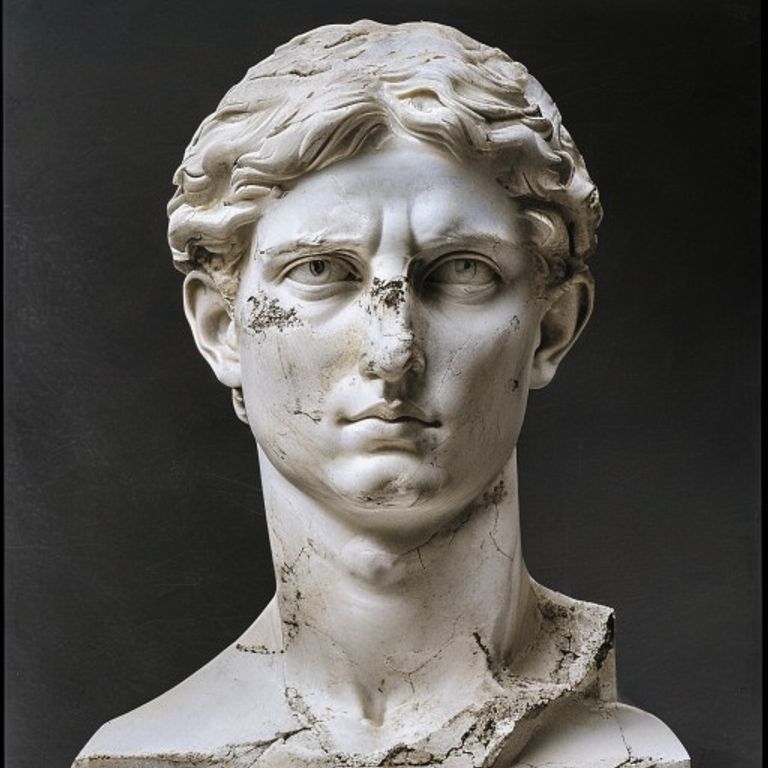
The prompt
Re-render this image as a Michelangelo-style non-finito marble sculpture, the form emerging from the unworked stone. The figure's front face is fully carved and idealized: the musculature is detailed and anatomically precise, the chest defined, the shoulders squared, the face idealized with classical proportions. The eyes are carved as deep ovals with a subtle pupils suggested, the expression intent and forward-looking. Moving backward from the frontal plane, the carving diminishes: the sides of the figure show rough chisel marks where the stone has been partially worked but not refined, the undercuts are blocked out but not smoothed, anatomical details fade as the figure merges with the raw stone. The back of the figure transitions into the unworked marble block: the stone is rough-faced from the original quarrying, pocked with claw marks from the pneumatic drill, the surface is irregular and blocky. The legs may be fully carved in the front and fade into rough stone at the sides and back. The overall effect is that the figure is being born from the stone or trapped within it, the degree of finish-work indicating the effort of emergence. The marble itself is white or pale Carrara, the raw block showing weathering and minor damage from transport. The lighting emphasizes the contrast: raking light across the rough unworked portions makes the texture visible, while directional lighting on the carved portions shows the anatomical detail. The entire composition shows the raw stone on the base and sides, making clear this is a block in the process of transformation, not a completed work. Aspect ratio 3:2 vertical. Preserve the subject, pose, and composition of the source image exactly, change only the medium and rendering.
What it is doing
The non-finito is Michelangelo's statement that becoming is always partial. The figure cannot be fully liberated from the stone because the act of liberation requires killing the stone that makes the figure. The front of the body is idealized and complete, the prisoner in the block of marble. As you move around the sculpture, the carving becomes rougher, the stone more present, until the back is still the raw block. This is not failure to finish, this is the argument that all emergence is incomplete, that the price of form is to remain tethered to the material that made you. The non-finito figures are not aspirations to completion, they are statements that completion is impossible. The figure is beautiful because it is trapped. Freedom would kill it.
Ways to change it
Pick any of these in the gallery and the choice is added to the prompt you copy.
- Finish-gradient dial: front fully detailed, back rough unworked stone (maximum non-finito contrast) vs front and sides detailed, back rough (partial finish) vs overall nearly-finished with select rough passages (approaching completion)
- Anatomical-detail dial: highly detailed musculature, every tendon indicated (Michelangelesque heroic anatomy) vs simplified geometric musculature (abstract reduction) vs softer idealized form without anatomical specificity (classical idealism)
- Raw-stone-character dial: rough chisel marks and claw marks from quarrying (raw quarry state) vs weathered rough surface with age patina (aged marble) vs blocky geometric unworked planes (architectural stone quality)
- Pose-orientation dial: figure turned slightly, showing the transition from carved to uncarved (maximum non-finito visibility) vs frontal pose with uncarved back vs contraposto pose suggesting dynamism (Mannerist refinement)
- Scale-suggestion dial: heroic scale, figure larger than life (Michelangelo grandeur) vs human scale, life-sized (accessible realism) vs fragment suggesting partial preservation (museum ruin quality)
- Base-treatment dial: raw unworked block visible beneath figure (complete non-finito context) vs rough stone plinth (simplified base) vs integrated base showing emergence (transition zone emphasized)
Style lineage
Learn the visual culture this draws from: Accademia.
Related prompts
See all 7 prompts in the Classical-Statuary-Marble grammar