Classical-Statuary-Marble / Style prompt
Carrara Marble Museum Bust on Plinth
The ideal portrait bust in white Carrara marble, the neoclassical form that turned European elites into immortals. Cut from the quarries of Tuscany, polished to optical translucence, mounted on a dark stone plinth with a formal inscription cartouche.
Customize this prompt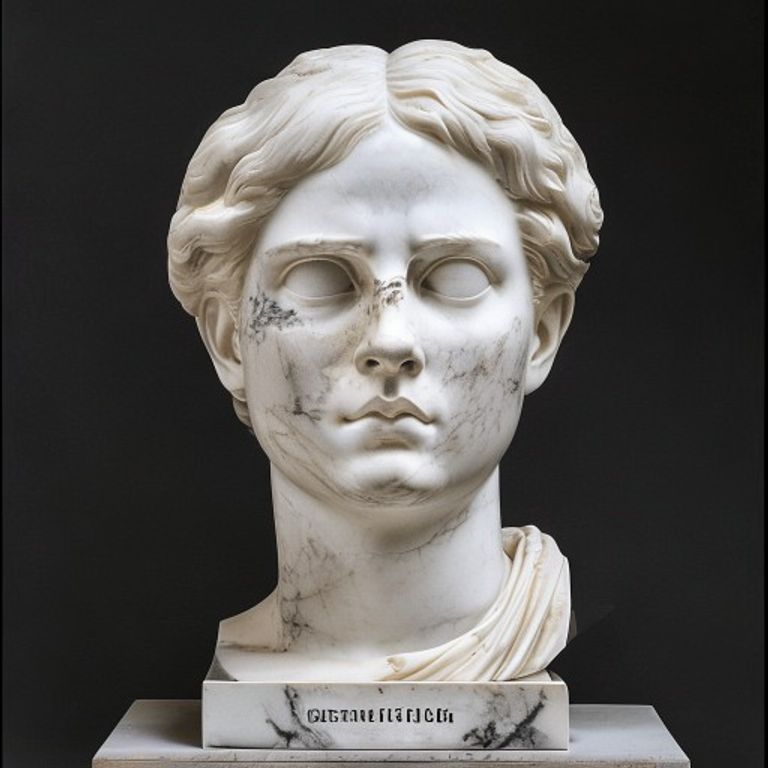
The prompt
Re-render this image as a neoclassical portrait bust carved from white Carrara marble, approximately 60 to 80cm tall. The marble surface shows the optical translucence characteristic of Carrara stone under museum lighting, with a subtle warm glow at the edges where light penetrates the stone. The portrait itself follows strict bilateral symmetry: the face rendered in high three-dimensional relief, the features idealized but specific (bone structure, the angle of the jaw, the nostril spacing preserved exactly). The hair is carved with directional flow, each curl articulated individually, the undercuts sharp enough to cast shadow. The eyes are left as smooth, unseeing ovals without pupils (the blank gaze of immortal indifference). The neck transitions to a draped classical toga or coat, the fabric rendered with parallel ridges from the chisel, not soft or naturalistic but formally architectural. The base of the bust shows the rough transition where the marble becomes the mounting block. The entire sculpture is mounted on a rectangular dark stone plinth (Belgian Black or similar), the base inscribed with a formal name cartouche (render as a blank relief panel, no legible text). Museum lighting: soft, directional, catching the translucent quality of the Carrara and throwing the features into sharp relief. The marble surface shows micro-weathering, a few subtle grain variations, but no cracks or active damage. Aspect ratio 3:2 vertical. Preserve the subject, pose, and composition of the source image exactly, change only the medium and rendering.
What it is doing
The neoclassical bust is the contract between the living and the marble. You pay, you sit, the sculptor carves. The result is supposed to outlive you by centuries. This is the bargain Rome offered and Europe accepted: the marble does not age, does not gossip, does not change its mind about your importance. The blank unseeing eyes are not a limitation of stone, they are a refusal. The bust says: I am past the need to see what you think of me. The surface translucence of Carrara under museum light is not accidental, it is the point. Light that makes living skin glow makes marble glow too. The sculpture is not a record of what you looked like. It is the assertion that you never looked like anything but eternal.
Ways to change it
Pick any of these in the gallery and the choice is added to the prompt you copy.
- Marble-finish dial: freshly polished high-gloss (neoclassical workshop) vs museum patina with age-bloom (soft chalky surface) vs raw chisel-marks visible (unfinished emerging quality)
- Idealization dial: perfect symmetry, idealized features (highest neoclassical standard) vs specific idiosyncratic bone structure (veristic Roman influence) vs smooth simplified planes (Brancusi reduction)
- Hair-carving dial: individual curl articulation (Thorvaldsen precision) vs wave-pattern flow without individual locks (Canova softness) vs geometric simplified mass (modernist reduction)
- Drapery-style dial: classical toga with parallel ridged folds (Roman ancestor) vs Romantic coat with naturalistic fabric flow (18th-century fashion) vs minimal neck-stump transition (Rodin radical simplification)
- Plinth-proportion dial: tall columnar base, formal inscription space (museum gallery standard) vs low restrained block (collector cabinet proportions) vs integrated pedestal with decorative molding (neoclassical ornament)
- Lighting-mood dial: cool museum fluorescent (institutional neutrality) vs warm gallery incandescent (neo-Romantic glow) vs directional spotlight (dramatic chiaroscuro)
Related prompts
See all 7 prompts in the Classical-Statuary-Marble grammar