Classical-Statuary-Marble / Style prompt
Polychrome Reconstruction, Painted Antiquity
The classical sculpture was never white. It was painted in garish colors: the lips red, the eyes inlaid or painted, the hair gilded, the garments detailed in purple and gold. Museums have hidden this scandal. Here is what it actually looked like.
Customize this prompt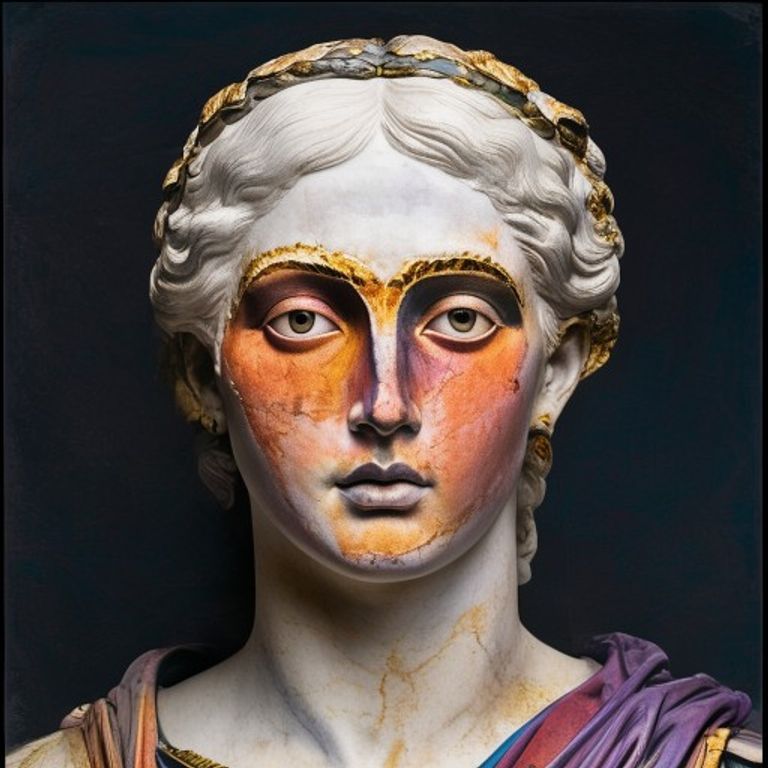
The prompt
Re-render this image as a polychrome-reconstructed classical marble portrait or bust, showing it as it would have been painted in antiquity. The marble itself is still white Carrara or pale limestone, but it is covered in applied color: the face is painted with a naturalistic flesh tone (golden ochre, warm pink undertones), the lips are rendered in deep red or vermilion pigment, the eyes are painted (iris color, pupil, white of the eye detailed) or inlaid with stone (the sclera white marble, iris lapis or turquoise inlay, pupil drilled deep), the eyebrows are drawn in dark pigment (brown, black, or reddish), the cheeks show a warm peachy blush. The hair is either gilded in gold leaf or painted in dark pigment (dark brown, black, reddish-gold highlights), with detailed striations and individual curls indicated in paint. The garments (toga, cloak, drapery) are painted in jewel tones: purple, deep blue, red-ochre, with details in gold or silver leaf highlighting hems and folds. The neck shows the transition from painted flesh-color to the garment color. The ears are fully painted. Gold accents appear on any jewelry, crowns, or emblems. The paint is not perfectly preserved (this is a reconstruction, not intact ancient paint), so there are areas where the gilt is flaking, the paint is worn or patchy, revealing the white marble beneath. The overall effect is vivid, luxurious, and utterly unlike the white neoclassical marble that museums display. The lighting shows the painted surfaces catching light differently than bare marble, the glossy quality of the pigment, the dimensional effect of the gold leaf. The base may be painted as well (dark stone color or bright color to match the garment). Aspect ratio 3:2 vertical. Preserve the subject, pose, and composition of the source image exactly, change only the medium and rendering.
What it is doing
The classical marble bust was never white. This is a scandal the Renaissance covered up. Ancient sculpture was painted in bold colors, gilded with gold, inlaid with semi-precious stone. The lips were red. The eyes were lapis. The hair was gold. The garments were purple and blue. Italian collectors in the Renaissance found these painted sculptures and scraped the paint off because color was considered barbaric, Oriental, un-Roman. They wanted white. They got white. The 19th century idealized this whiteness as purity and called it neoclassical. Now we know the truth: the ancient world was violently colored. The museum guides you past the white busts and tells you this is classical beauty. The actual classical beauty was garish, Byzantine, alive with gold and lapis. Museums are showing you the lie that the Renaissance wanted to believe.
Ways to change it
Pick any of these in the gallery and the choice is added to the prompt you copy.
- Paint-preservation dial: bright and vivid, reconstructed using archaeological evidence (high scholarly reconstruction) vs partially worn, flaking paint revealing white marble beneath (aged realistic patina) vs shadowed and faded, barely-visible paint ghosting on surface (heavily worn condition)
- Color-palette dial: jewel-tones with rich purples and lapis-blues (luxury Roman style) vs ochres and terra-cottas with spare details (simpler Egyptian influence) vs bright reds and golds, high contrast (Hellenistic dramatic)
- Eye-treatment dial: inlaid stone eyes with lapis iris and ivory sclera (highest-quality technique) vs painted eyes with detailed pupil and iris (painted technique) vs simple incised eyes with paint (simplified style)
- Hair-detail dial: individually curled locks, each indicated in gold and dark pigment (high detail) vs wave-pattern painted, gold highlights (stylized) vs simple painted mass with gold overall (economical)
- Gilt-application dial: generous gold leaf on all prominent surfaces (maximum opulence) vs selective gilding on crowns, jewelry, hem-details (hierarchical application) vs minimal gold accents (conservative approach)
- Drapery-pattern dial: garment fabric rendered in pattern paint (stripes, embroidery indicated) (narrative detail) vs solid jewel-tone color (simple opulence) vs shaded to suggest drape and fold (volumetric painting)
Style lineage
Learn the visual culture this draws from: Smithsonian.
Related prompts
See all 7 prompts in the Classical-Statuary-Marble grammar