Classical-Statuary-Marble / Style prompt
Roman Veristic Republican Bust
The Roman veristic bust that records every flaw, every age spot, every scar. Not idealization but arrest report. The face as forensic evidence of a life lived in rough daylight.
Customize this prompt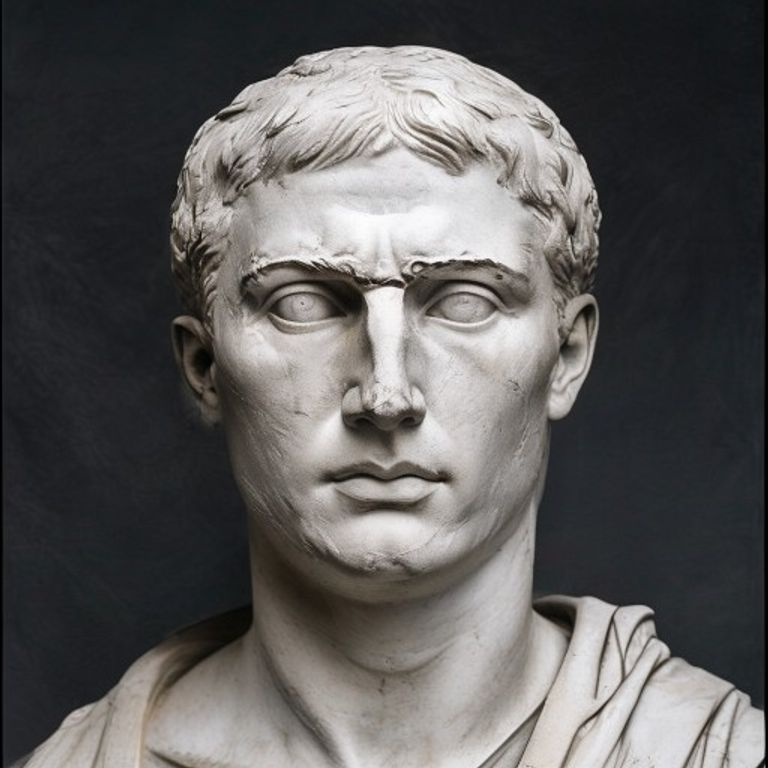
The prompt
Re-render this image as a Roman veristic Republican portrait bust (1st century BC style), the kind of unflinching portraiture that Roman oligarchs commissioned to prove they were too tough to need idealization. The marble is white or pale grey, un-polished or matte-finished, the surface showing the direct chisel work. The face is rendered with ruthless specificity: every wrinkle mapped, the asymmetrical bone structure preserved exactly, any scar tissue or birth marks included without omission. The eyes are carved as simple almond-shaped ovals (no pupils), the eyebrows rendered with precise individual hairs indicated by thin chisel lines. The nose is broken or irregular if it actually is, the septum off-center if it naturally runs that way, the nostrils specifically sized and shaped. The mouth is pursed or downturned, the expression crabbed and suspicious, the lips carved with individual ridges. The jowl is rendered without flattery, the neck shows the cords and folds of age, any surplus skin is indicated faithfully. The hair is rough-carved, not individual curls but a blocky formal mass with directional striation indicating combed waves. The ears are large and specifically modeled. The neck transitions to a toga or short cloak, the drapery indicated with harsh parallel ridges from the chisel, not soft. The overall impression is of a man who has fought battles, made enemies, and does not care if you think he is beautiful. The marble shows the direct attack of the chisel, the surface is neither polished to translucence nor roughened, but frank and objective. The shoulders are suggested but the bust does not extend far. This is a portrait meant for a funeral procession, for the ancestor shrine. Aspect ratio 3:2 vertical. Preserve the subject, pose, and composition of the source image exactly, change only the medium and rendering.
What it is doing
Roman veristic portraiture is the argument that character shows in bone structure and that the state is run by men too dangerous to need beauty. The veristic bust records every wrinkle, every scar, every asymmetry as evidence that this face has earned the right to power. The absence of idealization is itself the idealization: the marble says I am so assured of my position that I can afford to be ugly. The warts-and-all realism is not humility, it is arrogance. The chisel work is harsh because the life was harsh. The portrait is forensic evidence of a man who can survive anything because he looks like a man who has survived everything. Roman verism invented the idea that age and scars are credentials.
Ways to change it
Pick any of these in the gallery and the choice is added to the prompt you copy.
- Idealization-rejection dial: maximum unflinching realism, every wrinkle and flaw recorded (peak veristic) vs realistic but selective, softening some features (moderate realism) vs dignified realism with restrained modeling (transitional style)
- Age-indicator dial: weathered older face, heavy jowls and neck folds (veteran politician) vs younger face with asymmetrical bone structure and scars (military background) vs middle-age face showing specific hardship (lived experience)
- Expression-register dial: suspicious and crabbed mouth, furrowed brow (paranoid intensity) vs impassive and authoritarian (cold power) vs angry or contemptuous mouth (open disdain)
- Chisel-finish dial: direct harsh chisel marks visible, frank surface (unpolished veristic) vs partially refined but still rough (working state) vs matte finish without shine (formal republican simplicity)
- Scar-and-marking dial: visible scars on face and neck, birth marks recorded (forensic accuracy) vs few specific distinguishing marks (selective unflinching) vs unmarked but asymmetrical bone structure (character through bone alone)
- Drapery-style dial: toga with harsh parallel ridges (Roman formal) vs military cloak or cuirass (military authority) vs minimal neck-stump transition (bust-only form)
Related prompts
See all 7 prompts in the Classical-Statuary-Marble grammar