Bauhaus / Style prompt
Moholy-Nagy Photogram Constructivist (Style-Only, Image-Conditioned)
Style register: Laszlo Moholy-Nagy 1922 to 1928 photogram and Konstruktion grammar, light treated as machine-shop raw material, transparent geometric planes, hard-edged industrial silhouettes laid over silver-gelatin grey gradients.
Customize this prompt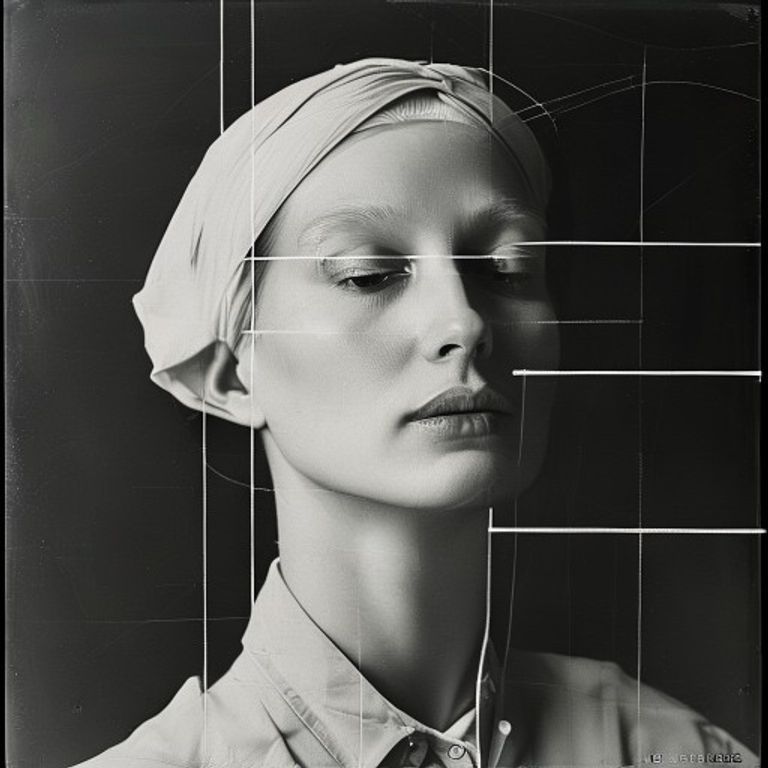
The prompt
Re-render this image in the visual register of a Laszlo Moholy-Nagy photogram crossed with a Bauhaus Dessau-era constructivist composition, circa 1923 to 1928. Treat the picture surface as a silver-gelatin print: deep velvet blacks, paper-white highlights, and a long ladder of cool neutral greys carrying every mid-tone. Overlay translucent geometric planes (clean circles, rectangles, narrow diagonals) at 30 to 70 percent opacity so the underlying subject reads as a constructivist silhouette caught between the planes rather than collaged on top. Edges are razor-precise, no painterly softness, the geometry plotted as if with compass and T-square on a drafting table. Allow a faint silver halation around the brightest forms as if light has bled at the emulsion edge. Restrict color to silver-gelatin neutrals plus one single primary accent (cadmium red OR cobalt blue OR chrome yellow, choose only one) used in no more than 5 percent of the canvas. Mood: laboratory clarity, machine-age optimism, the human form treated as an engineering specimen worth studying. Strictly no on-canvas text, no legible lettering, no signature, no watermark, no logos. Preserve the subject, pose, and composition of the source image exactly, change only the medium and rendering. Aspect ratio matches source.
What it is doing
Moholy-Nagy is sold as "light experiments" but the underlying claim is harder: he believed photography would replace painting because the camera was honest about its industrial nature, while the easel was lying about its monastic one. The photogram is the most extreme version of that argument, an image made without a camera, by laying objects directly on light-sensitive paper. To re-render anything in this register is to assert the subject deserves the same forensic, machine-age scrutiny that the early Bauhaus applied to chairs and teapots: not flattering, not warm, but taken seriously as a designed object.
Ways to change it
Pick any of these in the gallery and the choice is added to the prompt you copy.
- Plane opacity: 30 to 70 percent translucent (signature) vs solid opaque blocks (more El Lissitzky) vs barely there 10 percent (softer)
- Primary accent: single red vs single blue vs single yellow vs pure greyscale (most rigorous)
- Edge precision: razor compass-plotted (signature) vs slightly hand-drawn vs soft-photographic
- Halation: silver bleed at hot edges (signature) vs no halation, clinical vs heavy bloom (later photographic drift)
- Composition logic: orthogonal grid vs diagonal Elementarist tilt vs radial
Style lineage
Learn the visual culture this draws from: Moholy-Nagy Foundation.
Related prompts
See all 8 prompts in the Bauhaus grammar