Album-Cover / Style prompt
Fillmore Psychedelic Poster Sleeve (Wes Wilson / Vibrating-Color Register)
Source-image rendered as a 1966-1968 San Francisco psychedelic concert poster: liquid-light vibration, complementary color shimmer, hand-drawn organic curves, deliberate near-illegibility.
Customize this prompt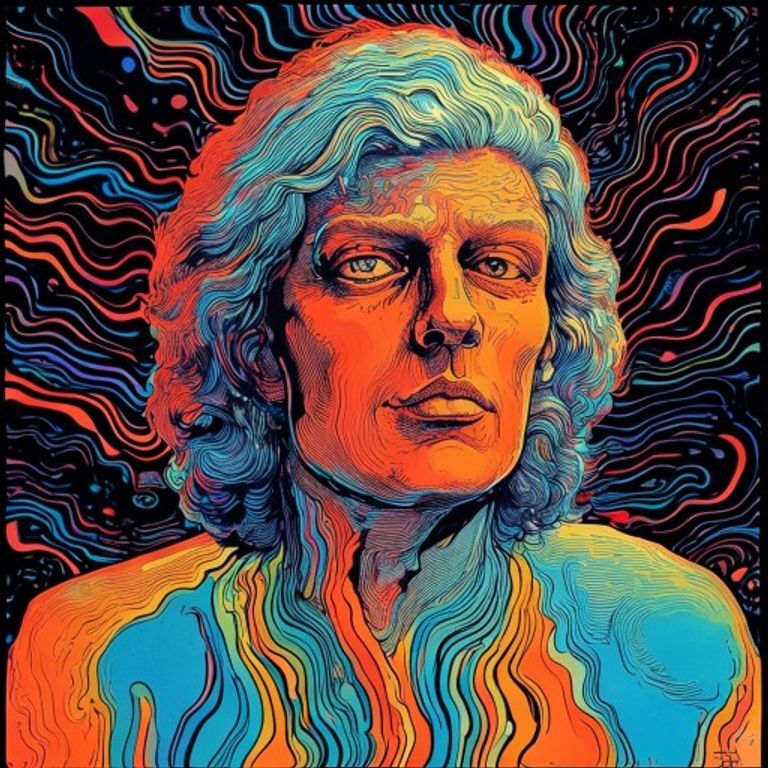
The prompt
Render the source image in the visual register of a 1966-1968 San Francisco Fillmore psychedelic concert poster, combining flowing lettering and colorful counterculture motifs with vibrating complementary colors and warped lettering. Palette built on vibrating complementary pairs (orange-blue, red-green, magenta-cyan) at near-equal value so the colors visually shimmer at their boundaries. Subject re-rendered with hand-drawn organic curves, melted contours, and Art Nouveau influence (Mucha quotation). Background filled edge-to-edge with swirling liquid-light patterns, ameoboid forms, and lettering-shaped negative space (without forming readable words). Hand-drawn ink line throughout, no photographic crispness. Square 12-inch LP-jacket framing where source aspect allows, otherwise preserve source aspect with continuous psychedelic field. Mood: hallucinatory, communal, hand-made, deliberately overwhelming, 1967 Haight-Ashbury optimistic. No legible text, no band name, no logos, no catalog marks. Preserve the subject, pose, and composition of the source image exactly, change only the medium and rendering.
What it is doing
The Fillmore poster was deliberately hard to read. That was the point. If you could decode the band name through the vibrating color and melted lettering, you were inside the tribe. The graphic illegibility was an initiation rite, a low-cost shibboleth distinguishing those who took the trouble from those who did not. Borrowing this register today is borrowing a counterculture's wink at itself; the cost is that there is no longer a counterculture for the wink to land in, only a marketing department.
Ways to change it
Pick any of these in the gallery and the choice is added to the prompt you copy.
- Color vibration intensity: subtle (one complementary pair) to maximum (full shimmer field)
- Organic curve aggression: light Art Nouveau quotation to full melted-clock distortion
- Pattern density: sparse background to fully filled edge-to-edge
- Mucha influence: strong (figural Art Nouveau) to absent (pure abstraction)
- Line weight: fine hand-drawn ink to thick brush
Style lineage
Learn the visual culture this draws from: Poster House.
Related prompts
See all 28 prompts in the Album-Cover grammar