Video-Game-Case / Style prompt
TurboGrafx HuCard Credit-Card-Format Frame
The NEC HuCard, a credit-card-thin ROM cartridge for the TurboGrafx-16 and PC Engine, sold in a slim plastic clamshell case the size of a small paperback. The most elegant cartridge format that lost the war.
Customize this prompt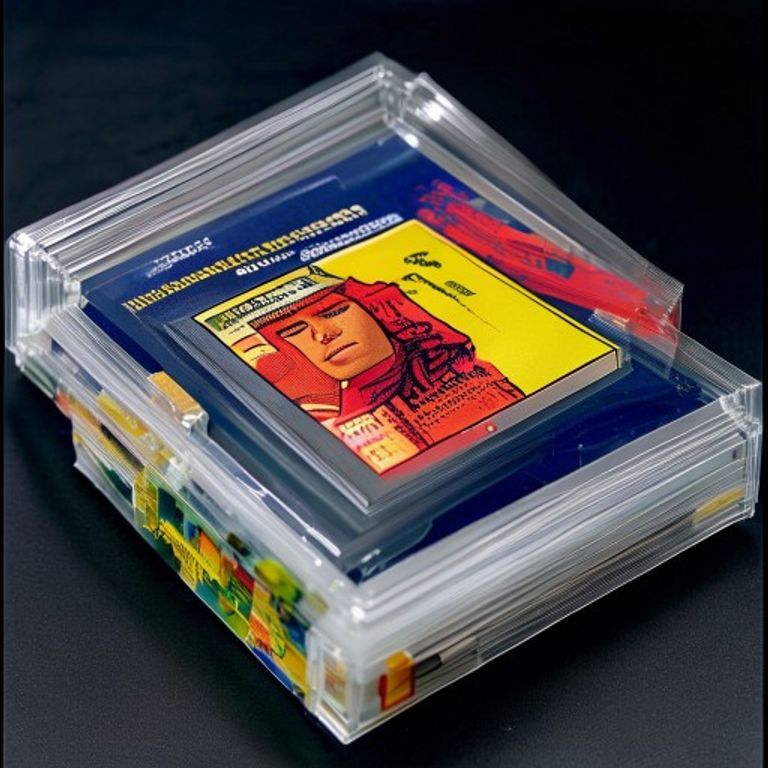
The prompt
Re-render this image as a 1987 to 1992 NEC TurboGrafx-16 (US) or PC Engine (Japan) retail HuCard video-game package, the canonical slim clamshell housing the credit-card-thin HuCard ROM format. Package format: a slim hinged plastic clamshell case roughly the size of a small paperback book (approximately 15cm tall, 11cm wide, 1.5cm deep), constructed of clear or translucent-tinted polystyrene plastic, opening on a left or center hinge to reveal a thin foam or plastic cradle holding a single HuCard. The HuCard itself: a credit-card-thin ROM cartridge (approximately 9cm by 6cm, less than 2mm thick), made of rigid plastic with a glossy printed full-face label that fills the front surface with hero artwork and a thin colored title-stripe (render the label as the primary keyart with no legible lettering). Insert artwork: a single hero illustration printed on a stiff card insert behind the HuCard cradle, painterly anime-keyart register typical of late-1980s Japanese game publishing (most PC Engine titles were Japan-originated even for US TurboGrafx releases), saturated palette, often with a featured character against a stylized environmental backdrop. Top edge of the insert: a thin colored title-band stripe (render as flat colored rectangle). Bottom edge: a thin platform-branding band area (render as small flat colored rectangles). Side spine: a vertical strip visible through the case, colored band at top. The case itself: clear or smoky-translucent polycarbonate, slim profile, hinge with a small clip closure, the spec NEC chose to signal "this is a more advanced and more compact format than competitor cartridges." Print quality: 1989 Japanese offset litho on the insert with gloss varnish, screen-printed full-face label on the HuCard, registration tight. Mood: elegant, compact, slightly more advanced than the competition, the format that arrived correct and lost the war anyway. No on-canvas legible text, no logos, no franchise marks. Preserve the subject, pose, and composition of the source image exactly, change only the medium and rendering. Aspect ratio is HuCard clamshell vertical portrait (roughly 3:4, slightly taller than wide).
What it is doing
The HuCard format was technically and aesthetically superior to every other late-1980s cartridge spec. Credit-card thin, denser ROM packing, full-face printable label, slim elegant case. NEC and Hudson Soft built the format correctly. They lost the platform war anyway, because format superiority does not win platform wars; install base, third-party licensing, and distribution muscle win platform wars. The HuCard is the cautionary case study against the engineer's fallacy that "the better technical product will win." Better products lose constantly. The HuCard is now a collector's specialty market trading at premiums no one in 1989 predicted, because scarcity plus craft-superiority is a survivable long-tail position.
Ways to change it
Pick any of these in the gallery and the choice is added to the prompt you copy.
- Case-tint dial: clear polycarbonate (canonical US TurboGrafx) vs smoky-grey translucent (PC Engine Japan variant) vs bold-color opaque (special edition)
- HuCard-label-style: full-face painted character (canonical) vs abstract geometric pattern (action/puzzle titles) vs anime-cel-illustration (RPG and adventure)
- Hero-render era: 1988 anime-keyart-painted (peak PC Engine) vs 1990 mixed-painted-with-screen-tiles (mid-cycle) vs 1992 fully-rendered-keyart (late-cycle)
- Insert-style: single hero-card insert (canonical) vs multi-fold mini-booklet (RPG SKU) vs card plus inlay-poster (deluxe)
- Case-surface: bare polycarbonate (canonical) vs embossed-clip closure (later run) vs printed-edge-band exterior (Japan-only)
- Shelf-wear dial: mint sealed in shrinkwrap vs light hinge-yellowing (lived-in) vs cracked clamshell plus faded label (relic)
Related prompts
See all 26 prompts in the Video-Game-Case grammar