Toy-Packaging / Style prompt
Transformers G1 Tech-Spec Grid-Box Frame
The 1984 to 1990 Hasbro/Takara Transformers Generation 1 box with the rear-panel tech-spec bar-chart grid. The roleplay spreadsheet rendered as toy packaging.
Customize this prompt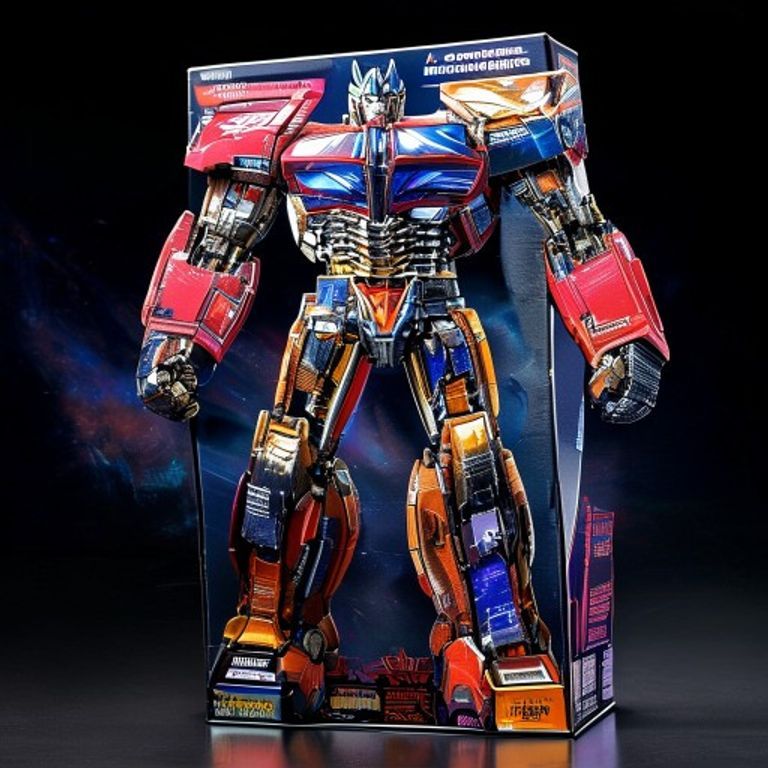
The prompt
Re-render this image as a 1984 to 1990 Hasbro Transformers Generation 1 retail action-figure box, the canonical first-generation format that established the entire Transformers brand and its character-tech-spec collector tradition. Package format: a rigid corrugated-cardboard rectangular box (sizes vary by character class, typical Autobot or Decepticon car sized approximately 23cm wide by 18cm tall by 7cm deep, Combiner or Triple-Changer SKUs larger), full-color offset-litho printed on all six visible faces. Front face: full-color photographic-and-illustration hybrid composition, the featured Transformer character shown in both vehicle-mode (photographed at angled hero perspective) and robot-mode (painted or illustrated in dynamic action pose), the dual-mode-reveal as the central visual contract of the package. Front-face background: deep saturated cosmic-color register (jet black, deep cobalt blue, blood crimson for Decepticons, ranging through hot orange and gold for Autobots), often with stylized starfield, energy-burst, or Cybertron-architecture environmental elements. Top edge: a thick colored faction-band stripe (red for Autobot, purple for Decepticon, render as flat solid colored rectangle, no legible lettering), often with a stylized faction-emblem element (render as a flat colored geometric shape, no recognizable mark). Lower portion of front face: character-name strip and class-identifier band (render as flat colored rectangles). Back face (THE DEFINING FACE, render with primary attention): a printed character-tech-spec composition with a horizontal bar-chart grid showing the character's attribute ratings (Strength, Intelligence, Speed, Endurance, Rank, Courage, Firepower, Skill) as filled-bar levels, each bar drawn as a horizontal rectangle with proportional fill (render as a grid of stacked horizontal colored bars with no legible numeric labels but with visible proportional fill differentiation between attributes), plus a character-profile illustration panel and a short flavor-text narrative block (render as a flat colored rectangular text-block area with no legible lettering). Side panels: continuation of the front composition wrapped onto the side, plus secondary photographs of the toy in alternate modes. The box itself: matte four-color offset litho with slight gloss varnish on the photograph areas, sharp registration, corrugated rigid construction. Mood: 1985 Saturday-morning, Cold-War-era roleplay-spreadsheet seriousness applied to a transforming-robot toy, the package register that says "this character has a profile and a story and a numerical attribute system." No on-canvas legible text, no logos, no franchise marks. Preserve the subject, pose, and composition of the source image exactly within the package format, change only the medium and rendering. Aspect ratio is Transformers G1 box front-face horizontal rectangle (roughly 5:4).
What it is doing
The Transformers G1 box's rear-panel tech-spec bar chart is one of the most influential design decisions in twentieth-century toy packaging. Hasbro and Takara took a Japanese toy line (Diaclone and Microman, which already had transformation gimmicks) and added one critical thing: a numerical attribute grid for each character on the back of the box. The tech-spec bar chart made every toy a roleplay-spreadsheet character: Optimus Prime has Strength 10, Intelligence 10, Speed 4, Endurance 10. Megatron has Firepower 9, Skill 9. The buyer (a seven-year-old in 1985) was being given an RPG character sheet on a toy box. This was simultaneously the first widely-distributed character-attribute system in children's toy marketing and a precursor to every modern collectible-character-game-with-stats from Pokemon Cards to Magic the Gathering to every gacha mobile game. The G1 box is therefore both a packaging artifact and a structural innovation in how character-driven collector economies are built: give the character measurable attributes, and the collector will spend the rest of their life completing the roster.
Ways to change it
Pick any of these in the gallery and the choice is added to the prompt you copy.
- Faction-palette dial: cosmic-black-and-crimson Decepticon register vs deep-blue-and-gold Autobot register vs neutral-grey-and-orange Triple-Changer-class register
- Hero-photograph-style: studio-photographed vehicle-mode hero shot (canonical front-face composition) vs painted-illustration robot-mode dominant (action-painted variant) vs dual-mode split-composition (canonical reveal format)
- Tech-spec-detail dial: eight-attribute horizontal bar grid (canonical 1984 to 1986) vs expanded ten-attribute grid (later mid-cycle variant) vs simplified four-attribute grid (budget SKU)
- Box-scale dial: standard car-class box (23 by 18 by 7cm) vs larger Triple-Changer or Combiner box (32 by 24 by 10cm) vs flagship Combiner-set box (45 by 30 by 14cm)
- Era-print-register dial: 1984 to 1985 cosmic-background-with-starfield (canonical first wave) vs 1986 to 1987 Cybertron-environmental backdrop (mid-cycle) vs 1988 to 1990 Pretender-or-Headmaster simplified register (late-cycle drift)
- Shelf-wear dial: mint sealed in shrinkwrap vs light box corner-wear with intact tech-spec face (lived-in) vs bottom-flap-opened with figure inside, box otherwise intact (mid-tier collector)
Style lineage
Learn the visual culture this draws from: Transformers Wiki.
Related prompts
See all 8 prompts in the Toy-Packaging grammar