Toy-Packaging / Style prompt
He-Man MOTU Painterly Box-Art Frame
The 1982 to 1987 Mattel Masters of the Universe box and blister-card painted keyart. The Frank Frazetta-derived barbarian register applied to aisle-five toy packaging. The last unembarrassed 1980s male-archetype rendered as five-year-old retail.
Customize this prompt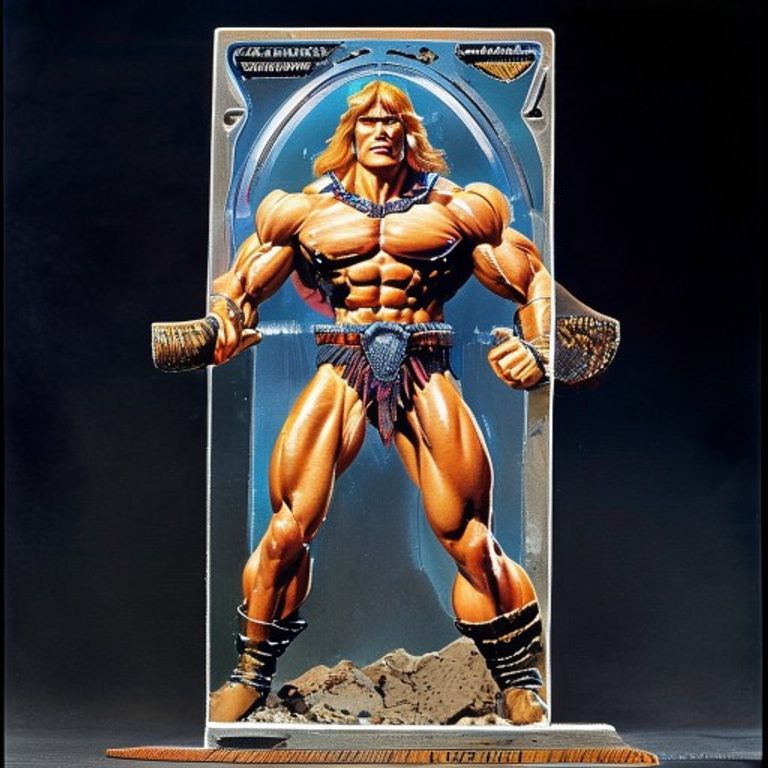
The prompt
Re-render this image as a 1982 to 1987 Mattel Masters of the Universe action-figure package, either the canonical blister-card format (for single 5.5-inch figures) or the boxed format (for vehicles, playsets, and creature companions). Package format option A (blister-card, the canonical figure SKU): a rigid coated cardback (approximately 17cm wide by 23cm tall, larger and beefier than the Kenner Star Wars cardback) with a clear vacuum-formed plastic blister bubble heat-sealed to the front face, the bubble cradling a single 5.5-inch musclebound action figure visible through the clear plastic. Package format option B (vehicle or playset box): a rigid corrugated-cardboard rectangular box (approximately 30cm by 25cm by 18cm), full-color offset-litho printed on all visible faces, with an inset window or full-photographic front face. Front face keyart (both formats): a hand-painted illustration in the Frank Frazetta-derived heroic-barbarian register, the iconic 1982 to 1985 MOTU box-art language of detailed warriors and colorful dramatic staging, depicting a musclebound hero figure mid-action against a dramatic fantasy backdrop (volcanic landscape, alien sky, ruined castle, crystalline cave), rendered in saturated oil-and-airbrush technique with strong directional lighting, anatomical exaggeration (impossibly broad shoulders, narrow waist, oversized weapon grip), and a palette dominated by jewel-tones (cobalt blue, blood crimson, gold-ochre, jade green) against a dramatic high-contrast background. Top edge of cardback or front box-face: a thick colored title-band stripe across the full width (render as flat solid colored rectangle, no legible lettering). Below the title-band: a stylized fantasy environment as the keyart background. Bottom edge: a thin colored character-name band beneath the figure (render as flat colored rectangle). Side panels of the box (Option B only): additional painted illustrations showing the toy in scale or in action context, plus colored character-name strips. Cardback finish: high-gloss UV-coat over offset litho, slight reflection. Mood: confident 1983 Saturday-morning, unembarrassed heroic-fantasy, the package register that says "this is for serious play and the painting on the front is the contract." No on-canvas legible text, no logos, no franchise marks. Preserve the subject, pose, and composition of the source image exactly within the package format, change only the medium and rendering. Aspect ratio: blister cardback is roughly 3:4, box format is roughly 4:3 horizontal.
What it is doing
The Mattel MOTU box-art commissions are the last full deployment of the Frank Frazetta-derived heroic-barbarian painting tradition at mass retail. The painters Mattel hired were trained in the same lineage as Frazetta, Ken Kelly, and the 1970s paperback-fantasy cover-art generation. The aisle-five toy package of 1983 was, accidentally, the largest distribution channel painted-fantasy-keyart ever achieved in the twentieth century. A child in a Wisconsin Kmart in 1984 was looking at a Frazetta-tradition oil painting on every box. Within ten years, the entire painted-keyart register had been killed by digital-render box-art, photographic-composite covers, and the cost-down pressure of contract illustration. The MOTU box is therefore a frozen sample of the moment painted heroic-fantasy ruled mass retail and was about to be exterminated by cheaper digital alternatives. Owning a sealed 1983 MOTU box today is owning a painted-tradition relic that the market has not yet fully priced.
Ways to change it
Pick any of these in the gallery and the choice is added to the prompt you copy.
- Painter-register dial: heroic-action register with muscular figures (canonical MOTU peak) vs environmental-painted register with fantasy landscapes (vehicles and playsets) vs ornate fine-ink fantasy register (mini-comic-style variant)
- Format dial: single-figure blister-card with painted cardback (canonical figure SKU) vs vehicle box with painted top and side panels (vehicle line) vs oversized creature-companion box with photographic-and-painted hybrid (deluxe SKU)
- Background-environment dial: volcanic-landscape with red sky vs crystalline-cave with cool-blue and violet vs ruined-castle with stormy ochre-and-grey backdrop
- Anatomy-exaggeration dial: extreme musclebound 1983-canonical proportions vs slightly more realistic anatomical proportions (early 1982 wave) vs cartoonized exaggeration (later 1986 to 1987 wave drift)
- Palette dial: jewel-tone cobalt-and-crimson (canonical heroic) vs gold-ochre-and-jade earth-tones (Eternia-environmental register) vs cold-blue-and-violet villain-register (Skeletor-faction SKUs)
- Shelf-wear dial: mint sealed in clear shrinkwrap vs light cardback corner-flex (lived-in but unopened) vs bubble crushed plus price-sticker residue (relic)
Style lineage
Learn the visual culture this draws from: Transformerland MOTU Collector's Guide.
Related prompts
See all 8 prompts in the Toy-Packaging grammar