Suprematism / Style prompt
Rayonism: Larionov and Goncharova Light-Ray Crossings
Mikhail Larionov and Natalia Goncharova's pre-Suprematist Rayonist mode circa 1912 to 1914, the world as crossing rays of light.
Customize this prompt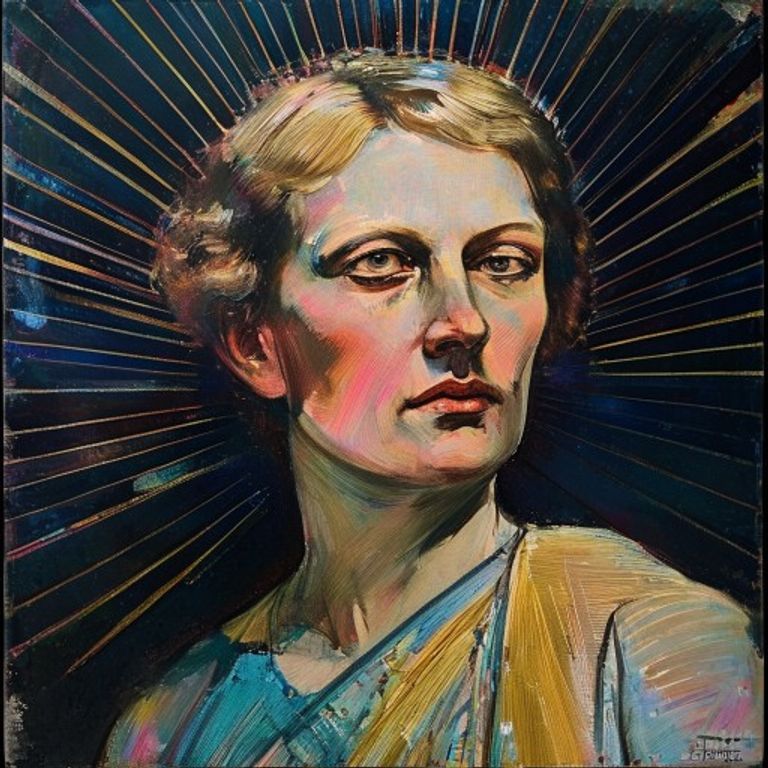
The prompt
Re-render this image in the visual register of Russian Rayonism (Luchism) circa 1912 to 1914, founded by Mikhail Larionov and Natalia Goncharova. Decompose the entire picture plane into crossing diagonal rays of light: every form sliced into long thin slivers that radiate from implied light sources at multiple angles, intersecting in dense lattice across the canvas. Palette of electric prismatic colors: cadmium yellow, vermilion, magenta, viridian, cobalt blue, white-light gold, against a deep slate or ochre ground. Surface reads as oil paint with rapid directional brushstrokes, each stroke 5 to 30cm long in canvas terms, near-parallel within ray groups. Compositional energy is light-shattered, the subject visible only as the result of intersecting beams. Strictly no on-canvas text, no legible lettering, no signature, no watermark, no logos. Preserve the subject, pose, and composition of the source image exactly, change only the medium and rendering. Aspect ratio matches source.
What it is doing
Rayonism claimed it painted the rays of light reflected from objects, not the objects themselves. The honest reading: it painted the painter's right to dissolve the world into pure sensation and call the dissolution insight. The Russian Empire was about to be dissolved into a much more violent set of crossing forces; Rayonism was the rehearsal. The aesthetic teaches the viewer that the object is secondary to the energy that strikes it, which is also the doctrine of every later regime that prefers to study its citizens through statistics.
Ways to change it
Pick any of these in the gallery and the choice is added to the prompt you copy.
- Ray density: sparse 30 strokes vs medium 100 strokes vs dense 300+ strokes
- Ray angle spread: narrow 30 degree fan vs broad 90 degree vs full 360 degree starburst
- Palette warmth: cool blue and green dominant vs balanced prismatic vs hot red and gold dominant
- Ground tone: deep slate vs warm ochre vs near-black void
- Subject dissolution: sparse rays, subject still clearly legible beneath a few crossing beams vs dense crossing lattice, subject visible only through intersecting beams (signature) vs total ray abstraction, subject dissolved into pure colored light shafts
Style lineage
Learn the visual culture this draws from: TheArtStory Rayonism Movement Overview.
Related prompts
See all 6 prompts in the Suprematism grammar