Samizdat-Zine / Style prompt
Wartime Occupied-Territory Resistance Broadsheet
The clandestine WWII-era resistance broadsheet register, printed in a cellar on a stolen press, distributed door to door at night.
Customize this prompt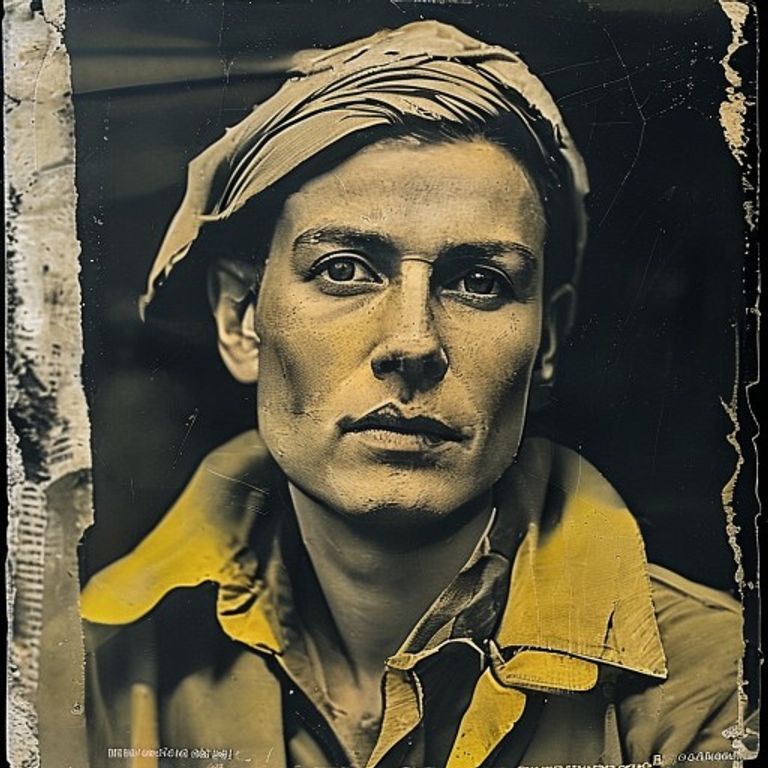
The prompt
Render in the visual register of a 1940s through 1944 clandestine resistance broadsheet from occupied Europe (lineage of Combat, Defense de la France, De Waarheid, the Polish Biuletyn Informacyjny). Medium: letterpress or small offset print on cheap newsprint or wrapping paper, the press operated in a cellar with limited type and limited ink. The impression is uneven, some columns crisp and others ghosted, with the slight registration tilt of a hand-operated platen press. Add the visible deckle edge of a roughly-cut sheet and folds suggesting it was distributed concealed inside a coat pocket. Palette: yellowed newsprint, black or sometimes brown ink (whichever was available in occupied conditions), occasional second pass of red for emphasis at a single edge or corner block, abstract block only never letters. Texture: paper has the soft pulpiness of poor wartime stock, creases from being handed person to person, faint water spot from being concealed in a courier's bag. Lighting: dim daylight through a cellar window, raking from one side. Mood: the dignity of the press that operates while the official press lies, the testimony of risk distributed in folded paper. Do not render any legible text, headlines, slogans, logos, watermarks, named hate symbols, or defamatory likeness of real persons; all text-feel and decorative blocks are abstract ink texture only. Preserve the subject, pose, and composition of the source image exactly, change only the medium and rendering.
What it is doing
The resistance broadsheet is the proof that legitimate authority and lawful authority are different things. The official press in occupied Paris said the regime was legitimate; the cellar broadsheet, printed at the cost of execution-on-discovery, said the regime was not. The reader knew which one was true because of which one was risky to print. The risk is the watermark of legitimacy under occupation. Any media that costs nothing to produce under a given regime is media that serves that regime, even if it criticizes it.
Ways to change it
Pick any of these in the gallery and the choice is added to the prompt you copy.
- Press condition: crisp vs uneven vs heavily-ghosted
- Paper: wartime newsprint vs wrapping paper vs school stock
- Second-color use: none vs red corner block vs full overlay
- Distribution wear: fresh vs coat-pocket vs courier-bag
- Era: early occupation vs midwar peak vs late liberation
- Country register: French style: tall narrow columns, crisp serif-like ink texture, small red corner block vs Polish style: smudgy stencil-duplicator print, faint violet ink, one cramped dense column vs Dutch style: small folded quarter sheet, heavy blocky sans-serif ink texture, brown ink
Style lineage
Learn the visual culture this draws from: Britannica Encyclopedia.
Related prompts
See all 10 prompts in the Samizdat-Zine grammar