Propaganda / Style prompt
Khmer Rouge Year Zero Austere
The 1975-1979 Democratic Kampuchea visual register: documentary photography and didactic poster art that flattened individual identity into uniform agricultural collectivity, the visual prelude to the killing fields.
Customize this prompt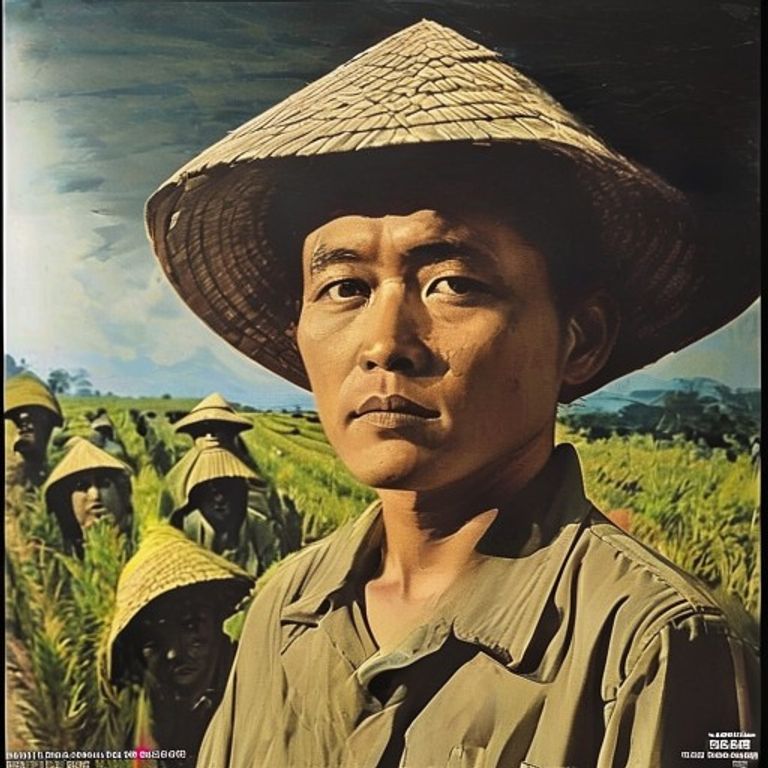
The prompt
Restyle the source image as a 1975 to 1979 Democratic Kampuchea (Khmer Rouge era) propaganda or documentary aesthetic. Two rendering modes can be selected via the dial below: (mode A) didactic poster art in flat opaque gouache, palette restricted to dull olive-green, ochre, dried-blood maroon, and cream paper ground, forms simplified into uniform peasant figures with identical conical straw hats, identical black pyjama clothing, identical neutral expressions, working in identical rice-field postures, composed in horizontal rows like a frieze; (mode B) documentary black-and-white film photograph from the era, medium-format with mild grain and chemical fixation marks, harsh tropical overhead noon sunlight, deep shadows under hat brims, faces flattened by exposure, group composition with figures spaced evenly and oriented uniformly toward a single off-frame point, the deliberate visual erasure of any individuating detail. Background is rice paddy, irrigation canal earthwork, or austere communal hall interior with bare walls. Mood is enforced uniformity, the calm of compelled silence, the documentation of erased personality. Forbid all regime-specific symbols absolutely: no Khmer Rouge red flag, no Angkar emblems, no party slogans in any script, no Pol Pot or leadership portrait imagery, no krama scarf in regime colors (allow only neutral black-and-white). Caption zones at top or bottom (if poster mode) should be empty: no letterforms, no Khmer script, no Latin script, no slogans, no party mottoes. Preserve the exact subjects, faces, poses, gestures, and spatial arrangement of the source image without alteration; restyle the rendering only.
What it is doing
The Khmer Rouge visual program performed individual erasure before physical erasure. Identical clothing, identical hats, identical postures, identical compositions: the persuasion mechanism was that a person without visual distinction is a person without political claim. By the time S-21 began photographing prisoners on intake, the visual flattening had been rehearsed in three years of poster art and documentary imagery. Aesthetic uniformity was the trial run for genocide. The lesson generalizes: regimes that flatten individuality in their visual culture are previewing what they will later do to individuals in life.
Ways to change it
Pick any of these in the gallery and the choice is added to the prompt you copy.
- Mode: poster-gouache-didactic vs documentary-photograph-monochrome vs mixed-poster-with-photo-inset
- Composition register: frieze-row-of-figures vs single-figure-in-landscape vs aerial-collective-labor
- Light: harsh-tropical-noon vs dawn-collective-rising vs austere-interior-shadow
- Palette restriction: olive-ochre-only vs pure-monochrome-photo vs black-pyjama-on-cream
- Scene: figures standing motionless in even rows, faces blank, arms at sides (signature) vs figures bent mid-stroke hoeing and hauling earth baskets in unison vs figures seated cross-legged in rows on bare floor, facing one point
Style lineage
Learn the visual culture this draws from: Britannica.
Related prompts
See all 32 prompts in the Propaganda grammar