1960s British Pop Scrapbook Collage with Layered Found-Print Textures (Style-Only, Image-Conditioned)
Style register: British Pop scrapbook density, where the source is rebuilt from varied print stocks rather than imported celebrity pictures.
The prompt
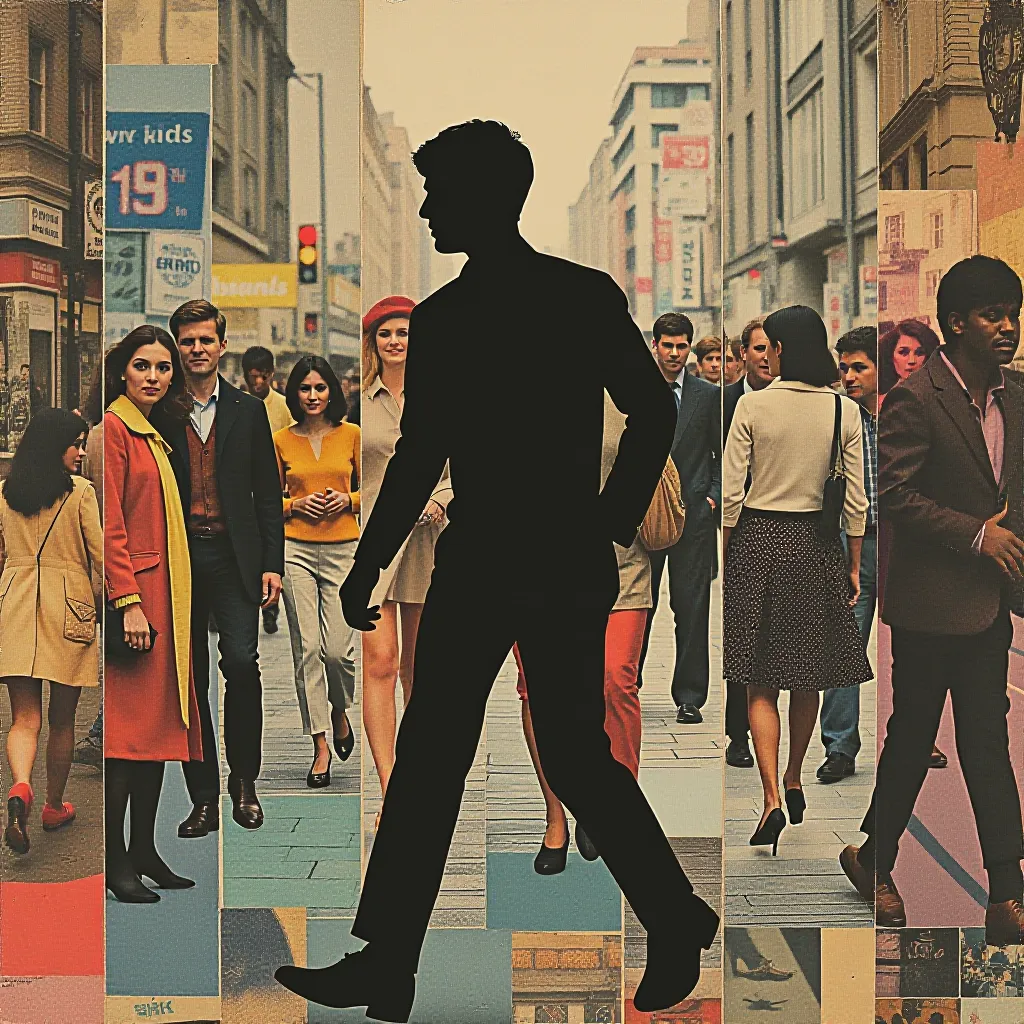
Re-render this image as a densely layered British Pop scrapbook collage in the register of 1960s found-image practice. Take the source scene apart into broad regions and print those same regions on mismatched old photographic and illustrated paper stocks before reassembling them in their original order. The principal subject keeps its identity, pose, scale, and place in the image; the crowded sensation comes from multiple paper borders closely nested around source details, not a crowd of newly invented people. Use cream mounting card, faded postcard blue, cherry red, dusty mustard, and charcoal photographic black. Give one major contour a scissor-cut photo edge, let a nearby plane become a rough lithographic illustration, and place a narrow hand-colored strip between them. Show a little glue discoloration, curled paper at a corner, and faint yellowing around the cuts, but leave the main silhouette clean enough to read instantly. Keep the background layered and materially busy while the center of attention remains stable. Do not paste in celebrity faces, borrowed album artwork, packaging, emblems, or archival lettering. The mood is affectionate and nostalgic with a faint unease: memory lovingly assembled from mass-market scraps. Think physical scrapbook depth, not seamless digital photomontage. Leave a calm, uncluttered band of negative space along the top or bottom edge where a title could sit. Strictly no on-canvas text, no legible lettering, no signature, no watermark, no logos. Preserve the subject, pose, and composition of the source image exactly, change only the medium and rendering. Aspect ratio matches source.
What it is doing
A communal memory is never one clean photograph. This cut paper describes affection as the labor of arranging printed leftovers, then asks whose images were available for the arrangement in the first place.
Tuning knobs
- Density: `nested broad paper borders` (signature) vs `three spare layers` vs `closely crowded layers`
- Aging: `light yellowing at cuts` (signature) vs `fresh paper` vs `strong faded stock`
- Photo mix: `photograph beside illustration` (signature) vs `all photograph` vs `mostly illustration`
- Mount: `cream card with curled corner` (signature) vs `flat bright board` vs `rough recycled sheet`
Related prompts
See all 10 prompts in the Pop-Art grammar · Open in the gallery
Get the free sample. The intro plus the first three chapters of The Liberation Engine, delivered as a PDF. The full book and the complete 642-prompt method are the paid edition.