Hamilton British Consumer Collage (Style-Only, Image-Conditioned)
Style register: Richard Hamilton's 1950s British Pop, combining glossy printed scraps, clipped edges, and incompatible image scales without imported advertisements.
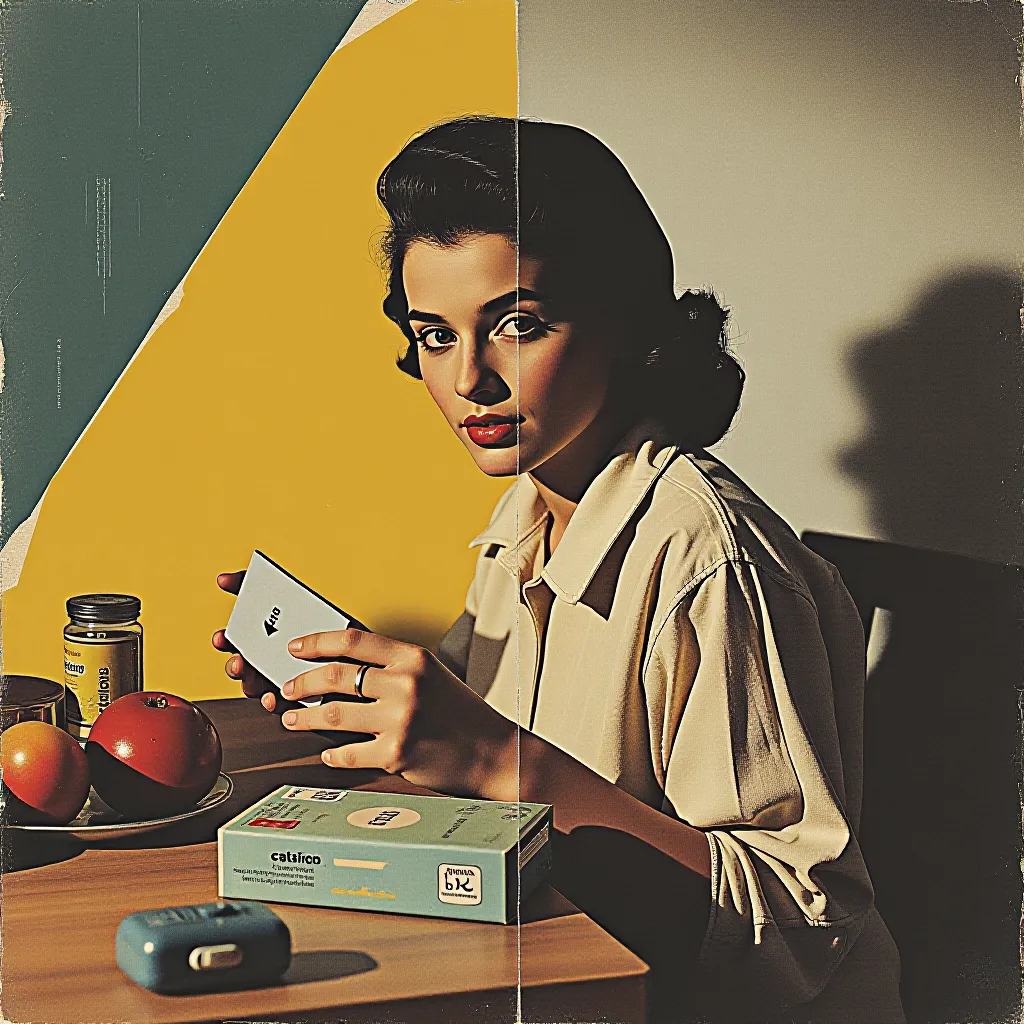
The prompt
Re-render this image as a British Pop paper collage in the register of Richard Hamilton's Independent Group work of the mid-1950s. Reproduce only visual fragments already inside the source as if each were torn from a different anonymous printed page: the main subject from a soft-gloss photographic sheet, background tones from uncoated newsprint, highlights from a slick magazine insert, and the darkest contours from coarse black ink. Reassemble those pieces at the same coordinates as the original image so the pose and scene remain readable, while the boundaries between printing technologies become conspicuous. Give one broad source shape a visible white scissor border, another a thin torn fiber edge, and one a subtle angle of paste lift. Juxtapose cool gray dots from cheap offset printing with warm flesh or object tones printed in slightly faded cyan, yellow, and red. Preserve the original focal point; do not add gadgets, food packaging, room props, slogans, or any outside picture. Let paper glue leave a delicate wrinkle in the negative space without distracting from the subject. The mood is curious and gently satirical, like a household view assembled out of mass-produced wishes. Keep joins chunky enough to read at thumbnail scale, not a cloud of little scraps. Leave a calm, uncluttered band of negative space along the top or bottom edge where a title could sit. Strictly no on-canvas text, no legible lettering, no signature, no watermark, no logos. Preserve the subject, pose, and composition of the source image exactly, change only the medium and rendering. Aspect ratio matches source.
What it is doing
Hamilton's collage proposes that domestic desire is not natural: it is cut from images and glued back together. Using fragments from the original, rather than importing advertisements, makes the mechanics of aspiration visible without selling any product.
Tuning knobs
- Source paper: `mixed newsprint and glossy sheet` (signature) vs `all coarse newsprint` vs `all satin magazine stock`
- Cut: `white scissor border` (signature) vs `ragged torn fiber` vs `flush trim`
- Join: `slight paste lift` (signature) vs `flat glued plane` vs `raised overlap`
- Print: `offset dots beside smooth photo` (signature) vs `uniform offset dots` vs `washed photographic ink`
Related prompts
See all 10 prompts in the Pop-Art grammar · Open in the gallery
Get the free sample. The intro plus the first three chapters of The Liberation Engine, delivered as a PDF. The full book and the complete 642-prompt method are the paid edition.