Wesselmann Flat Color Interior (Style-Only, Image-Conditioned)
Style register: Tom Wesselmann's Great American Nude-era flat interiors, limited here to domestic color geometry rather than borrowed figure poses.
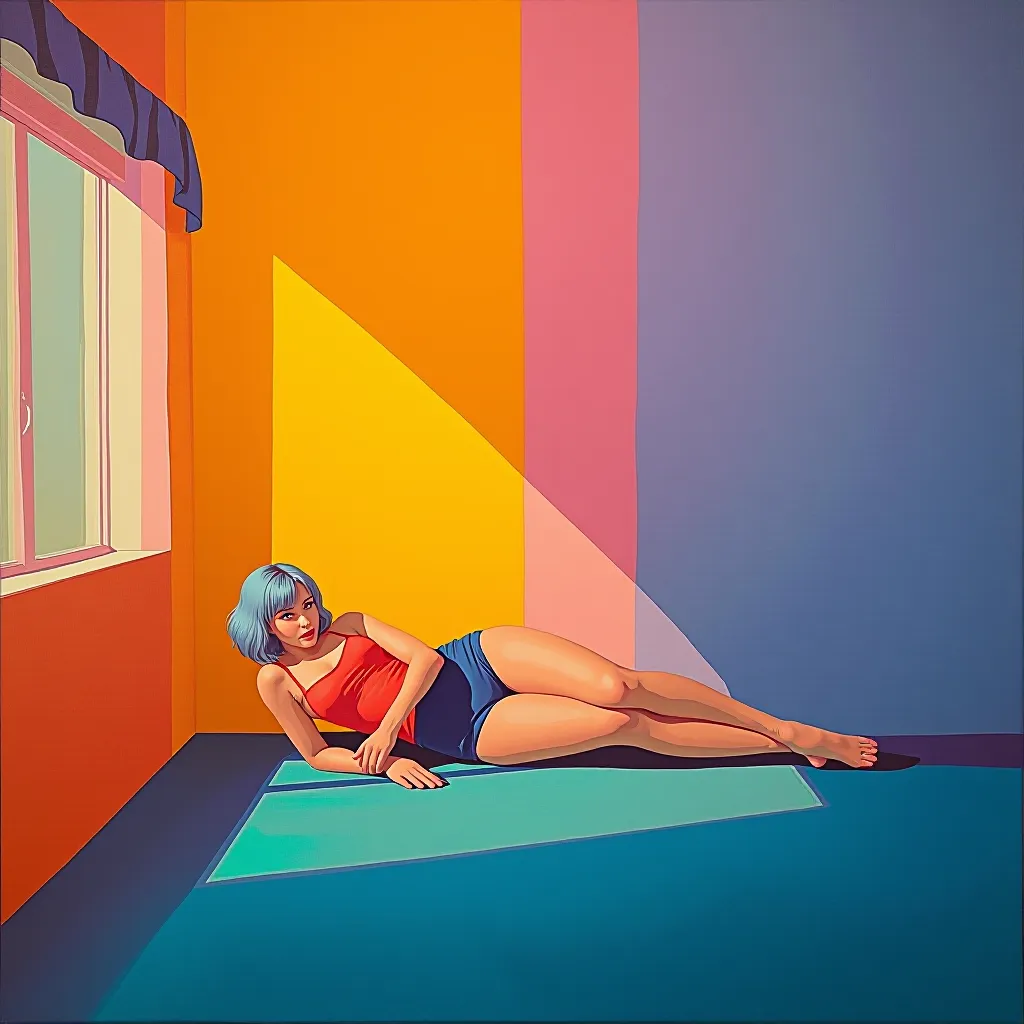
The prompt
Re-render this image as a hard-edged domestic Pop painting in the flat-color interior register of Tom Wesselmann's 1960s work. Translate each existing surface into a large, solid acrylic area, as though the image were laid out with cut stencils and painted on smooth board. Treat the source background as a room-like color field, even if it is only an open wall or plain ground: one broad wall plane, one contrasting horizontal plane where the source already suggests it, and no invented furniture. Render the source subject in its original position and pose with crisp contour lines and just two or three interior value shapes. Make the palette ripe but controlled: vermilion, petal pink, deep ultramarine, warm cream, and a leaf-green accent. Where contours touch a colored field, leave a narrow hand-painted seam so the two coats do not blend. Use a matte brush surface and very slight edge buildup; avoid photographic texture, gradients, and airbrushing. Keep open spaces resolutely empty instead of filling them with domestic props. The mood is sunny, still, and faintly theatrical, with the apparent ease of a perfectly staged everyday view. The source remains the actor; color planes supply the setting. Leave a calm, uncluttered band of negative space along the top or bottom edge where a title could sit. Strictly no on-canvas text, no legible lettering, no signature, no watermark, no logos. Preserve the subject, pose, and composition of the source image exactly, change only the medium and rendering. Aspect ratio matches source.
What it is doing
An interior can be manufactured from color alone. Wesselmann's theater of apparent domestic ease works because a painted plane can quietly tell the eye what to desire before any object arrives.
Tuning knobs
- Wall color: `vermilion wall plane` (signature) vs `ultramarine wall plane` vs `cream wall plane`
- Boundary: `crisp stencil edge` (signature) vs `visible brush edge` vs `slight overlap`
- Shadow: `two flat value shapes` (signature) vs `one silhouette` vs `three stepped values`
- Finish: `matte acrylic board` (signature) vs `chalky gouache` vs `glossy enamel`
Related prompts
See all 10 prompts in the Pop-Art grammar · Open in the gallery
Get the free sample. The intro plus the first three chapters of The Liberation Engine, delivered as a PDF. The full book and the complete 642-prompt method are the paid edition.