Dithered Demoscene Color Cycling (Style-Only, Image-Conditioned)
Style register: late-eighties home-computer demoscene raster art, ordered dithering and luminous stepped color bands that imply animation in a still image.
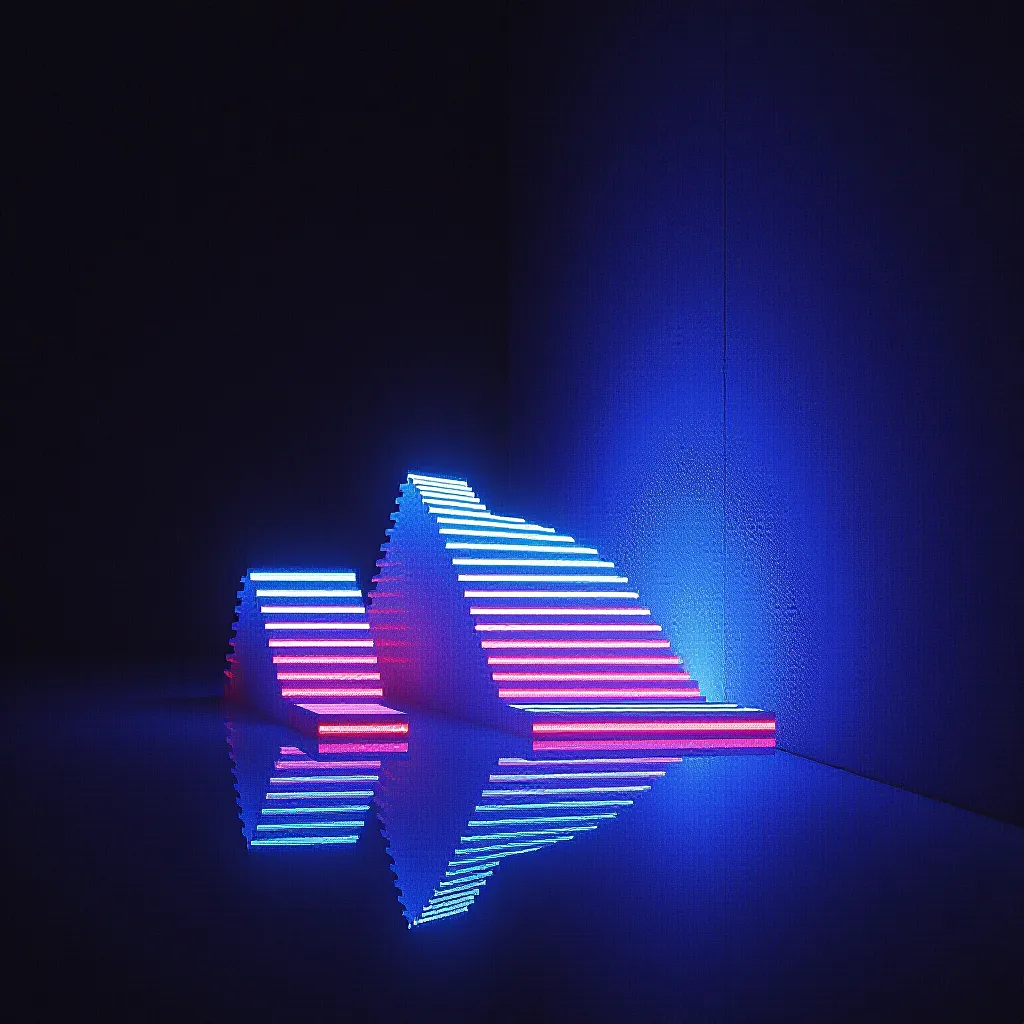
The prompt
Re-render this image as a late-eighties home-computer demoscene still, with carefully ordered pixel dithering and a luminous palette designed to suggest color cycling without actual animation. Translate the existing subject into chunky square-pixel contours and distinct bands of midnight blue, violet, cobalt, acid turquoise, rose, and white. Place repeated ordered checker or diagonal dither patterns where one band meets another, so adjacent discrete colors appear to mix at a normal viewing distance but remain unmistakable pixel marks up close. Wrap only the source's actual illuminated edges in a narrow progression of brighter bands; avoid inventing glowing objects, orbiting spheres, or arbitrary geometry. Recall the resourceful graphic experiments of European home-computer demo artists, who coaxed apparent light and motion from fixed palettes and limited memory. Use rhythmic stepped bands across existing gradients, such as a sky, wall, reflected surface, or cloth fold. Reserve deep unpatterned darks around the primary subject so the dither has somewhere to breathe. The picture should look hand-plotted cell by cell, not like a photograph processed through a coarse filter. Avoid blur, antialiasing, smooth airbrush bloom, and decorative interface chrome. Keep the source's hierarchy and directional light intact, while the repeating palette steps give the frozen scene a current of energy. Leave a calm, uncluttered band of negative space along the top or bottom edge where a title could sit. Strictly no on-canvas text, no legible lettering, no signature, no watermark, no logos. Preserve the subject, pose, and composition of the source image exactly, change only the medium and rendering. Aspect ratio matches source.
What it is doing
The demoscene made scarcity public: each apparent gradient was a visible record of techniques for exceeding a machine's limits. The still frame lets that ingenuity remain visible.
Tuning knobs
- Dither pattern: `ordered diagonal weave` (signature) vs `checkerboard` vs `widely spaced dots`
- Band spacing: `broad stepped bands` (signature) vs `narrow repeated bands` vs `few isolated bands`
- Palette temperature: `blue violet turquoise rose` (signature) vs `amber violet teal` vs `indigo coral white`
- Dark field: `broad midnight ground` (signature) vs `thin dark borders` vs `near-black majority`
Related prompts
See all 9 prompts in the Pixel-Art grammar · Open in the gallery
Get the free sample. The intro plus the first three chapters of The Liberation Engine, delivered as a PDF. The full book and the complete 606-prompt method are the paid edition.