William Eggleston Democratic Color-Banal
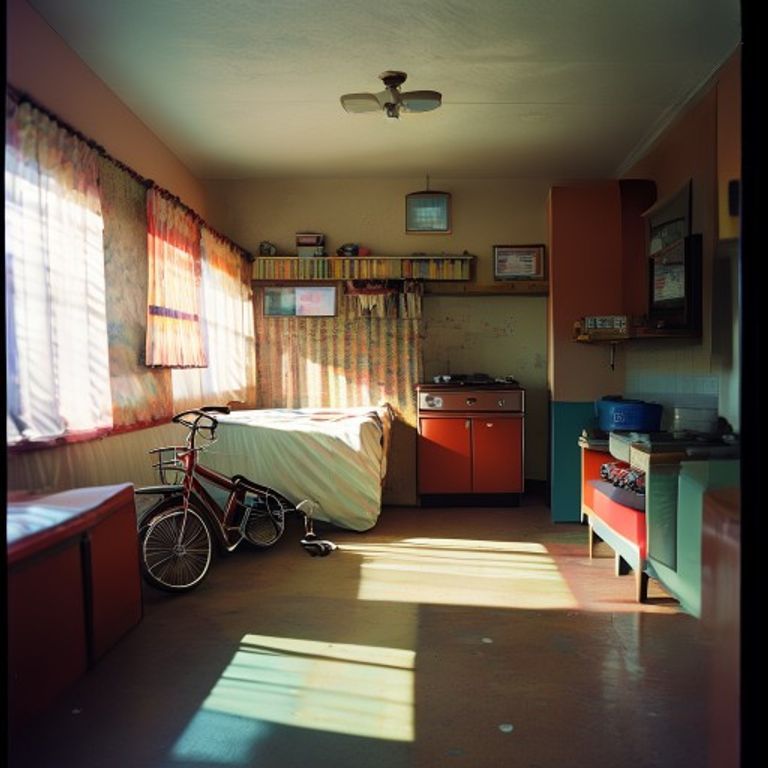
Re-render as a dye-transfer print of an "unimportant" subject: low angle, saturated color, southern vernacular, the banal made strange.
The prompt
Re-render this image as a color photograph in the manner of William Eggleston, exposed on 35mm or medium-format color negative and printed via the dye-transfer process (or rendered to look like a dye-transfer print): saturated but not garish color, deep specific reds and warm yellows, true blues, with mid-tones holding texture and shadows retaining color information rather than crushing to black. Subject is treated with the "democratic camera" approach: whatever is in frame is rendered with equal aesthetic weight regardless of conventional importance (a tricycle, a ceiling light, a freezer's contents, a sign, an empty bed, a person's shoulder are all photographed with the same care a formal portrait would receive). Camera angle often unusual: low to the ground looking up, oblique to the subject, or framing the subject off-center to include a "boring" expanse of wall, floor, or sky. Setting: American South vernacular interior and exterior (kitchen with formica, suburban driveway, motel parking lot, gas station, living room with patterned wallpaper, supermarket aisle, lawn with sprinkler), the everyday environment of mid-twentieth-century middle America. Lighting: available, often hard sun outdoors producing color-rich shadow, or interior tungsten producing warm color cast that is preserved rather than corrected. Composition: snapshot-casual in structure but rigorous in color and shape relationships. Mood: banal sublime, the ordinary made strange through attention, no narrative, no people-do-things, just things-are. Print quality: medium-size dye-transfer print, museum-mounted, slight three-dimensional color saturation that digital prints cannot quite match. Forbid: HDR digital saturation, any visible text or watermark or hallucinated brand logo, any cinematic color-grade overlay, any visible AI-compositing artifact. Preserve the subject, pose, and composition of the source image exactly, change only the medium and rendering.
What it is doing
Eggleston's 1976 MoMA show was attacked as "the most hated show of the year" because critics could not accept that color photographs of a tricycle deserved museum walls. The thesis Eggleston defended: any subject, attended to with seriousness, is worth seeing. Re-rendering an "unimportant" snapshot in this register asserts that attention itself is the artistic act.
Tuning knobs
- Saturation dial: `dye-transfer rich but real` vs `Kodachrome-leaning slightly muted` vs `slide-film vivid`
- Angle dial: `low ground-level looking up` vs `eye-level square-on` vs `slightly oblique three-quarter`
- Subject dial: `object alone (tricycle, lamp, freezer)` vs `interior with object dominant` vs `person fragment (shoulder, hand)`
- Light dial: `southern hard sun warm shadow` vs `interior tungsten warm cast` vs `flash with daylight mix`
Style lineage
Learn the visual culture this draws from: TheArtStory.
Related prompts
See all 10 prompts in the Photography grammar · Open in the gallery
Get the free sample. The intro plus the first three chapters of The Liberation Engine, delivered as a PDF. The full book and the complete 557-prompt method are the paid edition.