Op-Art Penrose Impossible Geometry Field (Style-Only, Image-Conditioned)
Style register: Penrose-triangle and impossible-geometry grammar in the Op-Art lineage, axonometric line construction producing forms that are locally consistent but globally impossible, the eye accepting paradox at first glance.
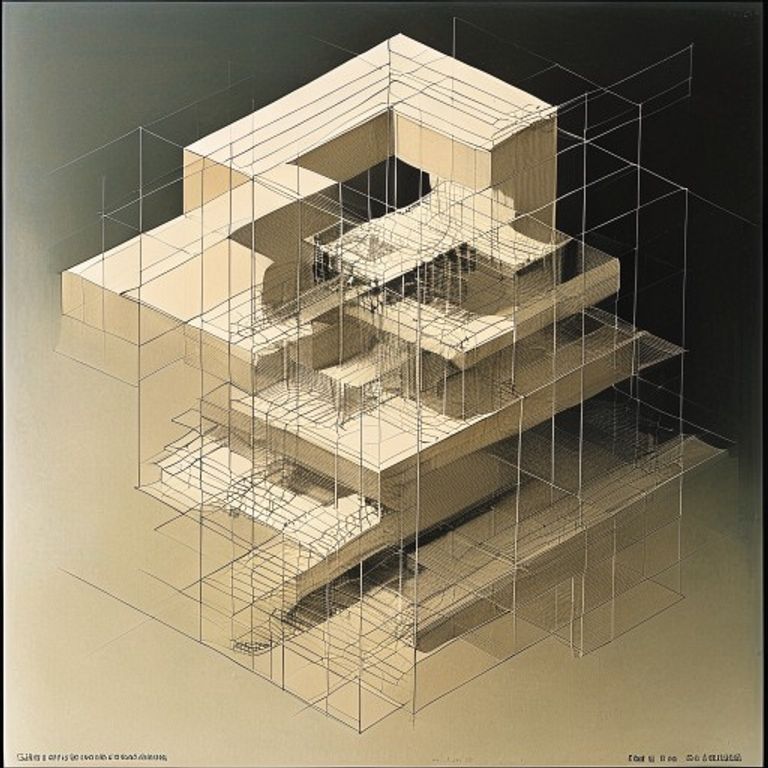
The prompt
Re-render this image in the visual register of an Op-Art impossible-geometry composition in the Penrose-triangle and L.S. Penrose / Escher-adjacent tradition, circa 1958 to 1975. Treat the picture surface as an axonometric (30-degree isometric) line construction in which the underlying subject is reconstituted from beams, struts, and planar facets that are each locally plausible but, when traced globally, form a geometric paradox: continuous staircases that climb forever, beams that join behind themselves, faces that flip from convex to concave depending on which corner the eye enters. Render the construction in flat unmodulated color: each face one solid value from a tightly restricted palette (warm beige, cool grey-blue, terracotta, ivory cream, lampblack outline at 2mm uniform weight). Lampblack outline traces every beam edge with mechanical precision. Background is a flat neutral cream or pale grey. No perspective convergence, no atmospheric depth, only the axonometric projection sustaining the paradox. Mood: vertiginous, cerebral, the picture as a logical trap the eye agrees to walk into. Strictly no on-canvas text, no legible lettering, no signature, no watermark, no logos. Preserve the subject, pose, and composition of the source image exactly, change only the medium and rendering. Aspect ratio matches source.
What it is doing
The Penrose triangle (described by mathematician Roger Penrose and his father in 1958, popularized by Escher) proves something quietly philosophical: the human visual system accepts local consistency as evidence of global possibility, and can be tricked when those two things diverge. Each corner of the Penrose triangle is a valid axonometric drawing. The triangle as a whole is impossible in three-dimensional space. We see it anyway. The buried claim, easy to miss because the figure is treated as a puzzle-page novelty, is that our perceptual contract with the world is local, not global, and is therefore exploitable by anyone who can construct local consistency while violating global rule. This is the same insight that makes propaganda, misinformation, and deepfakes work. The Penrose triangle is the visual version of a logical fallacy that feels true.
Tuning knobs
- Paradox type: `Penrose triangle continuous loop` (signature) vs `infinite staircase` vs `convex-concave flip face`
- Projection angle: `30-degree isometric` (signature) vs `45-degree axonometric` vs `oblique cabinet projection`
- Outline weight: `uniform 2mm lampblack` (signature) vs `hairline 0.5mm` vs `heavy 5mm cartoon-weight`
- Palette: `warm earth plus cool accent` (signature) vs `pure greyscale` vs `primary-color block`
- Background: `flat neutral cream` (signature) vs `pure white void` vs `gridded blueprint`
Style lineage
Learn the visual culture this draws from: The Illusions Index.
Related prompts
See all 6 prompts in the Op-Art grammar · Open in the gallery